
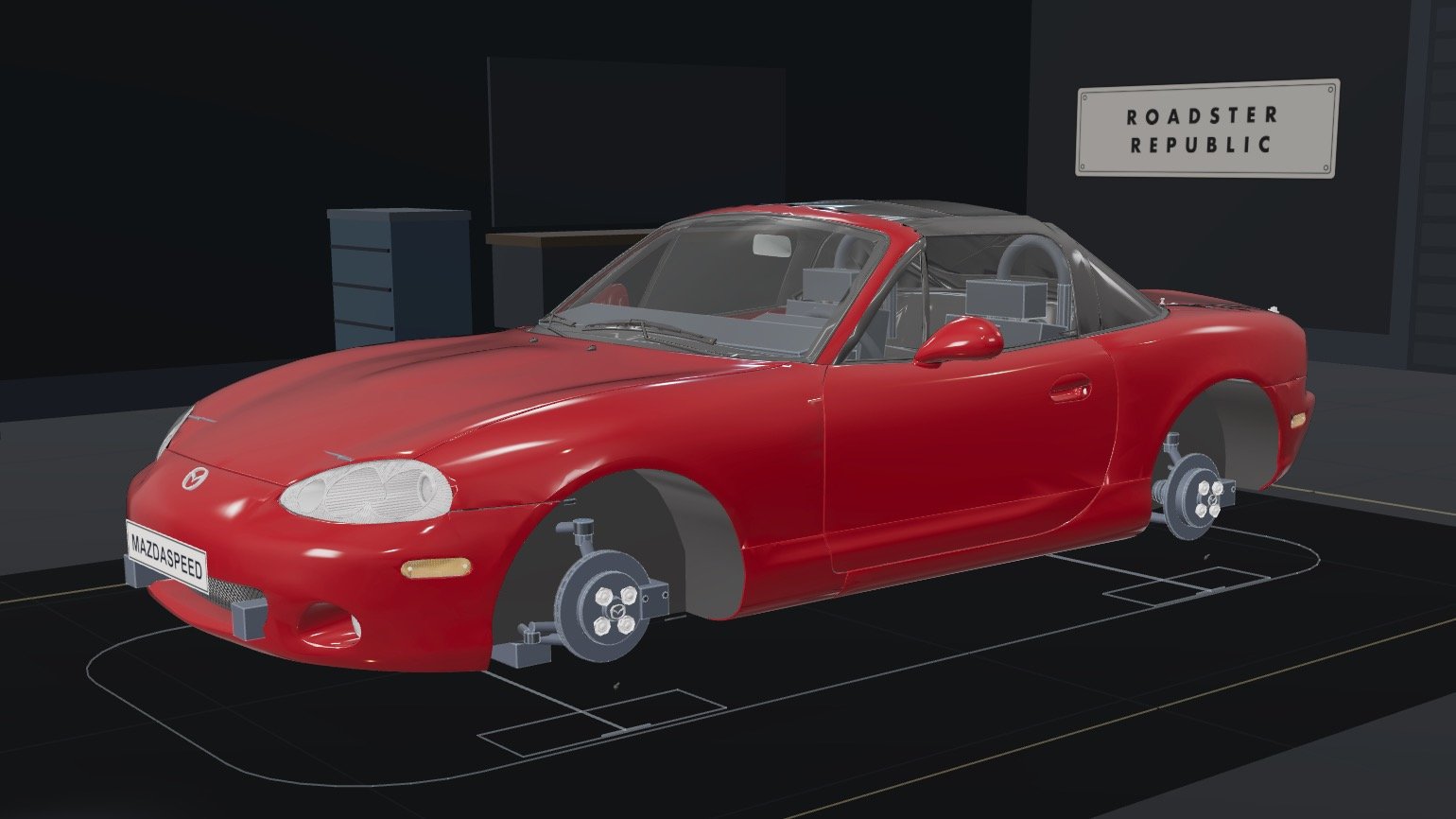


Six hundred ninety-nine parts. That’s how many individual components Ryan Montgomery modeled when he rebuilt his 2004 Mazdaspeed Miata in 3D, right down to the bolts.
He calls it the Roadster Atlas, and it costs nothing. No account, no download, no email capture. You open a browser and the car is there, waiting to be taken apart.
Montgomery runs Roadster Republic, a Miata-themed lifestyle brand. This didn’t come from Mazda’s engineering office or a parts catalog vendor. It came from an owner with a garage car and months of patience.
His Mazdaspeed was the starting point, but the model covers the entire NB generation. That’s model years 1999 through 2005, the second-gen Miata that plenty of enthusiasts now buy as cheap, honest project cars.
The detail goes deep. Body panels lift away, and the engine breaks down into its individual components. Body-off and exploded views show how everything stacks together, and you can click and drag to spin it to any angle.
It also moves. You can watch the engine rotate, or change suspension settings and see the geometry shift in response.
That last feature is the one that matters to people who actually wrench on these cars. Anyone who has stared at a control arm wondering what a camber adjustment will really do knows the value of seeing it before the wrench comes out.
Montgomery is upfront about what the Atlas isn’t. It won’t replace a shop manual. It shows owners how the pieces fit, which helps when planning upgrades, but torque specs and procedures still belong in the book.
The sourcing is where the project shows its roots. Measurements draw on Mazda’s published specs, plus information from media and community sources. That includes owners who have had their own cars fully stripped down.
So the most complete interactive teardown of the NB Miata was built partly from the knowledge of the people who drive them. Forum posts, teardown photos, and garage notes, all stitched into one model.
Montgomery posted the project on Reddit, noting it works on mobile but looks best on a desktop. With nearly 700 parts in play, a phone screen does it no favors.
The Miata has always rewarded this kind of obsession. It’s simple enough to understand completely and good enough to make that understanding worth the effort. Its owners have spent more than three decades proving it with spreadsheets, swap guides, and track days.
The Atlas just puts that habit in a new format. It’s a free, public, rotating blueprint of a car that left production two decades ago.
Montgomery isn’t stopping at the NB. He says the other Miata generations are next.
That puts the NA, NC, and current ND on the list. The ND RF’s retractable hardtop, with its stacked panels and folding mechanism, is the one a lot of owners will want to see blown apart on screen.
There’s no timeline yet. For now, the NB sits online in pieces, free to anyone curious enough to click.



Share this Story