
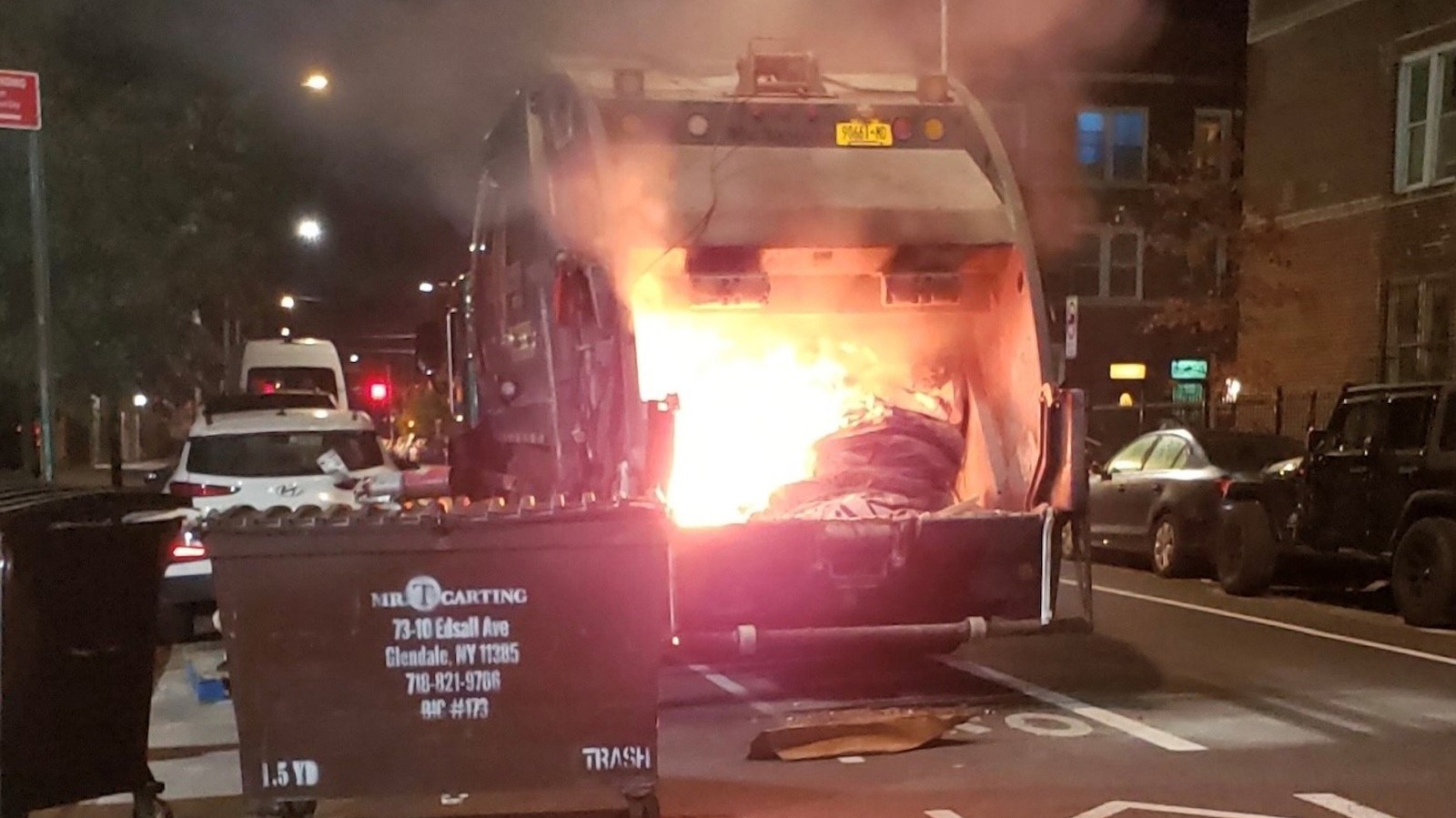


A garbage truck caught fire in Brooklyn in late May, moderately injuring two Department of Sanitation workers. The likely cause: a lithium-ion battery that someone tossed in the trash. It is illegal to do so in New York City. People keep doing it anyway.
Between 2022 and 2025, lithium-ion battery fires in New York City alone caused 30 deaths and 400 injuries across 800 separate incidents, according to the National Fire Protection Association. That is not a rounding error. That is a body count.
The mechanics are brutally simple. A garbage truck crushes everything thrown into it. When that includes a lithium-ion battery from an old laptop, phone, or power tool, the compaction damages the cell’s internal separator.
Anode meets cathode, a short circuit generates instant heat, the electrolyte decomposes into flammable gas, and the whole thing ignites. The resulting fire is toxic, fast, and nearly impossible to suppress quickly in a confined space packed with combustible waste.
This is not a New York problem. It is an everywhere problem. Roseville, California, near Sacramento, has had four garbage truck fires this year alone from improperly discarded batteries. In Troy, Michigan, a fire department recently documented a truck forced to dump its entire load onto the road after a pile of batteries ignited mid-route.
Sanitation workers are absorbing the consequences of consumer laziness at industrial scale. Every e-bike battery, every dead vape pen, every busted portable charger that gets tossed into a kitchen trash bag becomes a potential incendiary device the moment it hits a compactor. The people riding on the back of those trucks have no way of knowing what is inside.
The fix exists and it is not complicated. New York City operates thousands of dedicated battery drop-off sites. Many are inside Staples stores and Duane Reade pharmacies.
The city’s Battery Network provides an online locator tool and even supplies bags for safe transport. Covering the positive terminal with a piece of tape before drop-off is the recommended precaution. The infrastructure is there. The awareness is not.
Part of the disconnect is that lithium-ion batteries have become so embedded in daily life that people do not think of them as hazardous materials. They are in toothbrushes, earbuds, children’s toys. The same chemistry that makes the TSA restrict them from checked luggage makes them dangerous in a garbage truck, but nobody slaps a warning label on a dead electric screwdriver before chucking it in the bin.
Municipal enforcement of disposal laws remains nonexistent. Nobody is inspecting household trash bags for contraband batteries. The penalty structure, to the extent one exists, relies on the honor system. And the honor system, as 800 fires in one city over three years makes clear, is failing.
Sanitation departments have been flagging this for years. Fire departments have been responding to the results for years. The battery industry keeps selling billions of lithium-ion cells annually with minimal end-of-life accountability baked into the product cycle.
The cost of that gap is measured in burned trucks, injured workers, and a growing fire risk that scales directly with the number of battery-powered devices Americans buy and eventually throw away.
Thirty people died in New York. Two more workers got hurt in Brooklyn last month. And somewhere right now, someone is dropping a dead phone into a garbage bag without a second thought.





Share this Story