
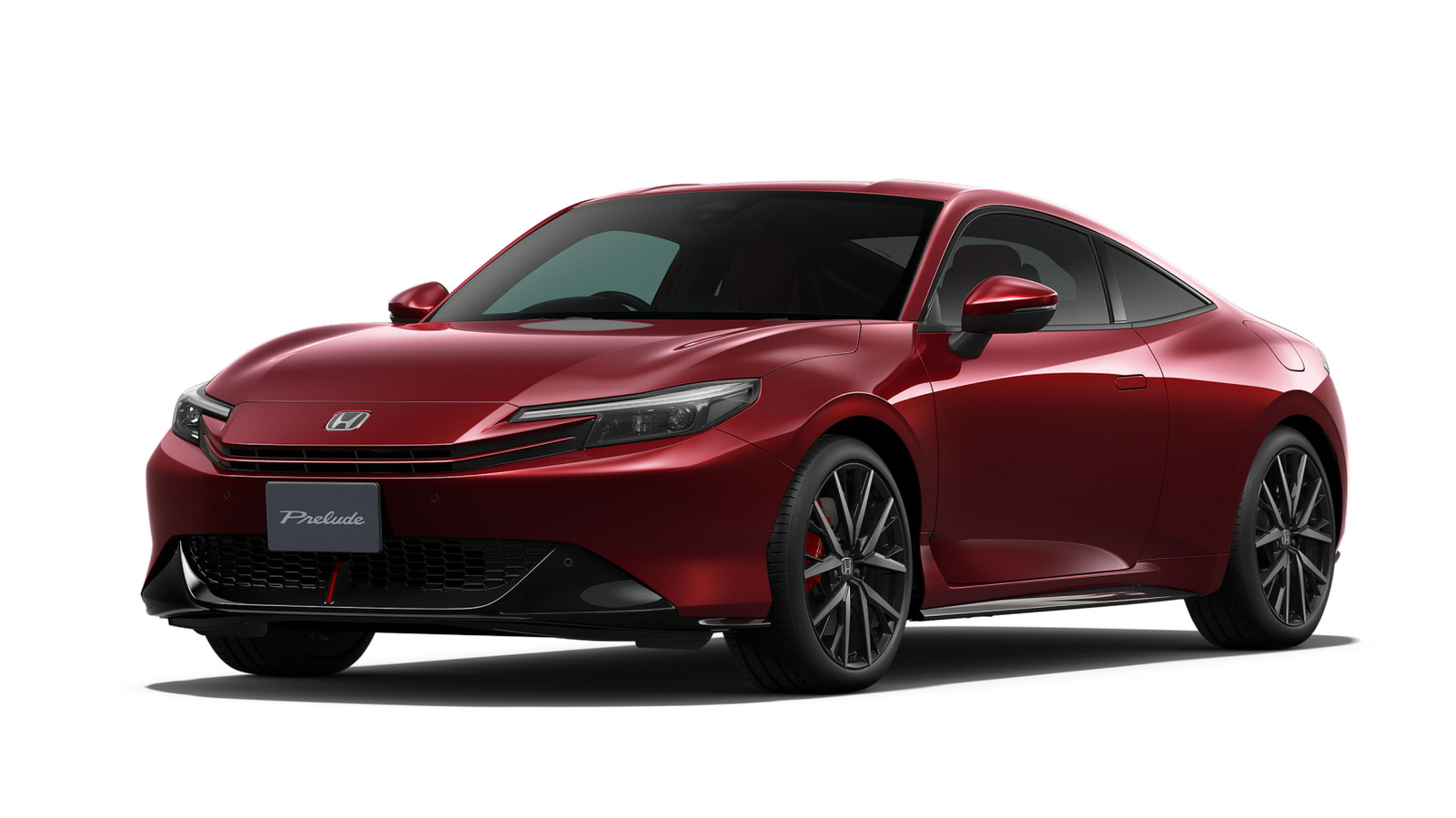


Honda just dropped a Limited Edition Prelude for the Japanese market, and it’s the kind of subtle, grown-up move the car probably needed from the start.
The 2027 Prelude LE doesn’t touch the mechanicals. No extra horsepower, no suspension tweaks, no trick differential. What it gets is a deep red exterior called Premium Crystal Garnet Metallic, a matching Bordeaux interior treatment covering the center console, door armrests, seat inserts, and dash trim, plus red brake calipers and red steering wheel stitching.
The price premium over a standard Japanese-market Prelude? Roughly $800. For context, most automakers charge that much just to swap from white to a non-grayscale color. Getting a bespoke interior color scheme thrown in makes this look almost generous.
The bigger story isn’t the paint. It’s what the LE’s existence tells us about the Prelude’s commercial trajectory, which has been far less grim than the enthusiast internet would have you believe.
When Honda relaunched the Prelude name on a hybrid-only, automatic-only coupe using the Civic Hybrid’s powertrain, the car community’s reaction was predictable. Journalists praised the Type R-derived front suspension and the styling, then hammered the tepid acceleration, the $43,195 U.S. price tag, and the conspicuous absence of a third pedal. The consensus landed somewhere between “pleasant surprise” and “missed opportunity.”
Japan didn’t get the memo. Honda projected 300 orders per month there. It got 2,400 in September alone, eight times the forecast, with buyers skewing older.
These are people who remember what a Prelude was supposed to be: a refined, stylish personal coupe, not a track weapon. They apparently like what Honda built.
The U.S. picture is murkier but not catastrophic. Honda moved 174 Preludes in its first month here, a figure that looked anemic until the company clarified it was a supply constraint, not a demand problem. Through May, 1,470 units have found homes.
Honda says sales are “right on target” and dealer feedback has been “incredibly positive.” That’s corporate speak, sure, but launching a limited edition within the first year of production isn’t something you do for a car that’s gathering dust on lots.
What’s striking about the LE is how precisely it targets the buyer Honda actually has versus the buyer the internet wished it was building for. The Crystal Garnet Metallic paint evokes a mature, wine-bar sophistication that the current U.S. palette, Boost Blue and Rallye Red, doesn’t come close to matching. Those colors read young and sporty, which is a strange choice for a car whose actual customer base leans decidedly middle-aged.
The Prelude’s real competitive problem was never the lack of a manual. It was the perception gap between what enthusiasts wanted and what Honda delivered.
A sub-200-horsepower hybrid coupe at $43K invites comparisons to the GR86 and Mazda MX-5, cars that cost less and involve the driver more. But Honda isn’t chasing that buyer. It’s chasing someone who wants something that looks and feels special without demanding weekend track duty.
A deep garnet two-door with a Bordeaux interior and no pretense of being a sports car? That’s a more honest pitch than Honda has made for the Prelude so far.
The U.S. gets neither this color nor this trim. American buyers stuck choosing between primary-color brightness and monochrome anonymity are missing the one option that actually suits the car’s personality. Honda would be wise to fix that before the conversation moves on entirely.


Share this Story