
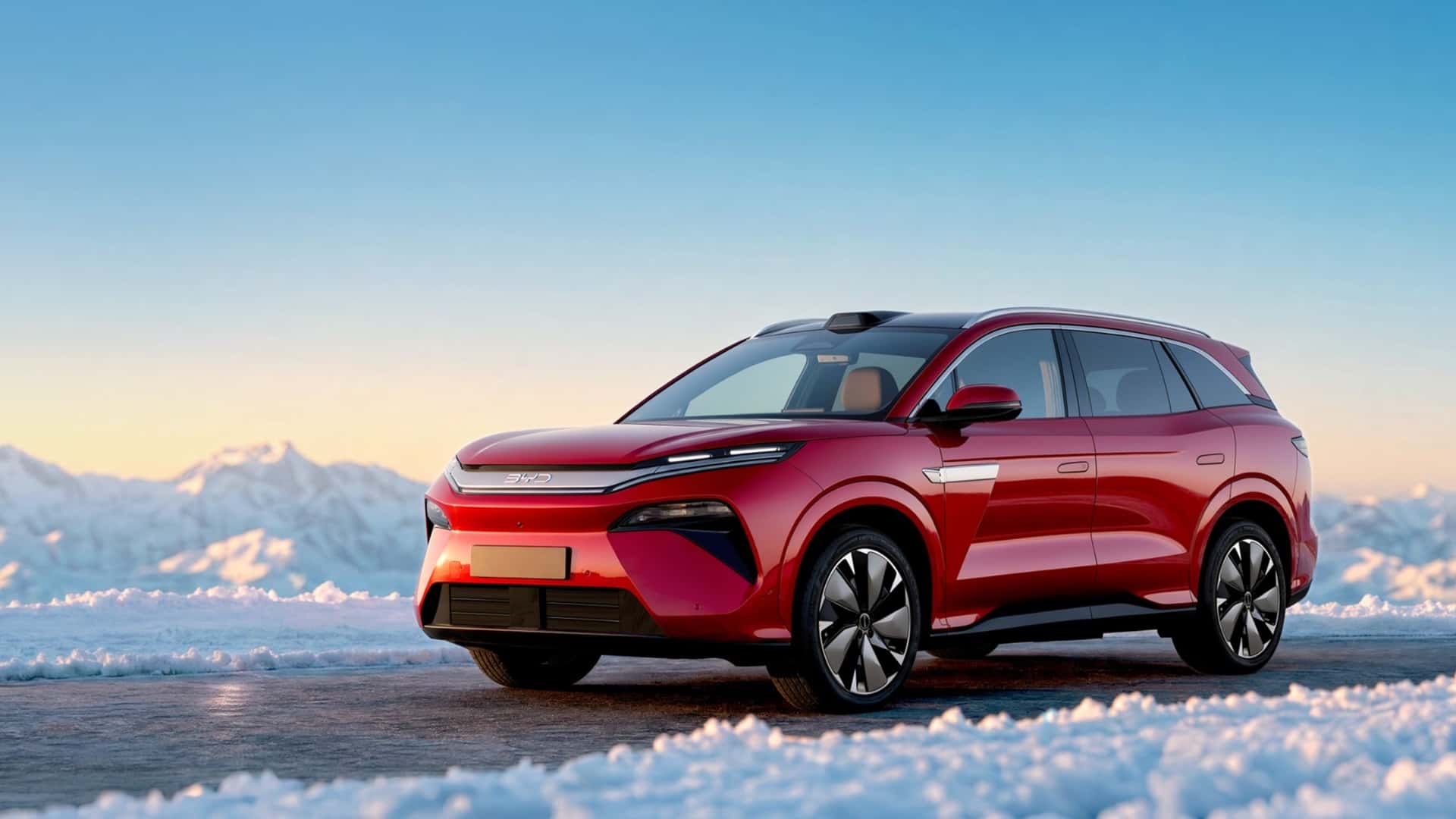


Ten to seventy percent in five minutes. That is the claim BYD is making with the Atto 8, a three-row electric SUV unveiled Monday at the 2026 Paris Motor Show. If it holds up in real-world conditions, it rewrites the charging conversation for every competitor selling EVs on the continent.
The Atto 8 carries BYD’s second-generation Blade battery at 115 kWh. WLTP range lands around 405 miles for the rear-drive model, dropping to 374 for the dual-motor Excellence AWD variant. That AWD version pushes 764 horsepower and does 0-62 mph in 4.9 seconds, which are big numbers for a seven-seat family hauler.
But the charging speed is the headline, and BYD knows it. The company’s Flash charging technology, first shown on the Denza Z9GT, makes its BYD-branded debut here. At peak rates, BYD says the Atto 8 can reach 97 percent state of charge in under 10 minutes.
Even in brutal cold, down to minus 22 degrees Fahrenheit, the 10-to-70 percent window stretches only to 12 minutes. Nothing from a European, American, Korean, or Japanese automaker matches that. Not close.
The catch, as always, is infrastructure. Flash charging requires specific hardware, and BYD is building its own. The company has committed to installing 3,000 of its proprietary T-shaped Flash chargers across Europe by the end of 2027.
That is an aggressive rollout, but it also means that for now, the five-minute promise remains theoretical for most buyers. You need the right charger at the right time in the right weather.
This is the core tension of BYD’s European push. The technology is real and measurably ahead of the pack. But without a mature charging network to support it, the Atto 8’s best trick becomes a demo feature rather than a daily advantage.
BYD is not waiting for someone else to solve that problem. It is building the chargers itself, running the same vertical integration playbook it uses with batteries, semiconductors, and vehicle assembly. That is a luxury most legacy automakers do not have.
Volkswagen, Stellantis, and Hyundai rely on third-party networks or joint ventures. BYD controls the pipe from lithium cell to charging plug.
The vehicle itself looks polished if slightly anonymous inside. The cabin is loaded with screens and soft materials, targeting the premium end of the family SUV market. Whether European buyers actually want a three-row electric SUV is another question. That body style dominates driveways in Texas and Georgia, not Munich and Lyon.
BYD is betting the charging story sells the car regardless. And there is logic to that bet. Range anxiety has always been a barrier to EV adoption.
If five-minute top-ups become routine, range starts to matter less. A 300-mile EV that charges in five minutes is more practical than a 500-mile EV that takes 40.
The timing is deliberate. European tariffs on Chinese EVs have tightened. China recently agreed to limit hybrid exports to the EU to 350,000 units annually. Political headwinds are real, and BYD’s answer is to show up in Paris with a product that makes the competition look slow, literally.
Whether the Atto 8 reaches European driveways in volume depends on pricing, which BYD has not disclosed, and on how fast those 3,000 chargers actually go into the ground. The technology exists. The car exists. The network does not, yet.
Share this Story