
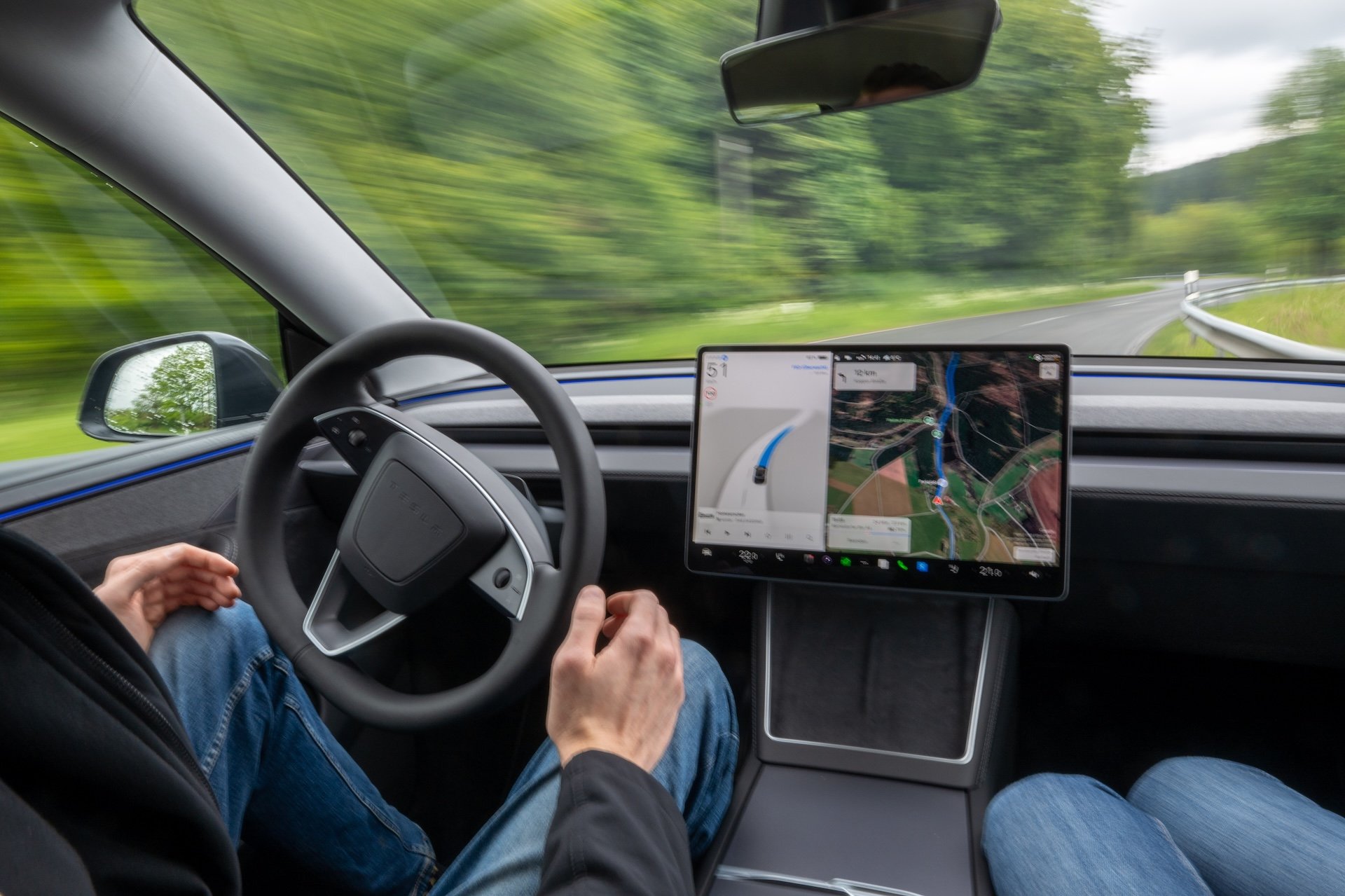


Germany’s transportation ministry just did what American regulators have refused to do for years. Tesla has dropped the “Full Self Driving” name in Europe, rebadging the system as “Assisted Driving” after sustained pressure from German officials.
The German regulators were blunt. They called Tesla’s original branding “somewhat misleading,” noting that “it is not a system that takes over the entire driving task. Rather, it is a driver assistance system that can support certain driving tasks such as accelerating, braking, and steering. The driver must remain attentive at all times.”
That language reads like a definition Tesla should have been forced to adopt years ago, on both sides of the Atlantic.
In the United States, Tesla still sells the system under the name “Full Self Driving (Supervised),” a parenthetical fig leaf that does little to counter the plain meaning of those three words before it. Multiple lawsuits allege the system routinely violates traffic laws, and it has been linked to several fatal crashes. NHTSA investigations remain ongoing, yet no American regulator has compelled a name change.
Missy Cummings, an engineering professor at George Mason University, told CNBC the European renaming doesn’t go far enough. She said the move “ignores both past and ongoing NHTSA investigations.” She’s right that a label swap alone doesn’t address the underlying safety questions, but at minimum it stops the marketing from writing checks the technology can’t cash.
The timing adds another layer. Elon Musk and Tesla have been running aggressive campaigns on European social media, accusing E.U. regulators of deliberately stalling approval of its autonomous systems. Whether the social media offensive was meant to preempt this kind of regulatory action or simply distract from it, the result is the same. Tesla blinked.
For anyone who has tracked the FSD saga since Tesla first started promising fully autonomous driving capability, the European rebrand is a quiet concession that the product has never matched its name. Tesla charged customers thousands of dollars for a feature described in language that implied the car could drive itself. It cannot.
That gap between promise and reality has fueled lawsuits, regulatory scrutiny, and a corrosive erosion of trust that no software update can patch.
The contrast between European and American regulatory posture is difficult to ignore. Germany saw misleading marketing and acted. NHTSA has opened investigations and issued recalls but has never touched the name.
The FSD branding has been one of the most effective pieces of automotive marketing in recent memory, precisely because it overpromises with surgical precision.
Tesla has not commented publicly on whether the European rebrand signals any shift in its broader naming strategy. The U.S. version of the product page still reads “Full Self Driving (Supervised).” No legislation is pending that would mandate truth-in-advertising standards for driver assistance system names.
Germany forced the issue in a matter of months. America’s regulators have watched the same story unfold for nearly a decade.
Share this Story