
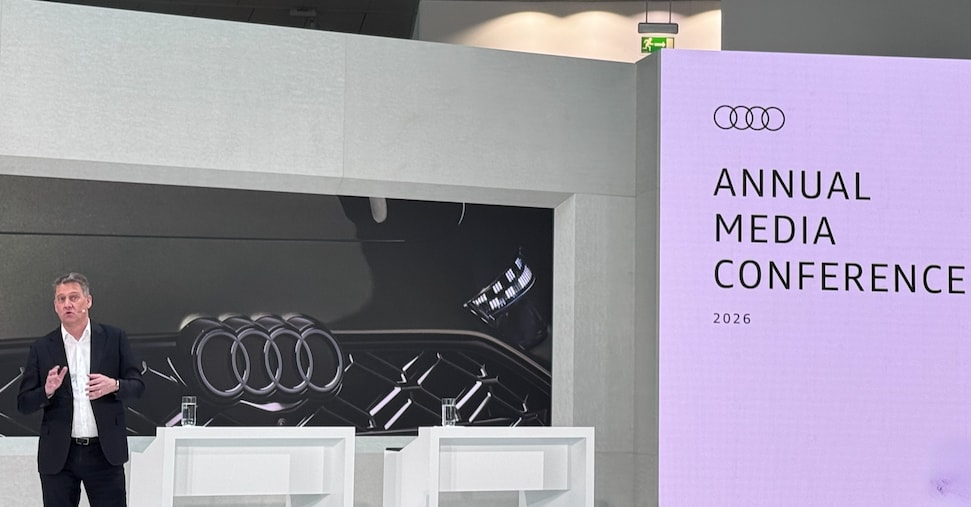


The numbers tell two stories at once. Audi Group revenue climbed to 65.5 billion euros in 2025, up from 64.5 billion the year before. Profit after tax rose to 4.6 billion euros.
But operating profit dropped to 3.4 billion euros from 3.9 billion, and the operating margin slipped from 6.0 to 5.1 percent. That gap between the top line and the bottom line is where the real story lives.
The culprit Audi wants you to focus on: U.S. tariffs, which carved 1.2 billion euros out of the bottom line. That is a staggering single-line hit for a company running a five-percent margin. Add CO2 compliance provisions, restructuring costs for its German workforce agreement, and the rescheduling of an electric platform shared across the Volkswagen Group, and 2025 looks like a year Audi survived rather than conquered.
Deliveries fell too. The Brand Group Progressive — Audi, Bentley, Lamborghini, Ducati — moved 1,644,429 cars, down from 1,692,548. The Audi brand alone slipped to 1,623,551 from 1,671,218.
Fewer cars, higher revenue. That math only works when the mix shifts upward, and it did: fully electric deliveries surged 36 percent to 223,032 units, led by the Q6 e-tron and A6 e-tron.
CEO Gernot Döllner framed 2025 as a year of bold decisions. CFO Jürgen Rittersberger called it resilient. The language is careful because the underlying tension is real.
Audi is simultaneously cutting jobs, launching more than 20 new models across two years, entering Formula 1, standing up an entirely separate China-only brand called AUDI, and trying to maintain profitability while tariffs and regulatory costs eat into margins from both ends.
That job reduction plan is already 65 percent implemented or locked in — up to 6,000 positions gone by 2027, with another 1,500 targeted by 2029 through retirement schemes. The company sweetened the mood by handing German skilled workers a 2,840-euro combined profit-share and pension contribution. A modest gesture given the scale of restructuring underway.
The luxury subsidiaries showed cracks. Lamborghini held deliveries steady at 10,747 units but saw its margin compress from 27 to 24 percent. Bentley took a harder fall — operating profit nearly halved to 216 million euros, margin collapsing from 14.1 to 8.3 percent.
Ducati’s margin was cut almost in half as well, dropping to 5.6 percent. These brands are supposed to be Audi’s profit cushions. In 2025, even the cushions got thinner.
Net cash flow was one genuinely bright spot, rising 11.4 percent to 3.4 billion euros. Audi credits cost discipline and investment restraint, which is another way of saying they spent less. When a company celebrates spending less during a product offensive, the tightrope is visible.
For 2026, Audi is guiding revenue between 63 and 68 billion euros and an operating margin of 6 to 8 percent. That wider band reflects the uncertainty no one in Ingolstadt will pretend has gone away.
The product pipeline is aggressive — the entry-level A2 e-tron, the flagship Q9 aimed squarely at the American market, a new Q7, a reimagined Q4 e-tron, and the RS 5 with its plug-in hybrid powertrain.
The U.S. strategy is particularly telling. Audi is betting big on large SUVs — the Q9, Q7, and Q3 — to build what it calls the youngest premium SUV portfolio in America. This is an automaker reading the room: American buyers want size, and Audi needs the margins that come with it, especially while tariffs are punishing transatlantic logistics.
China remains a separate gamble. The AUDI brand, exclusive to that market and built with local partners FAW and SAIC, launched its first model, the E5 Sportback, in late 2025. A second, the E7X, arrives this year.
It is a frank admission that global Audi cannot compete head-on with BYD and its domestic rivals on price or speed. So Ingolstadt created a flanker brand to fight that war separately.
Audi’s 2025 was not a disaster. It was a year of absorbing blows — tariffs, market contraction, platform delays — while furiously rebuilding the product lineup. Whether the 2026 margin guidance proves optimistic or conservative will depend on forces largely outside Audi’s control.
The restructuring is real. The question is whether the world cooperates long enough for it to pay off.


Share this Story