
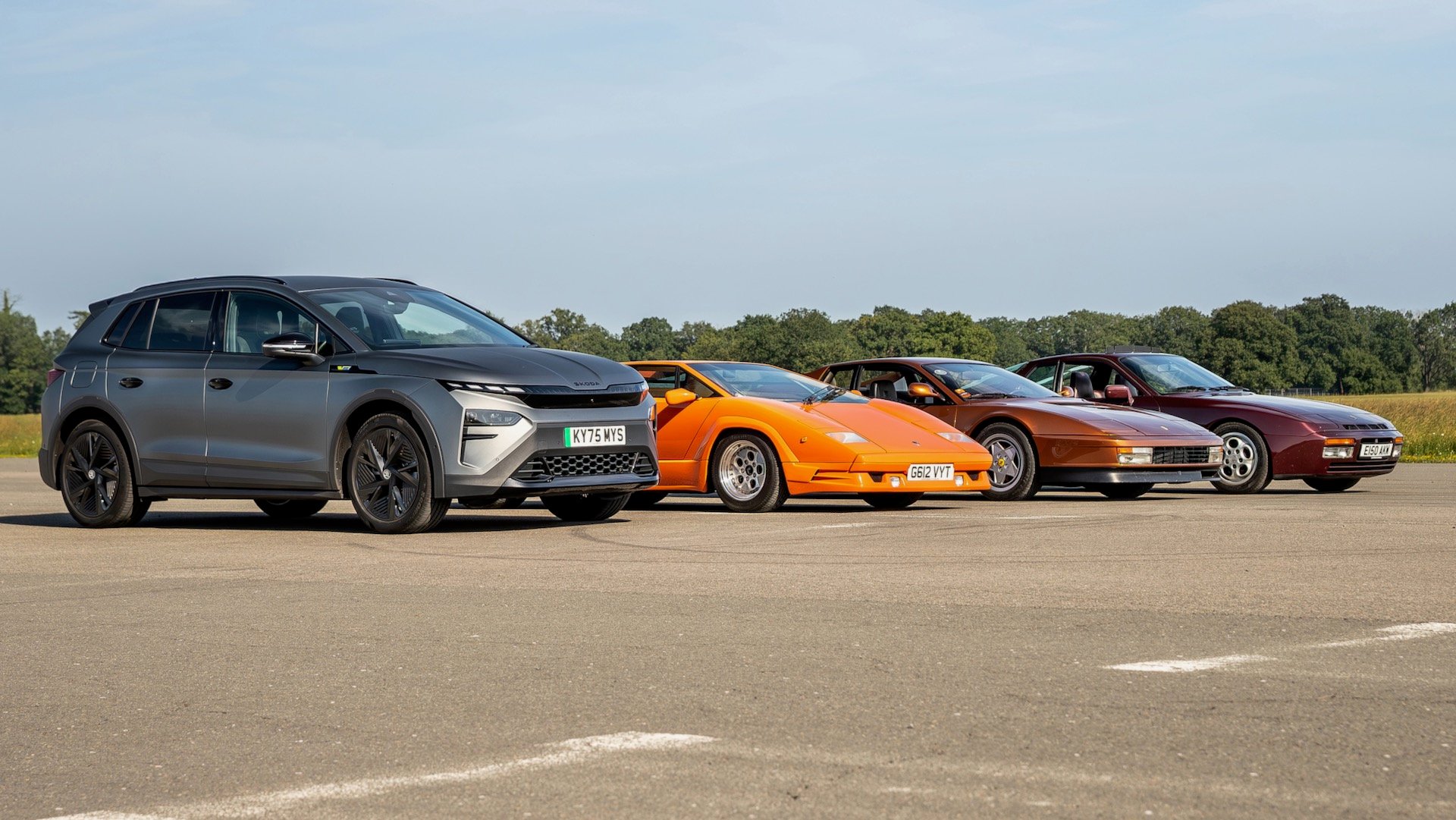


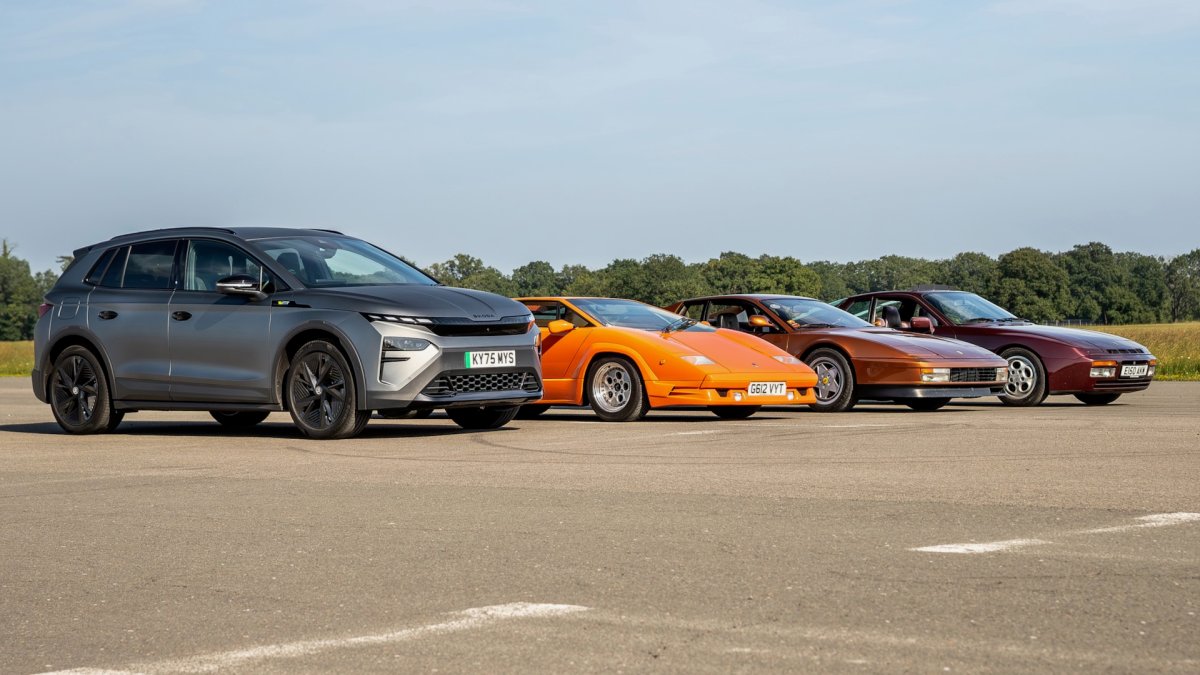
A Czech electric crossover just walked away from a Ferrari Testarossa, a Lamborghini Countach, and a Porsche 944 Turbo in a drag race. Let that sentence sit for a moment.
Skoda’s U.K. PR team staged the stunt at Dunsfold—the old Top Gear test track—pitting its new Elroq vRS against the three bedroom-poster icons of the 1980s. The result was predictable to anyone paying attention to the last decade of EV launches, but still stings if you grew up with those cars on your wall.
The Elroq vRS makes 335 horsepower and 402 pound-feet of torque from its dual motors. It rides on Volkswagen’s MEB platform, the same bones underneath the ID.4 and Audi Q4 e-tron. It weighs nearly 4,900 pounds.
It is, by every conventional measure, a family appliance. And it demolished machines that once defined the word “supercar.”
The Testarossa actually stayed close, finishing just behind the Skoda in a cloud of tire smoke that suggested a cleaner launch might have changed the outcome. Skoda itself admits the Ferrari’s claimed 5.3-second zero-to-60 time is a tenth quicker than the Elroq’s 5.4 seconds on paper. But paper times assume a perfect driver working a gated manual, nailing shifts, managing wheelspin. The Skoda just needs a right foot and gravity.
That’s the real story buried inside this promotional video. The democratization of speed has been so thorough, so complete, that the defining advantage of a 1980s supercar—the ability to accelerate in a way that rearranged your internal organs—is now table stakes for a crossover built in the Czech Republic.
But Skoda’s own data tells the rest of the story, the part the PR team would prefer you gloss over. The Elroq vRS tops out at 111 mph. The 944 Turbo, the slowest of the three classics, does 162. The Testarossa cracks 180.
Give these cars a runway instead of a quarter-mile strip and the hierarchy reasserts itself with brutal clarity.
There’s a pattern the EV era keeps repeating. Instant torque delivers a spectacular parlor trick off the line, and manufacturers have learned to exploit it for exactly these kinds of videos. But sustained performance—top speed, repeated hard laps, the ability to carve through corners without hauling around nearly two and a half tons of battery mass—still belongs to a different engineering philosophy.
None of which diminishes the Elroq’s actual mission. It seats five. It carries groceries. Skoda claims 344 miles of range on the generous European WLTP cycle, which would translate to roughly 260 miles under EPA testing if the car were sold in the U.S.
It does everything a family needs and nothing a family doesn’t.
The Countach could barely fit a briefcase behind its seats. The Testarossa’s side strakes caught every parking garage pillar within a zip code. The 944 Turbo was the sensible choice of the trio, which tells you everything about the caliber of impracticality on offer.
Skoda knows exactly what it’s doing with this video. Every EV brand has run some version of this drag race because the outcome is guaranteed and the headlines write themselves. It’s smart marketing. It’s also a narrow truth dressed up as the whole story.
Speed used to be expensive and dangerous and rare. Now it’s accessible, safe, and routine. The supercars lost the drag race. They’ll never lose the argument about what makes a car worth dreaming about.
Share this Story