
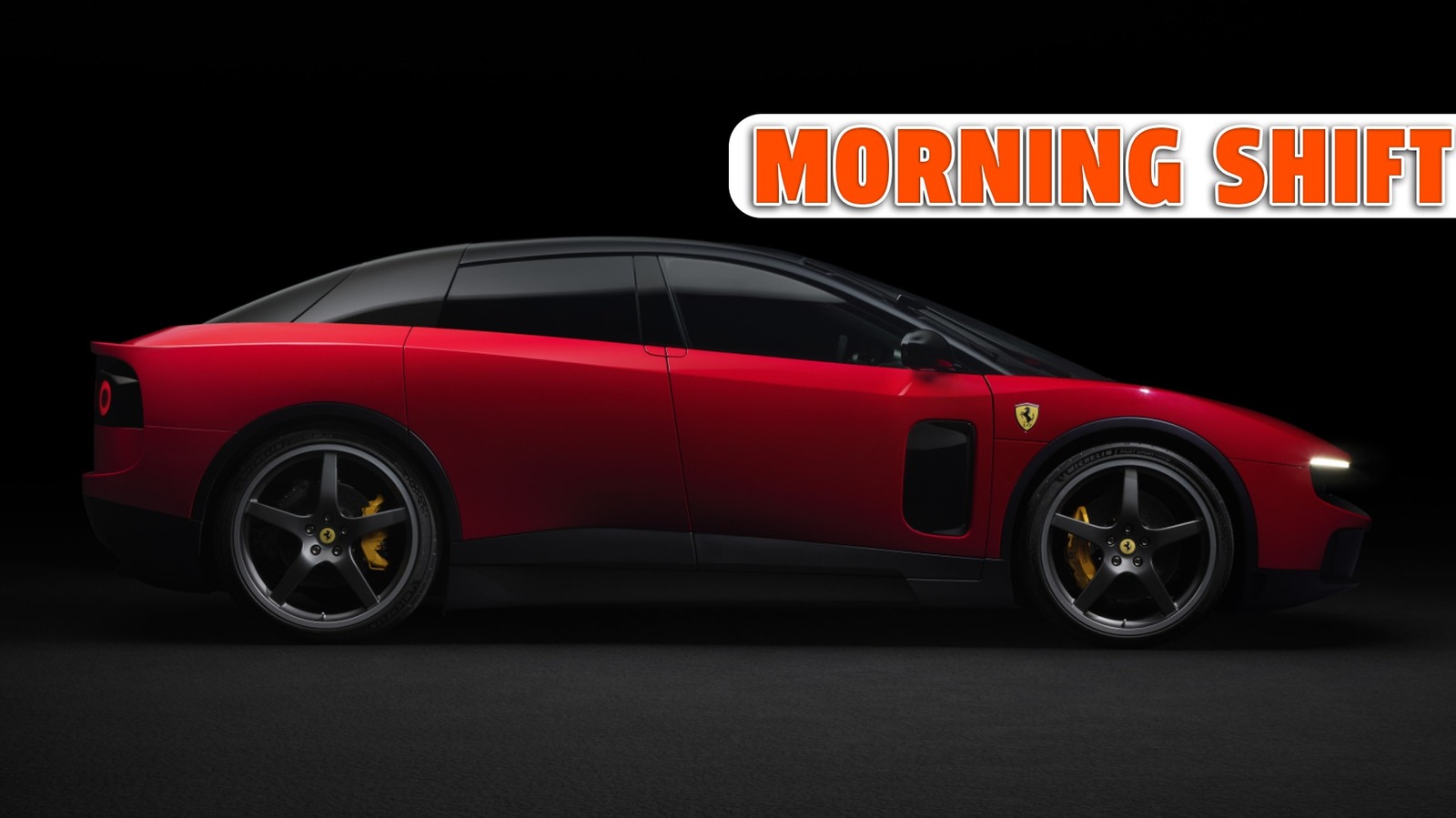


Ferrari just said the quiet part out loud. The company’s Chief Marketing and Commercial Officer Enrico Galliera publicly acknowledged that forcing customers to buy the $640,000 Luce EV as a ticket to more exclusive models would be, in his words, a “huge mistake.” That’s Ferrari essentially admitting its own notorious allocation playbook — the one that made buyers stomach unloved Californias just to qualify for a LaFerrari — would backfire spectacularly with its first electric car.
The admission, reported by Reuters, came during a product presentation where Galliera addressed a Bloomberg report suggesting the Luce could become a mandatory purchase for access to limited-run Ferraris. He warned it would create “negative ambassadors” who would trash-talk the car and dump it on the secondary market within months, destroying residual values.
That last point is the tell. Ferrari isn’t being magnanimous here. It’s being strategic.
The luxury EV resale market is a graveyard right now. Depreciation has savaged everything from the Porsche Taycan to the Mercedes EQS. Ferrari knows that if Luce values crater because resentful owners flood the used market, the damage wouldn’t just hit one model — it would stain the entire brand’s carefully cultivated image of exclusivity and value retention.
Galliera told dealers to sell the Luce only to buyers who “truly want it” — not those trying to curry favor for future allocations. It’s a remarkable statement from a company that has spent decades perfecting the art of making customers prove their loyalty through their wallets.
The timing matters. Ferrari CEO Benedetto Vigna claimed “strong interest” in the Luce after its May reveal, but the company has gone conspicuously quiet on actual order numbers since then. Ferrari says it will share precise figures when it reports second-quarter results at the end of July.
That gap between “strong interest” and hard data is where the real story lives.
Ferrari sold roughly 84 percent of its 2025 production to existing owners, with 56 percent going to multi-car collectors. These are the people who make or break a new model’s reputation in the rarefied air of Maranello clientele. If those buyers aren’t lining up voluntarily for the Luce, no amount of allocation pressure would fix the problem — it would only amplify it.
Meanwhile, the broader context is brutal for premium automakers trying to navigate electrification. Porsche, once Volkswagen Group’s profit engine, is planning to produce fewer than the 280,000 vehicles it sold last year. New CEO Michael Leiters told Bloomberg that “Porsche must be able to make money even with fewer cars,” as the brand absorbs hits from U.S. tariffs, European competition, and a Chinese market that keeps getting worse.
The company is looking to deepen collaboration with Audi and considering additional cuts beyond an already announced 3,900-job reduction by 2029.
On the opposite end of the demand spectrum sits Toyota, which just fired up RAV4 production at its Georgetown, Kentucky plant. The company expects to build 40,000 units there this year, adding to maxed-out lines in Japan and Canada. It still won’t be enough.
On June 16, Toyota’s 1,237 U.S. dealers collectively had just 967 unsold RAV4 hybrids. The model’s turn rate hit 97.6 percent in May, meaning nearly every available unit sold.
RAV4 deliveries through May dropped 40 percent to 121,605 — not because demand softened, but because Toyota couldn’t build them fast enough during the model changeover. Dealers were told to push alternatives like the Corolla Cross and Crown Signia, which saw gains as high as 114 percent.
Ferrari is trying to sell a $640,000 electric car without alienating its own customer base. Porsche is shrinking to survive. Toyota can’t build its $35,000 hybrid crossover fast enough. Three very different companies, three very different problems, one shared reality: the market doesn’t care about your corporate strategy. It only cares about what people actually want to buy.
Share this Story