
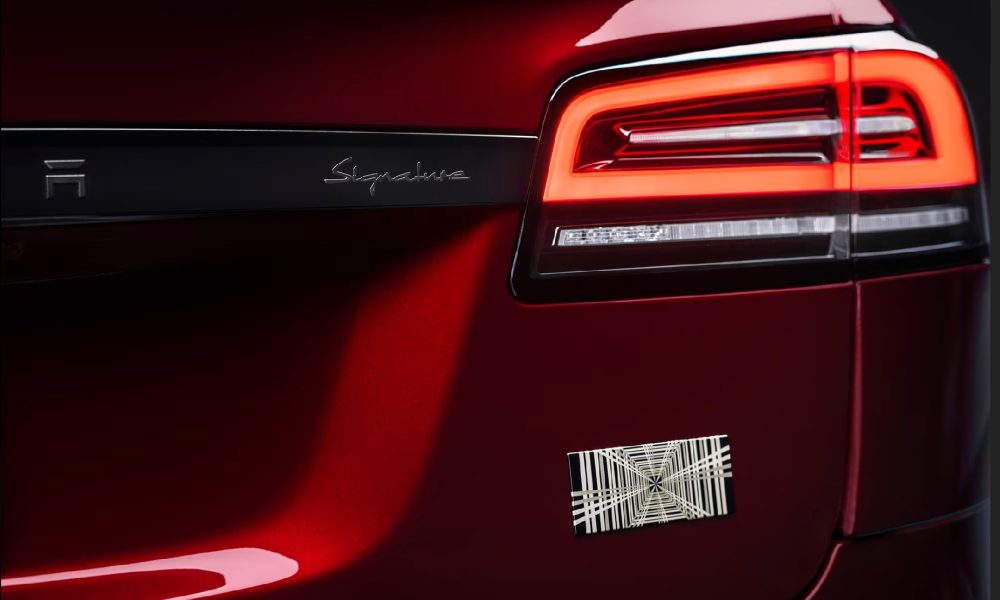


A New Jersey dealer called J&S Autohaus has listed a Tesla Model S Signature Edition for $260,490 — a cool $101,070 above the $159,420 Tesla charged for it roughly two months ago. The catch: Tesla’s no-resale agreement explicitly forbids flipping these cars within the first year, with a penalty of $50,000 or the full resale value, whichever is greater. So the seller is staring down a potential $260,490 clawback.
The Model S Signature was Tesla’s farewell lap for the Model S and Model X, both discontinued earlier this year after more than a decade in the lineup. Only 250 units were built, sold by invitation only, each individually numbered. Garnet Red paint, gold badges, white Alcantara interior, carbon-ceramic brakes with gold calipers, lifetime free Supercharging, Full Self-Driving included, and roughly 1,020 horsepower with a sub-two-second sprint to 60.
It was designed to be a collector’s piece, and Tesla priced it like one. Then Tesla wrote the contract to make sure nobody treated it like a commodity — at least not right away.
The no-resale clause doesn’t just threaten financial penalties. Tesla also strips the car of its most valuable software perks upon transfer. Full Self-Driving, free Supercharging, and Premium Connectivity all die the moment ownership changes hands.
The buyer at $260,490 would be getting a very fast, very pretty sedan without the digital crown jewels that made it special. That raises an obvious question: who is the buyer at that price?
A stripped Signature Edition is still a Model S Plaid with bespoke cosmetics and ceramic brakes, but the Plaid itself listed for around $90,000 before Tesla killed it. The premium here is almost entirely about scarcity and bragging rights.
This is the same playbook we’ve seen with limited-run Ferraris, Porsches, and Ford GTs — buy low on allocation, flip high to collectors, and dare the manufacturer to enforce its resale restrictions. Ferrari has famously blacklisted flippers. Ford sued over GT resales. Tesla’s contract language suggests it’s ready to do the same, and given how publicly this listing has surfaced, the company almost has to act.
Tesla’s enforcement mechanism is contractual, not a lien or title restriction. That means it comes down to whether Tesla chooses to pursue it in court or simply revoke the software features and move on. Either way, the original buyer is exposed.
The timing makes the listing even more conspicuous. Deliveries of the Signature Edition only began about two months ago. The one-year restriction hasn’t come close to expiring. This isn’t a gray area — it’s a direct challenge to the contract.
The broader context matters too. Tesla just lost its biggest consumer incentive nationally when the $7,500 federal EV tax credit expired. California scrambled to fill the gap with its new MyFirstEV rebate program, but that caps eligible vehicles at $50,000 MSRP — a ceiling the Signature Edition blows through by more than triple. There is no government subsidy softening this transaction for anyone involved.
Meanwhile, the Model S itself is gone. Tesla’s Fremont line no longer builds it. Whatever inventory remains is all there will ever be. That finality is exactly what the speculator is banking on.
Tesla built 250 of these cars to honor a legacy. Someone is trying to turn that legacy into a six-figure markup before the paint has had time to cure. Whether Tesla lets them get away with it will say as much about the company’s seriousness as any earnings call.
The listing is still live. The clock is ticking on both the seller and Tesla’s response.


Share this Story