
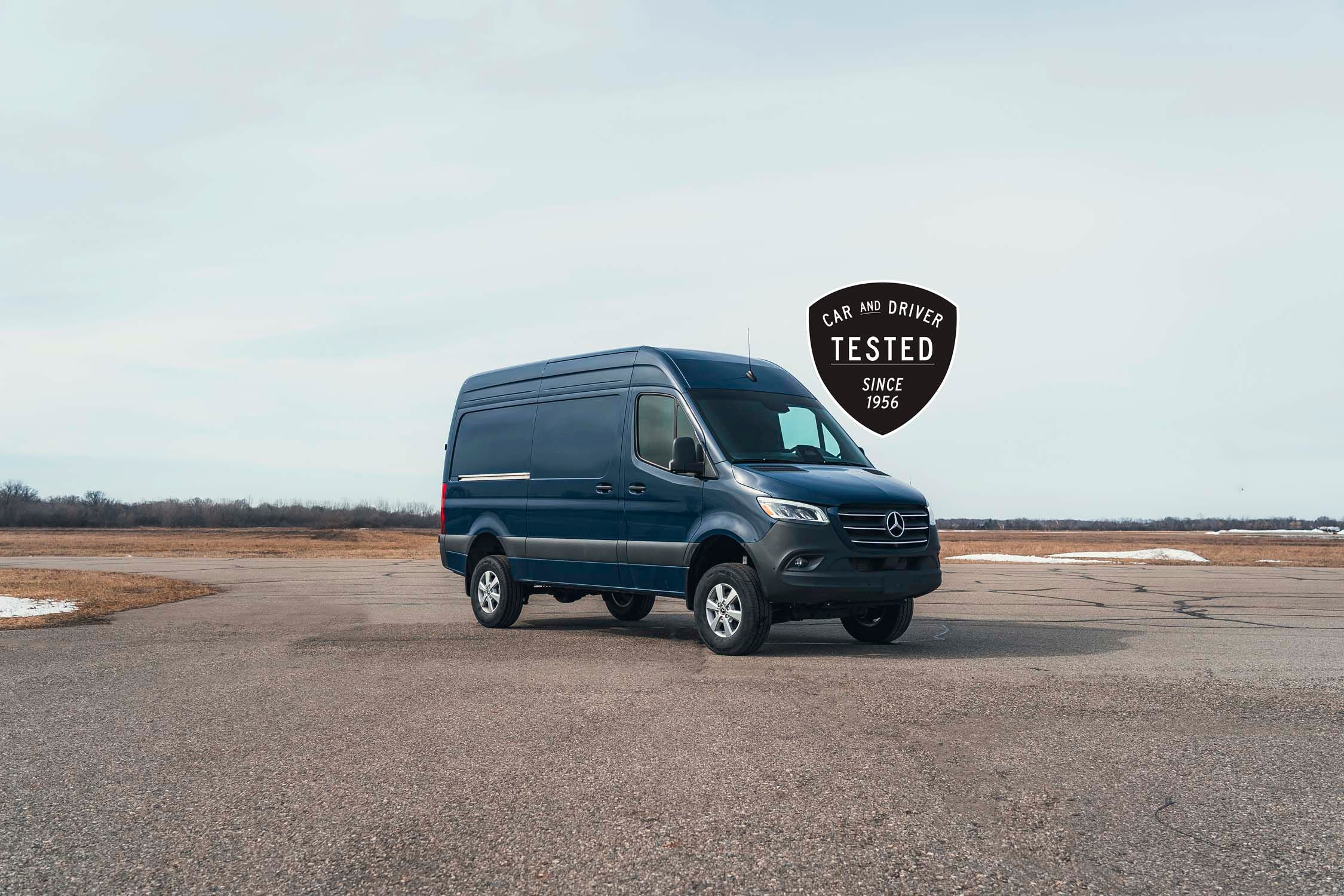


A nine-foot-tall Mercedes-Benz Sprinter cargo van climbed farther up Car and Driver’s Ramp Travel Index test than a Porsche 911 Dakar, a Hyundai Ioniq 5 XRT, and nearly every Honda TrailSport model in existence. Let that sink in for a moment.
The 2026 Sprinter 2500 High Roof — a two-seater diesel workhorse built to haul 3781 pounds of payload up hills in San Francisco — managed 29.1 inches on the magazine’s 20-degree articulation ramp. That’s a vehicle stretching 234 inches long, too tall for most drive-thru lanes, with a sliding door. It’s the first van in the 40-plus vehicle history of this test.
The RTI test is beautifully simple and brutally honest. Drive one front wheel up a 20-degree ramp until the opposite rear tire lifts. Measure the distance climbed, divide by wheelbase, multiply by 1000. No driver in the seat, no room for marketing spin.
A perfect score of 1000 would mean the rear tire stays planted all the way to the top. Nobody has gotten there yet.
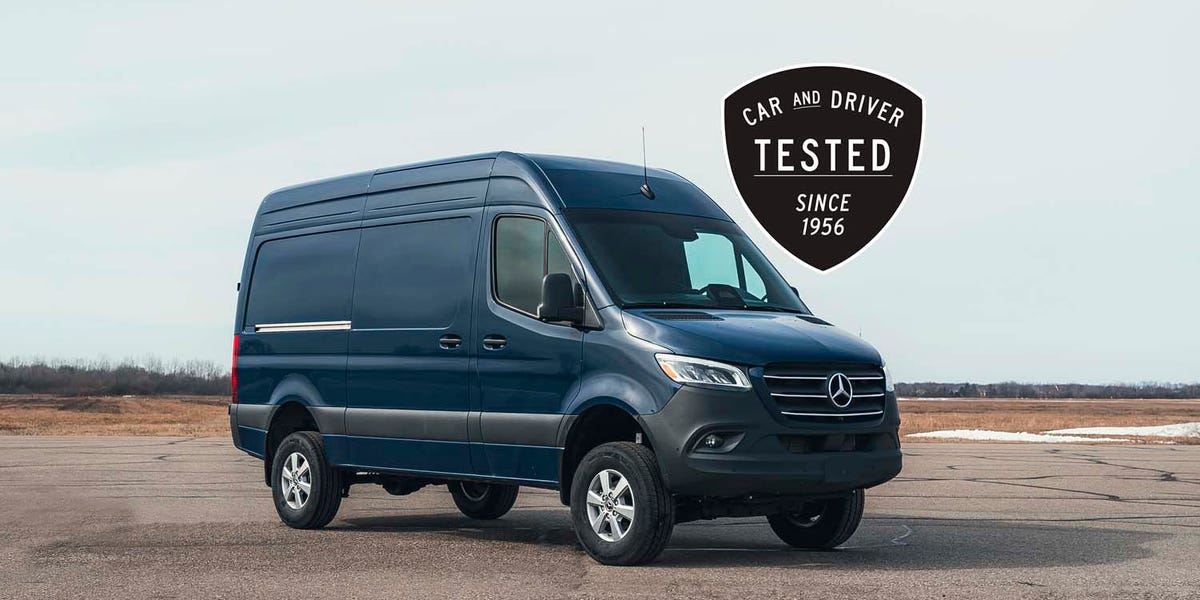
The Sprinter’s RTI score landed at a modest 202. That 144-inch wheelbase — necessary for hauling a small apartment’s worth of cargo — penalizes it mathematically. But the raw climb distance tells a different story.
Those 29.1 inches represent more ramp travel than the Ford Maverick Tremor and Subaru Crosstrek Wilderness achieved. Both of those vehicles were purpose-built with off-road trims, aggressive marketing, and rugged-lifestyle branding dripping from every press photo.
The leaderboard’s top remains predictable. A two-door Jeep Wrangler Rubicon sits at 847, followed by the four-door Wrangler Unlimited 4xe at 773 and the Ford Bronco Badlands Sasquatch at 648. These are purpose-built rock crawlers with decades of trail DNA.
What the Sprinter did challenge — and beat — is far more interesting. The Maserati Grecale Trofeo, Audi Q4 e-tron, and Volvo EX30 Cross Country all scored lower. That “Cross Country” badge on the Volvo suddenly feels generous.
Credit the hardware. MacPherson struts handle the front, but the rear rides on a solid axle with leaf springs — the kind of old-school suspension geometry that exists to carry weight but happens to articulate reasonably well over uneven terrain. The optional full-time all-wheel-drive system replaces the manually engaged transfer case from earlier Sprinters, though it lacks a true low range.
A very short first gear compensates somewhat, giving the 211-hp turbodiesel four-cylinder and its 332 pound-feet of torque — peaking at just 1400 rpm — enough grunt to get moving from a dead stop under load.
The broader lesson here is about the growing gap between off-road marketing and off-road reality. Automakers have spent the last five years slapping plastic cladding, earth-toned paint, and aggressive names on crossovers that can barely handle a gravel parking lot. The RTI ramp doesn’t care about any of that. It measures how far your suspension actually moves before a tire lifts.
A commercial van designed to deliver packages just exposed the fiction. The Sprinter wasn’t engineered with trail ratings or adventure-lifestyle Instagram campaigns in mind. Mercedes built it to work — to haul, to tow its rated 5000 pounds, to survive hundreds of thousands of fleet miles.
And yet its workaday suspension geometry, born of necessity rather than aspiration, outperformed vehicles that cost more and promise far more capability than they deliver.
Nobody is taking a Sprinter High Roof rock crawling in Moab. That’s not the point. The point is that when a delivery van embarrasses your off-road trim package on an objective test, maybe it’s time to ask what you’re actually paying for — the capability or just the stickers.


Share this Story