
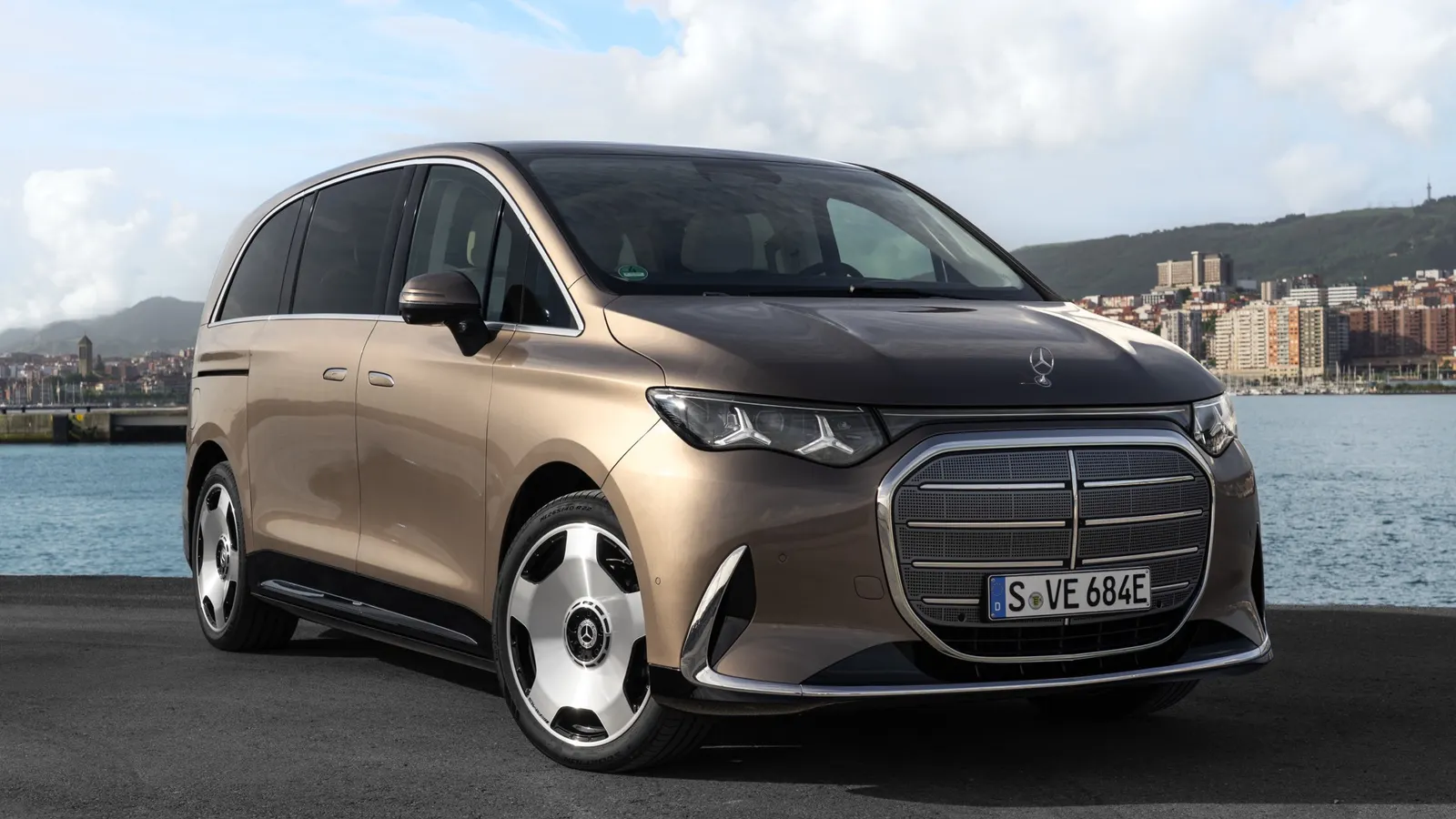


Mercedes-Benz has spent decades trying to convince American buyers that a van can be a luxury vehicle. The 2028 VLE, arriving in the second half of 2027, is its most aggressive attempt yet. It’s a fully electric people-mover engineered from the ground up to drive like the GLE and GLS SUVs that actually sell in this market.
The numbers alone tell a story. At up to 216 inches long, the VLE dwarfs most things on the road. Yet rear-wheel steering turns those rear wheels up to seven degrees, giving it a turning circle of 35.8 feet, roughly the same as the compact CLA sedan.
Built on Mercedes-Benz’s new VAN.EA architecture, the VLE ditches the compromises that plagued the EQV, a battery-electric van never officially sold stateside. That vehicle was a conversion, an electric motor shoehorned into the bones of the V-Class commercial van. The VLE is different.
The seating position has been lowered. The steering wheel angle now matches passenger-car norms. The drag coefficient hits 0.25, a figure most sedans would envy.
Two powertrains will be offered. The entry-level VLE 300 runs a single front-mounted motor producing 272 hp, paired with a 115-kWh battery. Mercedes projects more than 414 miles of WLTP range, though EPA numbers will be lower.
The VLE 400 4Matic adds a second motor for 416 hp and all-wheel drive, cutting the 0-62 mph sprint to 6.5 seconds while still claiming 391 miles on the European cycle. Both variants use 800-volt architecture and can DC fast-charge at up to 300 kW, enough for 221 miles of range in about 15 minutes.
Behind the wheel, journalists who drove it in June found the refinement startling. Wind noise stays muted. Road noise is distant.
The optional Airmatic air suspension delivers a ride quality closer to an S-Class than anything previously built on a van platform. Body motions stay controlled without the wallowing float that plagues most large people-movers.
Inside, configurations range from five to eight seats. A “Roll and Go” system lets chairs slide, fold, or come out entirely, standard minivan tricks executed with Mercedes-level materials and tech. Electrically adjustable seats can be repositioned from the infotainment screen or a smartphone app.
The optional MBUX Superscreen stretches across the dash, and a retractable 31.3-inch rear entertainment display is on the options list.
Not everything hits the mark. Brake pedal feel drew criticism during the first drive, lacking the precision expected at this price point. The regenerative braking system works well enough, with multiple levels of adjustment including one-pedal driving, but the physical pedal itself needs calibration work before production.
The larger challenge is cultural. Americans abandoned minivans for crossovers and SUVs a generation ago. The few remaining entries, the Toyota Sienna, Honda Odyssey, and Chrysler Pacifica, survive on practicality and value, not prestige.
Mercedes-Benz is betting that electrification, combined with genuine luxury refinement, can rewrite that equation. The forthcoming Mercedes-Maybach VLS, also built on VAN.EA, will push even further upmarket.
Pricing for the U.S. remained unconfirmed as of the June drive. Mercedes-Benz has indicated that a new EU-U.S. trade framework should help stabilize what customers ultimately pay. That “should” is doing a lot of heavy lifting in the current tariff environment.
The VLE is a technically impressive machine that drives far better than any passenger van has a right to. Whether Americans will spend luxury-SUV money on a vehicle with sliding doors remains the only question that matters, and it’s one no amount of engineering can answer.

Share this Story