
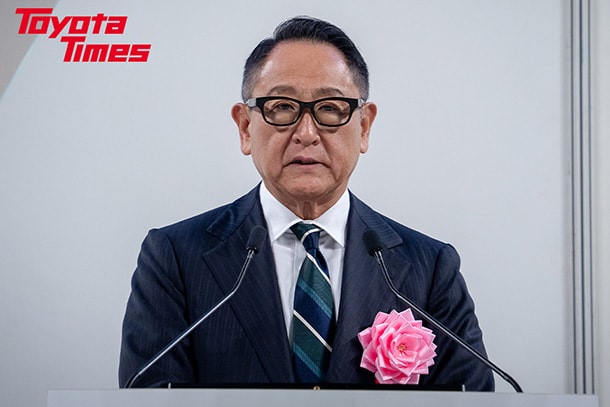


Akio Toyoda stood inside Toyota Arena Tokyo on May 25 and told a room full of government officials and industry executives that his job isn’t to be the star. It’s to run the spotlight.
Reappointed to a second two-year term as chairman of the Automobile Business & Culture Association of Japan, Toyoda used his address to frame a vision that sounds modest but carries enormous ambition. He wants to make cars the pride of Japanese culture by illuminating the 5.5 million people who build, sell, fix, and drive them.
He opened not with quarterly results or policy demands but with a racing story. The day before, his privately funded ROOKIE Racing team won its first-ever Japanese Super Formula Championship race at Suzuka, with twentysomething driver Nirei Fukuzumi behind the wheel. Toyoda wasn’t at the track.
He watched the broadcast. And the detail that stuck with him wasn’t the checkered flag — it was the Honda drivers sprinting over to congratulate Fukuzumi before anyone else.
“Athletes don’t see divisions between manufacturers,” Toyoda said. “They simply celebrate each other’s achievements.”
That anecdote was doing heavy lifting. Toyoda has spent years trying to dissolve the tribal walls between Japanese automakers, and he clearly sees motorsport as the solvent. Under his first year as ABAJ chairman, the association helped bring a NASCAR event to Japan — a deal Toyoda says grew out of a casual conversation with U.S. Ambassador George Glass during tariff negotiations.
The two men discovered they both loved cars, and the diplomatic friction melted into a cultural exchange built on horsepower instead of trade policy.
“With sports and culture as our starting point, I think we were able to take a step back from politics and economics, and engage in conversation with smiles on both sides,” Toyoda said.
It’s a tidy narrative, and Toyoda is self-aware enough to know how it sounds. “If I keep talking about motorsports like this, people might start saying Akio Toyoda is just doing what he wants,” he admitted. Then he pivoted to the broader point.
ABAJ’s membership now spans parts suppliers, new and used car dealers, maintenance shops, trucking and bus companies, taxi operators, JAF, and motorsport organizations. Toyoda’s stated mission is to turn the spotlight on the genba — the front lines — across every one of those sectors. Not to place himself center stage, but to direct the beam.
“My role is to be the lighting guy,” he said. “I’ve come to feel that this reflects what I am trying to achieve as ABAJ chairman.”
It’s a striking posture for a man whose last name is on the world’s largest automaker. Toyoda stepped away from Toyota’s CEO seat in 2023 but remains chairman of the company and clearly hasn’t lost his appetite for shaping how Japan thinks about automobiles. The ABAJ role gives him a platform that sits above any single brand — and conveniently outside the quarterly earnings cycle.
His first year produced the Cars, Culture & Society Partnership Awards in March 2026, a public forum on motorsport’s future at the Japan Mobility Show last November, and the NASCAR Japan event. None of these moves alone rewrites the industry. Together, they sketch a strategy: use culture, sport, and cross-industry camaraderie to rebuild emotional connection to the automobile in a country where car ownership among young people has been sliding for years.
Whether the lighting-guy metaphor holds up under the pressure of tariffs, electrification mandates, and a shrinking domestic market is another question entirely. Toyoda has always been better at narrative than most auto executives. The test is whether shining a spotlight generates enough heat to actually change anything.

Share this Story