
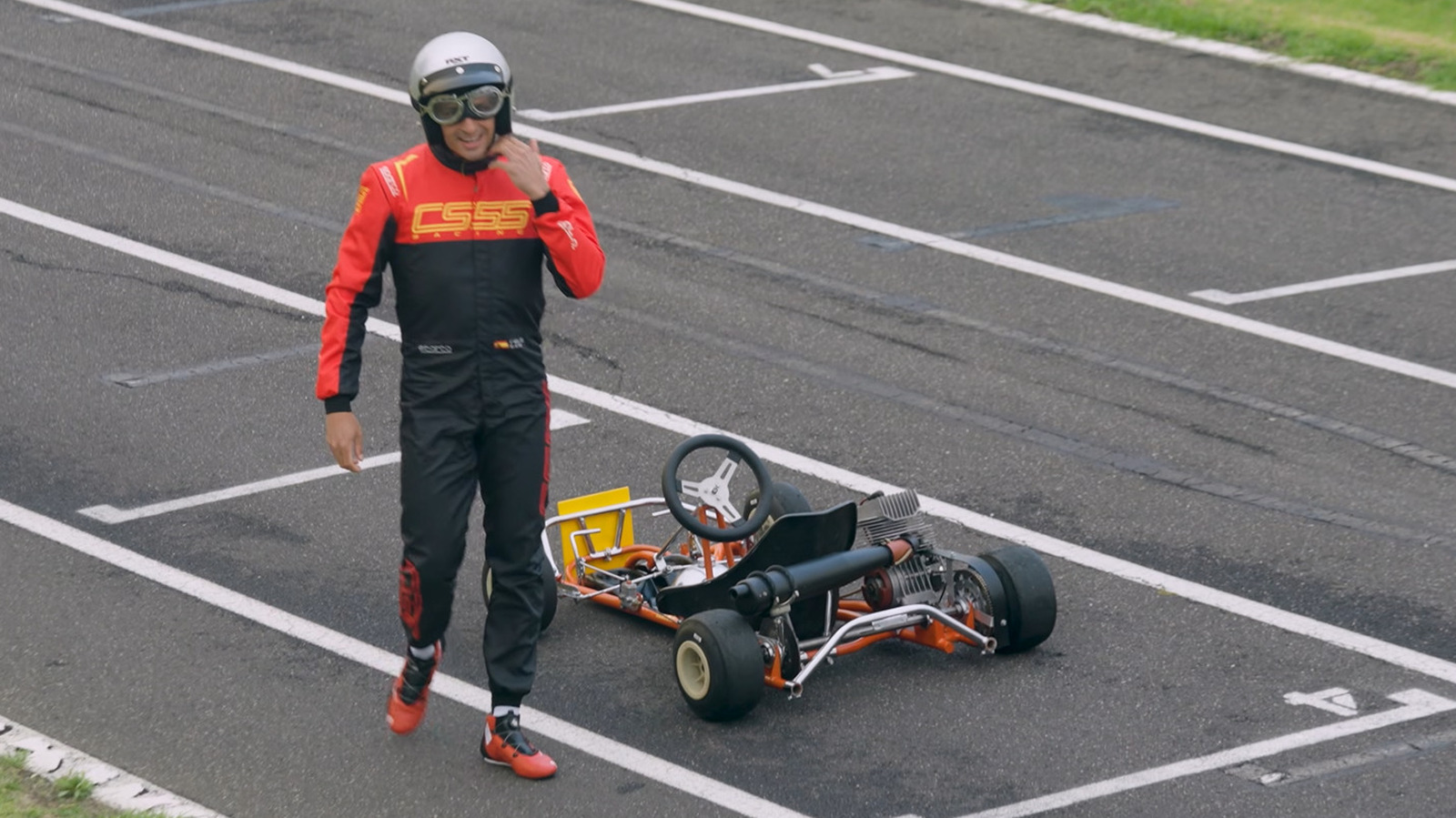


A 1959 Twin Vill go-kart, piloted by Carlos Sainz, turned a 59.62-second lap. A 2026 LN Racing Kart, with Lando Norris at the wheel, did the same track in 40.91 seconds. That’s nearly 19 seconds carved away across seven decades of engineering, but the story those numbers tell isn’t quite what you’d expect.
In a new video from Norris’s Quadrant YouTube channel, the two former McLaren teammates reunited to race karts spanning from 1959 to present day. Each driver got one flying lap per machine on the same track, same day. The format is simple. The results are revealing.
The 1959 Twin Vill was barely a vehicle. Tubes, an engine, a seat that couldn’t hold a grown man through a corner. Norris clocked a flat 60 seconds and called it “a workout not to fall out.
Sainz beat him by four-tenths, looking equally rattled. Then came the 1968 HKS. Sainz dropped nearly six seconds immediately but noted the kart had “zero brakes.”
He was nearly launched from the seat under deceleration. The machine had a real engine. It just didn’t have much else.
The 1979 DAP chassis, a replica of the kart Ayrton Senna once raced, brought Norris down to 51.68 seconds. That’s an eight-second drop from the ’59 machine in just two decades of development. The performance gains from the fifties through the seventies were enormous, driven by basic engineering breakthroughs like proper seating, engine placement within the wheelbase, wider tires, and actual braking systems.
They kept going. An ’89 Birel Parilla. A ’96 CRG Kalifornia. A rare 2000 CRG Millennium. A 2010 Fernando Alonso-IAME X30. Each one faster, but by shrinking margins.
And that’s where the real picture comes into focus. The gap between the 1950s kart and the 1970s kart is enormous. The gap between a 2000s kart and a 2026 kart is almost nothing.
Karting technology plateaued somewhere in the 1990s. The low-hanging fruit was picked decades ago — better chassis geometry, stickier rubber, more efficient two-strokes. What’s left to optimize now lives in fractions.
There are caveats, of course. Tire compounds have evolved, and bolting modern rubber onto vintage chassis would change the picture. Regulations constrain the modern karts to keep competition fair for the kids coming through the ranks.
The test wasn’t scientifically controlled. But having two current Formula 1 Grand Prix winners — both of whom grew up racing karts competitively — handle every machine eliminates the biggest variable. These two know what they’re doing.
In the final showdown on 2026 equipment, Sainz posted a 41.40 and Norris answered with a 40.91. Bragging rights to the Briton. But both times sit barely a second apart from what competitive karts were capable of a quarter-century ago.
One commenter on Motorsport.com put it bluntly: “Every driver is looking for something to race, as F1 is boring.” There’s a kernel of truth buried in the snark. Two of the grid’s biggest names flew halfway around the world not to test some cutting-edge simulator or prototype, but to strap into machines their grandfathers could have built in a garage.
Karting remains the sport’s purest form. No power steering, no data engineers on the radio, no DRS. The kart does what the driver tells it to do, and the driver feels everything. That hasn’t changed since 1959. The lap times have, but not as much as you’d think, and not for a long time now.
Share this Story