
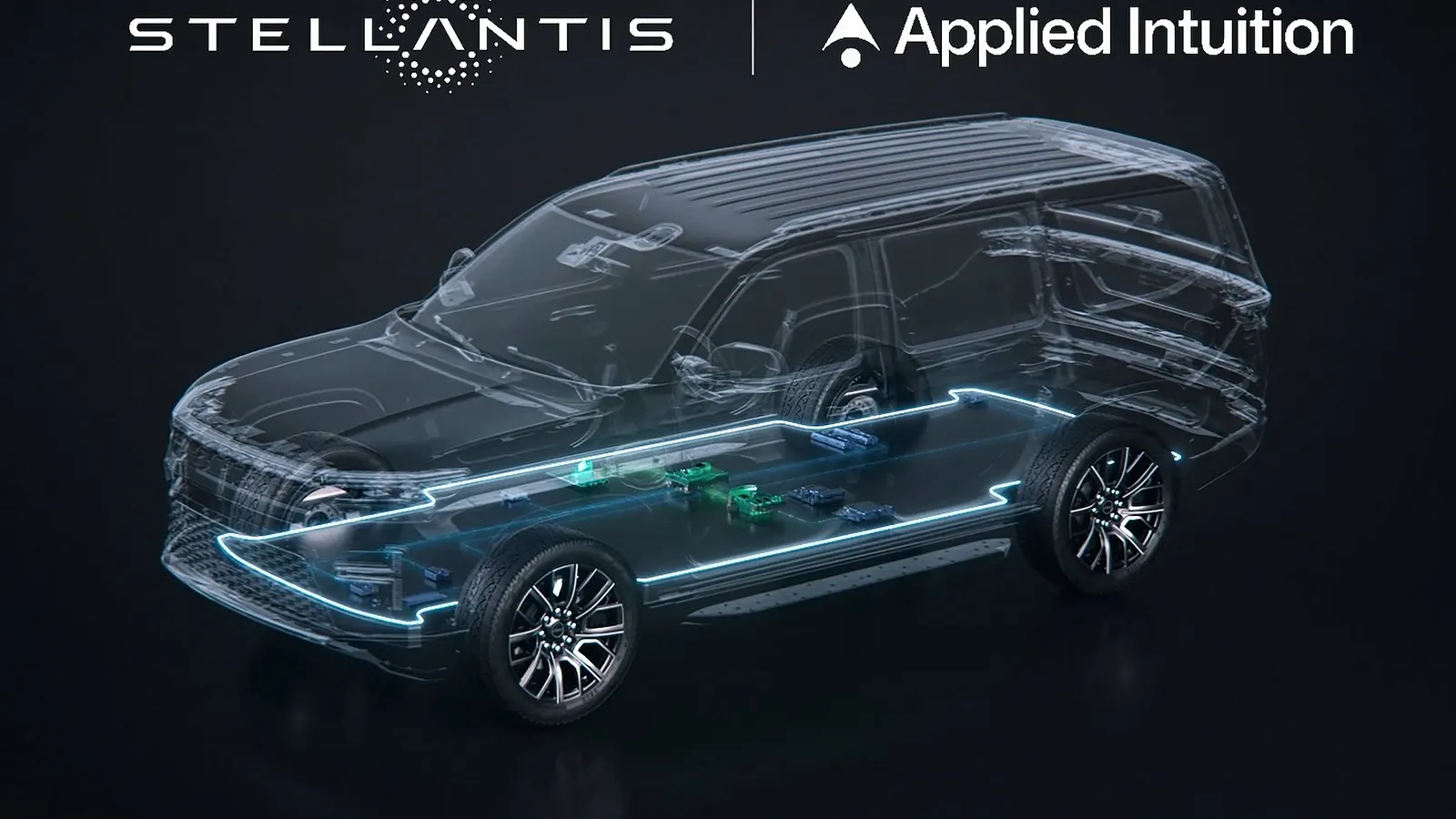


Stellantis just told investors it will spend up to 70 billion euros over five years to reinvent itself. What it didn’t say quite as loudly is that the reinvention depends heavily on companies headquartered thousands of miles from any Stellantis assembly line.
The automaker’s Investor Day on May 21 rolled out STLA One, a new global vehicle platform targeting over 30 models and 2 million units by 2035. Ambitious numbers. But buried in the announcements was a telling pattern: Applied Intuition for the vehicle operating system, Qualcomm for the unified compute platform and ADAS stack, Accenture and Nvidia for digital twin factory simulation. Stellantis isn’t just partnering. It’s outsourcing the nervous system of its next-generation cars.
Applied Intuition, a Silicon Valley software firm, is now co-developing an AI-powered Vehicle OS meant to serve as the standard foundation across future Stellantis models. The company previously helped build the STLA SmartCockpit infotainment layer. Now its role expands into STLA Brain, the architecture that connects every electronic system in the vehicle and enables over-the-air updates throughout a car’s service life.
That’s not a peripheral contribution. That’s the digital backbone.
Qualcomm’s involvement goes even deeper. Its Snapdragon Digital Chassis solutions will underpin cockpit systems, connectivity and advanced driver-assistance across the entire Stellantis portfolio. The Snapdragon Ride Pilot stack brings Level 2+ autonomous capability, including hands-free highway driving, automated lane changes and urban-assisted driving.
Stellantis plans to push these features to millions of vehicles through software updates, scaling from basic ADAS upward.
Chief Engineering and Technology Officer Ned Curic framed it as speed and efficiency. “Our customers deserve seamless, next-generation experiences that continuously evolve,” he said. Translation: Stellantis needs to catch up, and it needs help doing it fast.
The automaker is hardly alone in this approach. Every legacy OEM is grappling with the same question: build or buy the software expertise that defines the next era of vehicles. Volkswagen created Cariad and spent years struggling with it. GM built Ultifi in-house. Toyota partnered with Woven by Toyota.
Each path carries risk. Stellantis chose the partner-heavy route, and the structure of these deals reflects that calculus.
The Applied Intuition agreement explicitly leaves room for “additional collaborations in the software space,” with final scope subject to future contracts. It’s an open-ended arrangement, which suggests either strategic flexibility or the absence of a firm plan. Maybe both.
The Accenture-Nvidia digital twin initiative adds another layer. Using Nvidia’s Omniverse platform, Stellantis wants to create virtual replicas of its assembly plants fed by real-time factory data. It’s a manufacturing play, not a consumer-facing one, but it signals how broadly Stellantis is leaning on external technology partners to modernize operations it has run for decades.
None of this is cheap. That 70 billion euro investment figure covers the entire five-year strategy, including product, platforms and technology. Stellantis hasn’t broken out how much flows to these partnerships versus internal development, and that distinction matters enormously for long-term margins and intellectual property control.
There’s a tension embedded in every one of these announcements. Stellantis wants to be a software-defined vehicle company. It wants continuous OTA updates, AI-driven cockpits, scalable autonomy. But the software isn’t coming from Stellantis.
It’s coming from Qualcomm, Applied Intuition, Nvidia and Accenture.
The 2 million vehicles Stellantis wants rolling on STLA One by 2035 will carry Jeep, Ram, Peugeot and Citroën badges. Under the skin, they’ll run on Silicon Valley code. Whether that makes Stellantis a smarter automaker or a more dependent one is the question this entire strategy hinges on.

Share this Story