
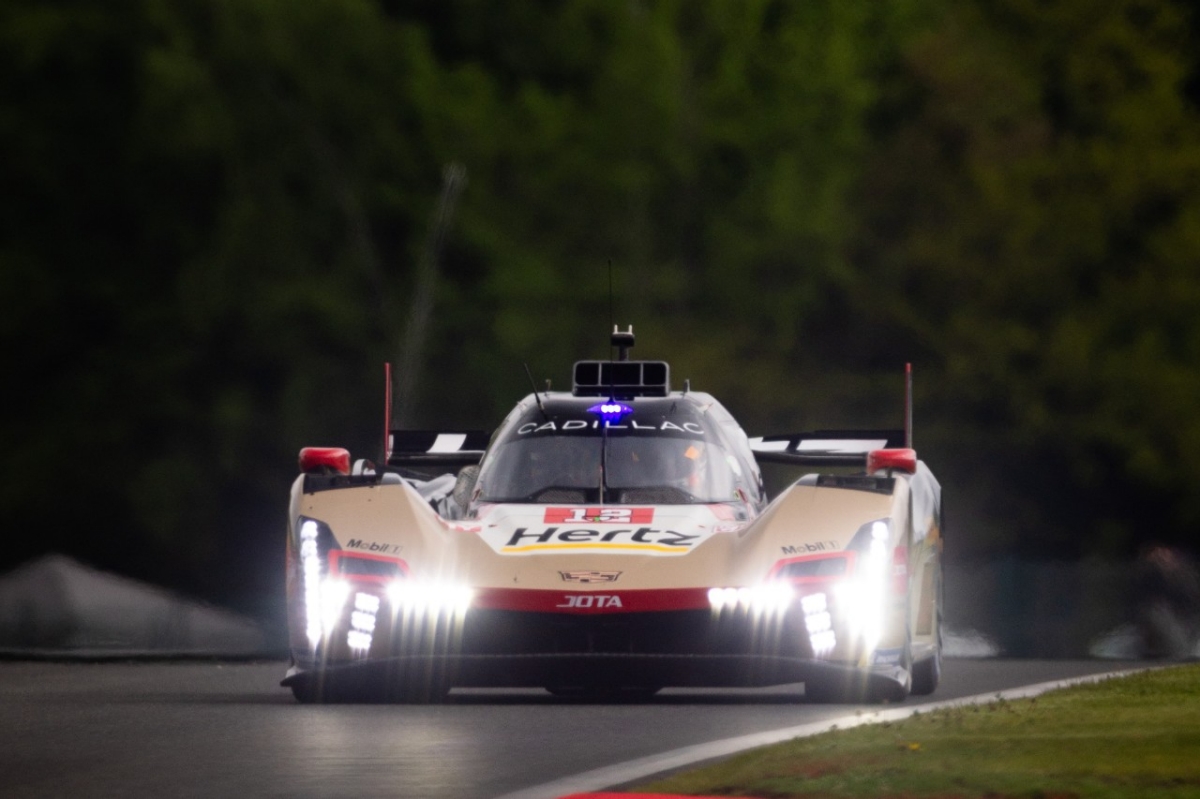


Three Cadillac V-Series.R prototypes will roll onto the Circuit de la Sarthe on June 13 for the 94th running of the 24 Hours of Le Mans. Nine drivers, two team operations, a redesigned aero package, and new brakes. All of it aimed at closing a gap that qualifying speed alone has never been able to bridge.
Last year Cadillac became the first American manufacturer since Ford in 1967 to lock out the front row at Le Mans. The pole was the brand’s first in 75 years of showing up at the French classic. The result? Fourth place, seventh place, and two retirements.
That tension sits at the center of the 2026 effort. Cadillac has proven it can produce raw pace over a single lap. What it has not proven is that its LMDh machinery can survive and thrive across 24 brutal hours of race traffic, tire management, and the unique strategic calculus that only La Sarthe demands.
The engineering response is telling. Chief engineer Jeromy Moore says the entire aero package was redesigned to reduce downforce loss when following other cars closely. The rear wing now sits noticeably lower.
A new brake supplier has been brought in, one that aligns with what goes on the CT5-V Blackwing road car. That sounds like marketing synergy but actually reflects a fundamental change in how Cadillac manages heat and wear over marathon stints.
Moore admits the sim can only take you so far. “It is hard to fully simulate what we get during the 24 Hours of Le Mans,” he said, noting that track grip evolves constantly as rubber is laid down and the public road surface cleans up. The team spent four days in the simulator ahead of the race, but nothing replaces real laps on real pavement.
Cadillac Hertz Team JOTA fields the two WEC entries: the No. 12 with Will Stevens, Norman Nato, and newcomer Louis Deletraz, and the No. 38 with Le Mans native Sebastien Bourdais, Earl Bamber, and Jack Aitken. The IMSA crossover entry is the No. 101 from Wayne Taylor Racing, driven by Ricky Taylor, Jordan Taylor, and Filipe Albuquerque.
The driver roster drips with Le Mans pedigree. Bamber has two overall wins. Albuquerque, Bourdais, Stevens, and Ricky Taylor all have class victories.
Yet none of them have delivered an overall win in a Cadillac. The car’s Le Mans history since entering the Hypercar class in 2023 reads like a study in almost: third in 2023, seventh and a DNF in 2024, and last year’s front-row heartbreak.
Jordan Taylor was candid about where things stand. “We didn’t have the best showing there last year, but I feel very confident in what we’ve learned these past 12 months,” he said. Bourdais called the preparation “a colossal effort” but admitted being “a little bit apprehensive because obviously when you put in so much effort with so many people, you really hope that the work gets rewarded.
The collaboration between JOTA and Wayne Taylor Racing has deepened. Data flows in both directions now, and what one team learns in IMSA goes straight to the WEC operation and back again. Albuquerque confirmed JOTA engineers were embedded at Daytona earlier this year.
None of this guarantees anything. Le Mans is a race that punishes hubris and rewards relentless preparation over 24 hours. Toyota, Porsche, and Ferrari are not standing still.
The Hypercar field is arguably the deepest and most competitive it has been in the modern era. Cadillac can qualify. That much is settled.
The question, the only question, is whether the brand can convert Saturday afternoon speed into Sunday afternoon champagne. Three years of trying says that jump is the hardest one in motorsport.
Share this Story