
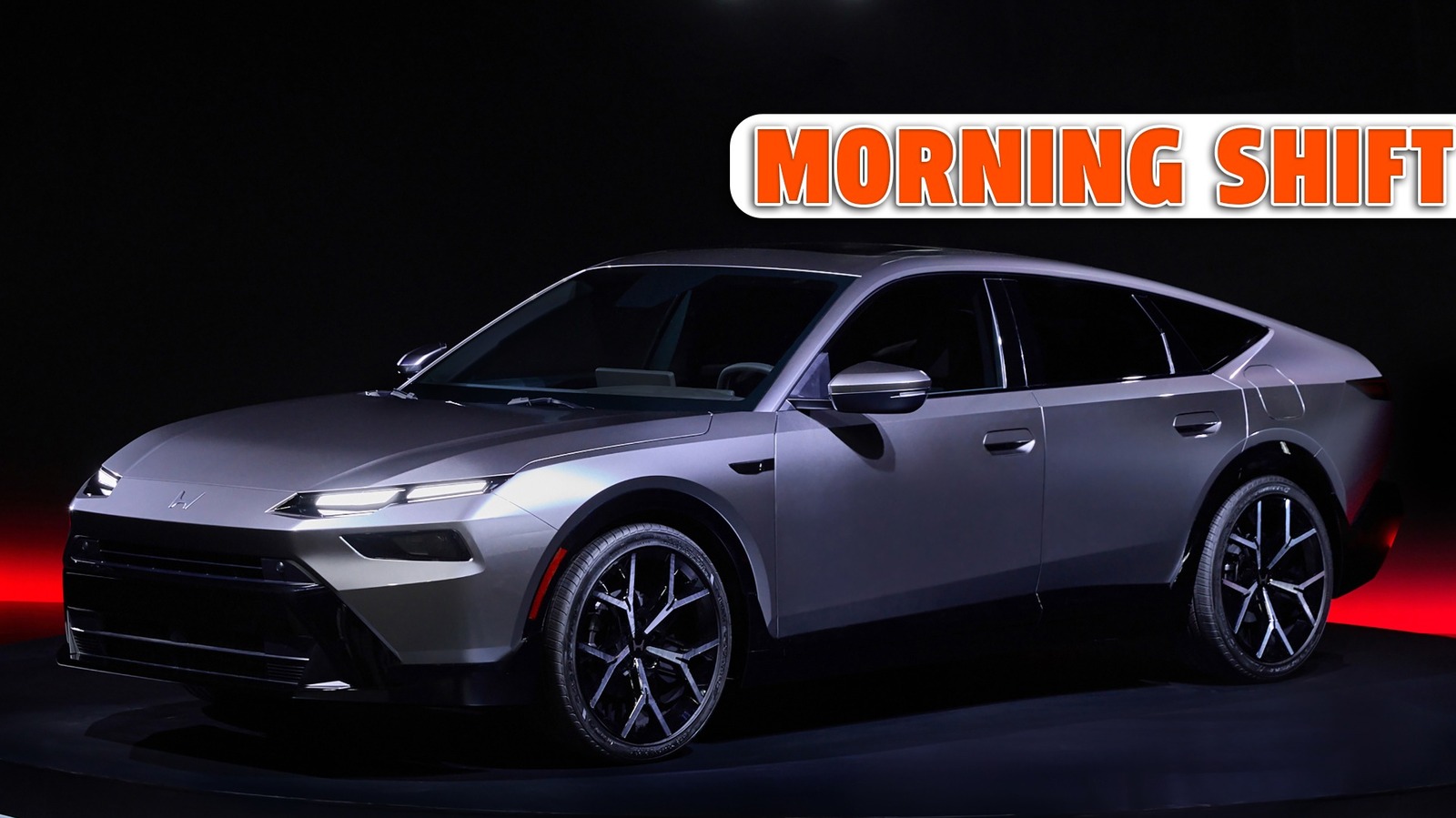


Honda just posted its first annual operating loss since going public in 1957. Let that sink in for a moment. Nearly seven decades of unbroken profitability, wiped out by a colossal misread on electric vehicles.
The numbers are staggering. An operating loss of $2.59 billion for the fiscal year ended March 31, obliterating the previous year’s $7.58 billion operating profit. EV-related write-offs and impairments totaled $9.9 billion, and net loss hit $2.65 billion.
CEO Toshihiro Mibe stood before reporters and did what executives do when the house is on fire — he pointed at the new house he’s going to build. Honda is abandoning its 2040 combustion-free target and pivoting hard to hybrids, promising 15 new gasoline-electric models by 2030.
Two prototypes were paraded out at the press conference: a silver liftback sedan with Accord DNA and a red compact crossover that looks like the next Acura RDX. Both are slated for sale within two years.
“We have to stop the bleeding as soon as possible and pave the way for future growth,” Mibe said. “We are facing a very harsh business environment.”
The bleeding is real. Honda bet big on a pure EV future, pouring billions into the 0 Series lineup, the revived RSX nameplate, and the Sony-partnered Afeela project. Then it flinched. The pullback triggered massive write-downs, and now the company is scrambling to repurpose those EV architectures and components for hybrid duty.
To dodge tariffs and improve margins, Honda plans to ramp U.S. procurement of hybrid drivetrain components from a paltry 16 percent today to 64 percent by 2028 and above 90 percent by decade’s end. That’s an enormous supply chain overhaul on an aggressive timeline, and Mibe offered few specifics on how he’d actually pull it off.
He also pledged to halve development timelines, costs, and workload by 2030, modeling the approach after Chinese automakers. But no concrete details emerged on how Honda — a company known for methodical, consensus-driven engineering — plans to suddenly move at Shenzhen speed. No plans for trimming jobs, cutting production capacity, or consolidating the product lineup were announced either.
Mibe projected a recovery for the current fiscal year ending March 2027, forecasting $3.13 billion in operating income and $1.63 billion in net income. Encouraging, except that an additional $3.13 billion in carryover EV charges is already baked into those projections. The hangover from the electric binge isn’t close to over.
Honda is hardly alone in retreating from aggressive EV targets. The entire industry is recalibrating. But few companies have paid this steep a price for the pivot.
Toyota, which never wavered from its hybrid-first strategy and endured years of criticism for it, looks almost prophetic by comparison.
The irony is thick. Honda built its reputation on engineering audacity — VTEC, the original Insight, the hydrogen-powered Clarity. The 0 Series and Afeela promised to channel that spirit into an electric future. Instead, cold feet and red ink killed them before customers ever got a chance to vote with their wallets.
What Honda is offering now — more hybrids, faster development, leaner operations — is rational. It’s also safe. And safe has never been what made Honda interesting.
Mibe has a $9.9 billion hole to climb out of and a company culture to reinvent on the fly. Promising 15 hybrids is the easy part. Delivering them profitably while Chinese competitors eat the industry alive from below is something else entirely.
Honda’s 68-year streak of profitability didn’t end because of bad luck. It ended because of a strategic bet that was placed too aggressively and pulled too late. The next few years will determine whether the correction was swift enough — or whether it was just the first loss of many.
Share this Story