
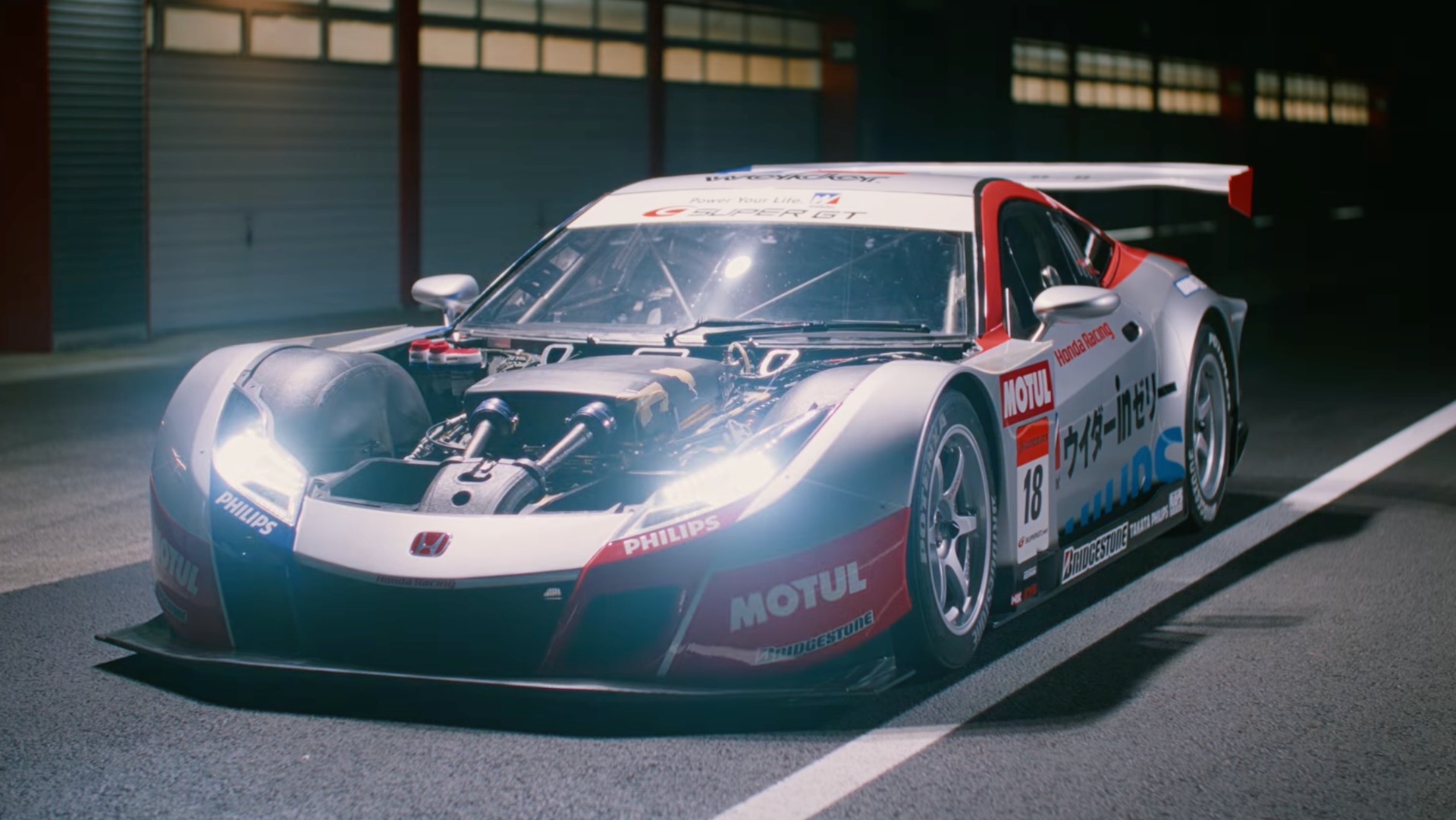


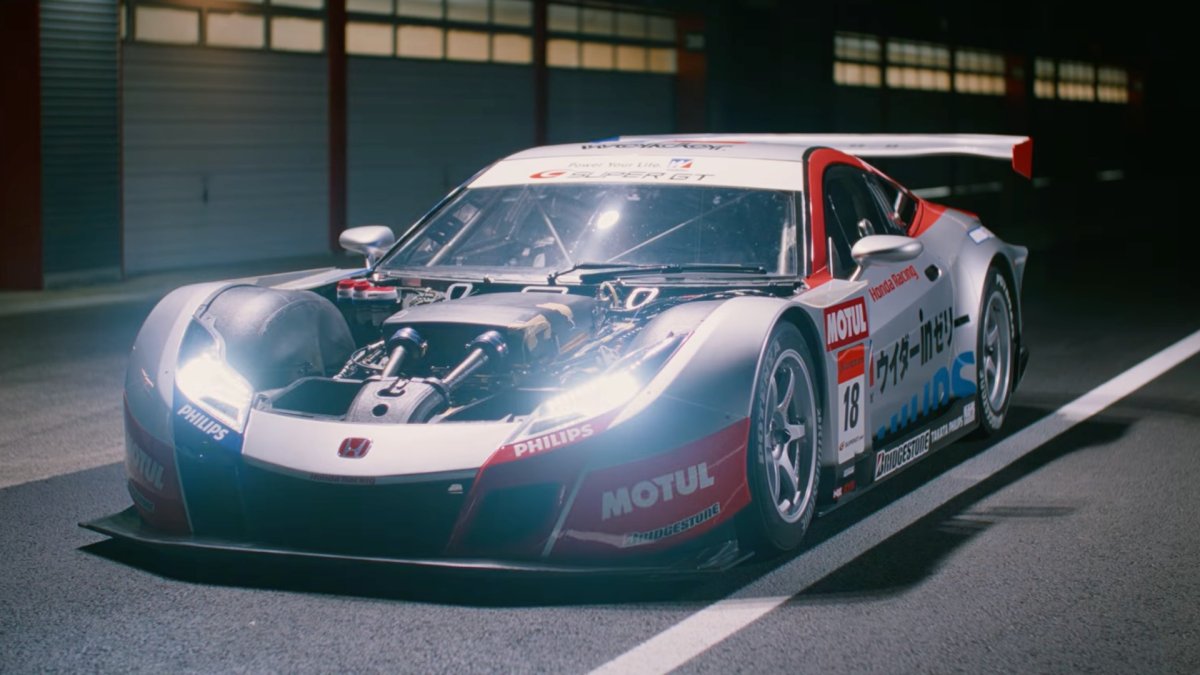
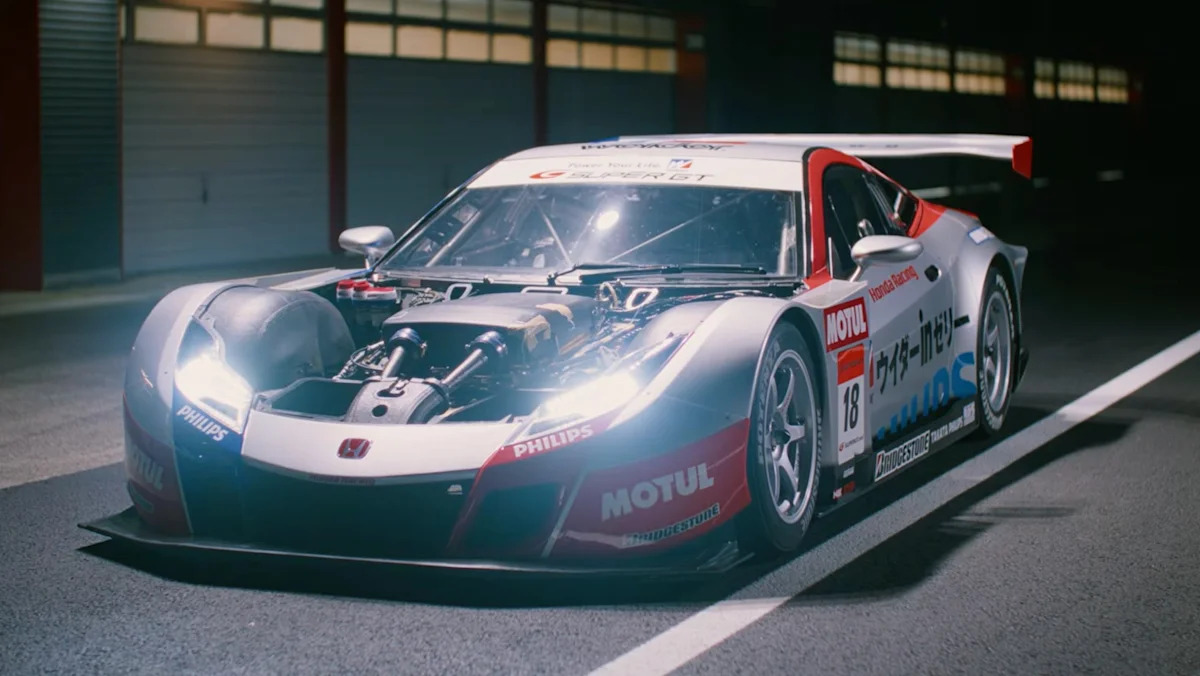
Honda just woke up a ghost. The automaker recommissioned an HSV-010 GT — the purpose-built race car it campaigned in Japan’s Super GT series from 2010 to 2013 — and posted high-quality audio of the 3.4-liter naturally aspirated V8 screaming back to life on its YouTube channel. It’s believed to be the first time one of these machines has run since being pulled from competition over a decade ago.
Two engineers approach the car in a quiet garage. No music, no narration. Switches flip, systems cycle online, and then the HR10EG V8 detonates into a raw, metallic howl that makes you forget Honda’s current lineup is dominated by crossovers and hybrids.
The video is part of a broader Honda Racing series that also features an RA272 Formula 1 car and the NSX GT that preceded the HSV-010. But it’s the V8 that commands attention, because this car represents a road Honda never took.
The backstory is a tangle of abandoned ambitions. When Honda killed the first-generation NSX in 2005, the replacement plan called for a front-engine V10 supercar. V10s were still powering Formula 1 at the time, and a road-going version would have made strategic sense.
Toyota was chasing similar logic with what became the Lexus LFA. Honda got as far as the Acura Advanced Sports Car Concept, unveiled at the 2007 Detroit show with a front-mounted V10 and rear-biased all-wheel drive. It looked like a statement of intent, and then the intent evaporated.
Meanwhile, Honda’s Super GT waiver for the aging NSX racer was expiring in 2009. The V10 road car was already dead, but Honda needed something to race. Series organizers granted an unusual exception: Honda could build a purpose-designed GT500 car that didn’t correspond to any production model.
The HSV-010 GT was born from that loophole. It borrowed styling cues from the abandoned ASCC concept but swapped the V10 for a V8 derived from Formula Nippon single-seater hardware. Baseline spec was roughly 500 horsepower and 290 pound-feet of torque — numbers that undersell the engine’s true character.
This wasn’t a smooth, composed powerplant. It was a high-revving, mechanically violent thing that dominated everything around it with sheer acoustic fury.
The car delivered on track, too. Weider Honda Racing swept the drivers’ and teams’ championships in its debut 2010 season. Over four years, the HSV-010 GT racked up 10 race wins before Honda replaced it for 2014 with a racer based on the not-yet-production second-generation NSX — a mid-engine V6 hybrid that eventually reached showrooms but never carried quite the same visceral charge.
Comparisons to the Lexus LFA’s Yamaha-tuned V10 are inevitable and instructive. The LFA sounds operatic, almost musical in its precision. The Honda’s V8 takes a different posture entirely — it snarls, barks, and feels perpetually on the edge of breaking free from whatever restraint the engineers imposed.
One is a symphony hall. The other is a cage fight.
Honda has never built a V8 road car. Its only V8-powered vehicle sold to the public was a rebadged Land Rover Discovery from the 1990s, a footnote so obscure it reads like a typo. That makes the HSV-010 GT a genuine orphan in Honda’s history — a competition machine with no production sibling, born from a canceled supercar program and a regulatory workaround.
Firing it up again after all these years feels less like nostalgia and more like an admission. Honda once had the engine, the chassis, and the racing pedigree to build something extraordinary for the street. The V8 screaming in that garage is the sound of the path not taken — and twelve years later, it still sounds angry about it.




Share this Story