


Ten seconds. That is how long it takes the steering wheel in the Fangchengbao Tai 9 to fold up and disappear into the dashboard.
The wheel only goes away when the car is parked. Then it comes back, because somebody still has to drive.
The Tai 9 is a six-seat plug-in hybrid from Fangchengbao, one of BYD’s premium brands in China. It sits at the top of that range and is roughly the size of a Cadillac Escalade IQ. The vanishing wheel belongs to the flagship Foldable Smart Cabin trim.
The trick works because the Tai 9 uses steer-by-wire. With no mechanical column tying the wheel to the front tires, BYD’s engineers were free to tuck it out of sight.
Anyone who saw the clip online and assumed it signaled a self-driving breakthrough got it wrong. Kevin Williams of InsideEVs admitted his first reaction was that the footage had to be AI-generated. It wasn’t.
The hardware is real. The autonomy it suggests is not.
China’s rules on automated driving are strict. No automaker selling cars there has approval for commercial eyes-off, hands-off driver assistance. So the Tai 9 can move its steering wheel out of the way, but it can’t take over the wheel’s job.
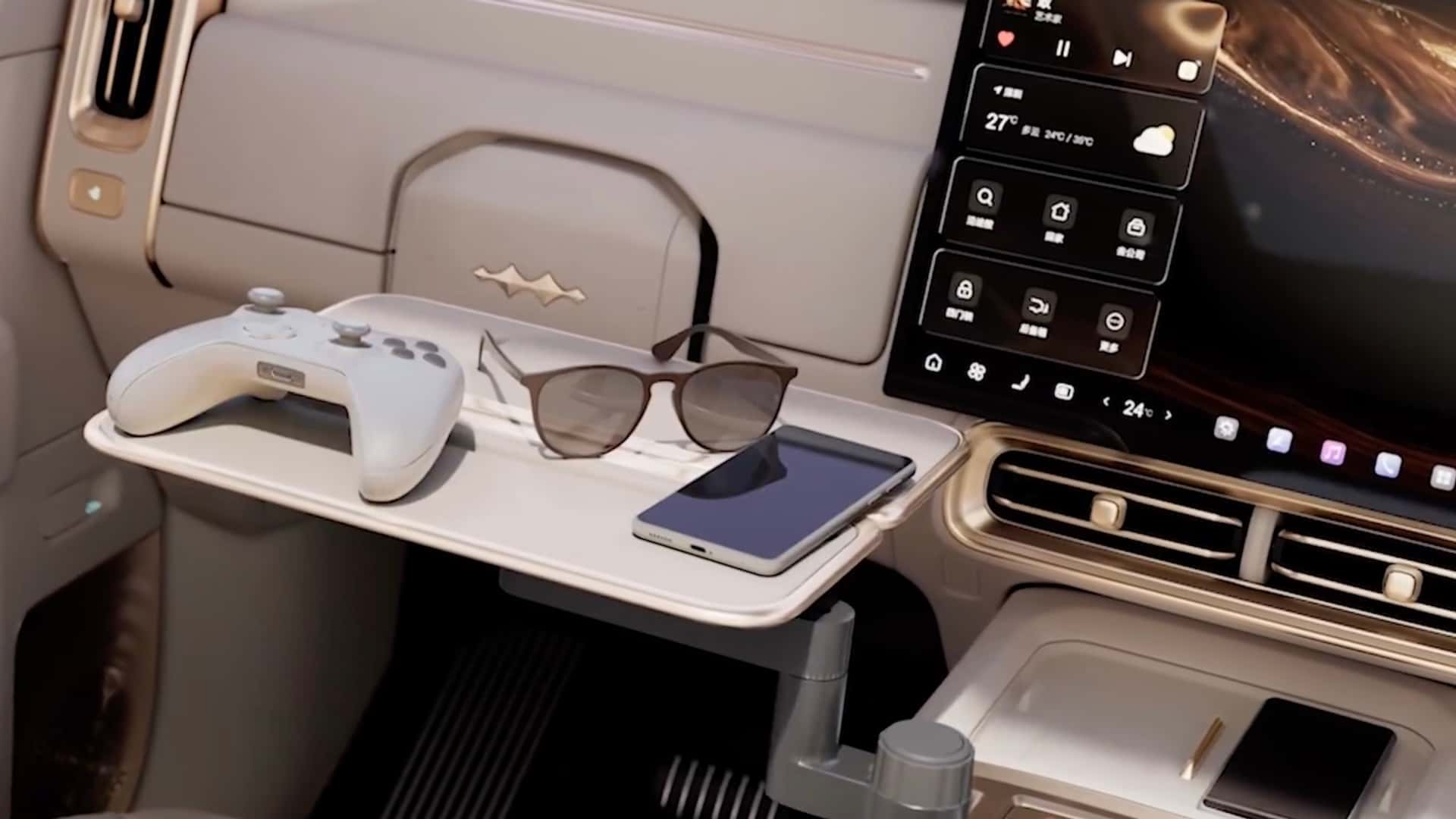
What BYD is selling instead is a living room. With the wheel stowed, the driver’s area opens up enough to fit a small table.
Add Nappa leather, plush seating, and a folding screen for the second row, and the pitch becomes clear. This is a place to sit, not just a way to get somewhere.
Chinese buyers have been pushing large SUVs in that direction for a while. The industry calls it the “third space,” a cabin you hang out in while the car sits still. The Zeekr Mix and the SkyNomad N90 Studio work the same angle.
The Tai 9 carries that idea as far as the hardware allows without regulators signing off on the next step.
Underneath the furniture, the numbers are serious. Two electric motors produce 536 horsepower at peak, and a 1.5-liter turbocharged engine handles combustion duty.
The 66.5 kWh battery supports BYD’s flash charging. The company claims it goes from 10 percent to 97 percent in nine minutes.
Then there is the price. The Tai 9 starts at about $42,000 in China. The foldable-wheel version runs about $49,500.
That’s a full-size, 536-horsepower, six-seat luxury hybrid with a retracting steering wheel for under fifty grand. Western rivals have spent years parading steer-by-wire and stowable controls on concept stands, and BYD just put them on a showroom floor.
Not everyone is impressed. One InsideEVs reader dismissed it in five words: “More gimmicks nobody is asking for.”
That critique has teeth when the feature solves a problem that only exists in a parking spot. It loses some bite when you remember what the wheel is physically capable of doing, and what it’s waiting on.
Tesla’s Cybercab went the other way. It largely drops manual control and can’t be driven by hand above low speeds. BYD built a car that keeps the wheel and simply learns to put it away.
For now, the Tai 9’s wheel folds only when the car is going nowhere. The mechanism to hide it is already in production. The permission to use it on the move still sits with Chinese regulators.

Share this Story