
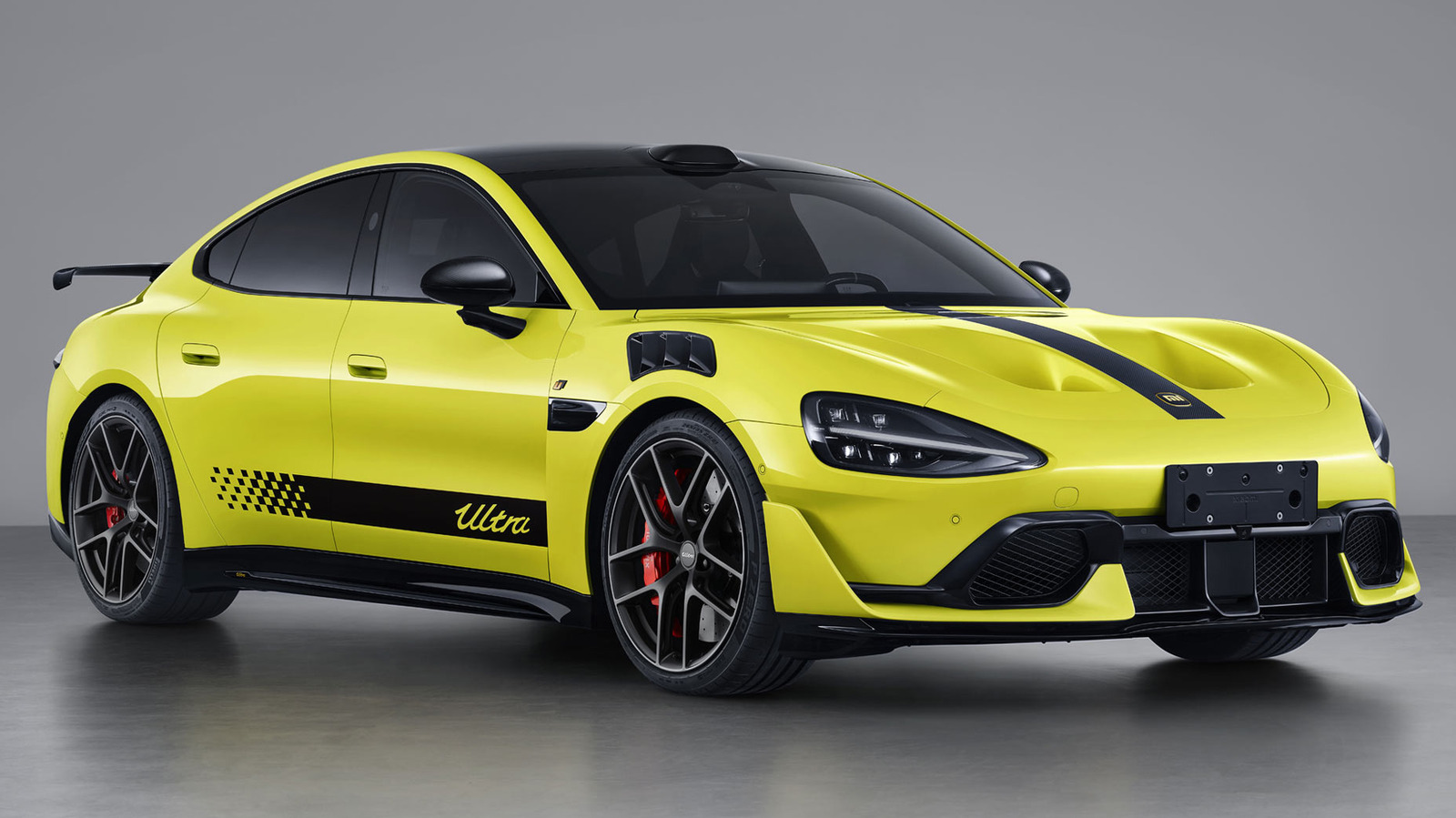


Ten seconds. That’s roughly the gap Xiaomi has to close at the Nurburgring, and it plans to find that time in carbon fiber rather than kilowatts.
Filings with China’s Ministry of Industry and Information Technology have revealed the updated SU7 Ultra. The big power figure the rumor mill promised never materialized.
Early reports floated a fourth electric motor and output north of 2,000 horsepower. The MIIT documents kill that idea, listing the same tri-motor layout and the same 1,526 hp as the current car.
That restraint tells you where Xiaomi thinks it lost the record.
The outgoing SU7 Ultra lapped the Nordschleife in 7:04.957 in 2025. Porsche then rolled out the Taycan Turbo GT with the Manthey Kit, put Lars Kern behind the wheel, and posted 6:55.553.
The Manthey Kit is an aero package. Xiaomi’s answer is an aero package.
Xiaomi was back at the circuit with an updated prototype just a couple of months after losing the crown. Now we know what it was testing.
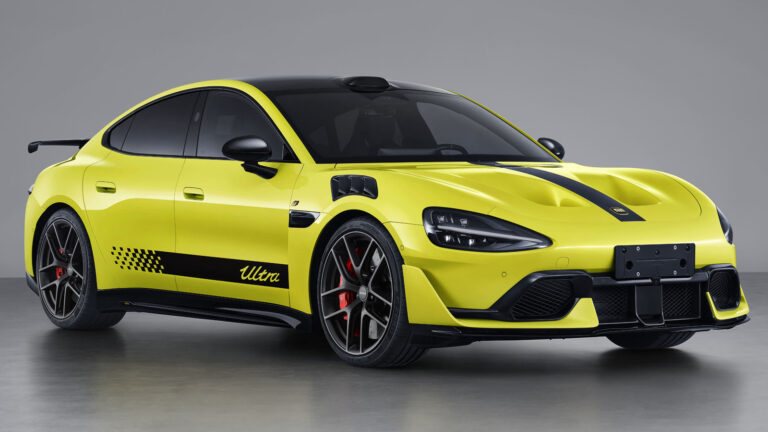
The standard car barely changes. Louvers appear on the front fenders, the front bumper and grille get sharper, and the rear picks up a new bumper and diffuser.
The real hardware lives on the options sheet.
Top of the list is a huge swan neck carbon fiber rear wing, the one spotted on recent prototypes. It appears to use two electronic struts to open the upper element, a drag reduction trick borrowed from the Porsche 911 GT3 RS.
Buyers who want less theater can pick a smaller carbon wing in four tones. There’s also a simple pop-up spoiler that rises from the tailgate.
Up front, an optional carbon fiber bumper adds vents and winglets for more front-end downforce. A more aggressive carbon diffuser rounds out the package.
Then there’s the rubber. Track-focused wheels wear Pirelli P Zero Trofeo RS tires, 295/30 front and 325/30 rear.
Other wheel designs carry Pirelli P Zero Elect tires, likely the standard fitment. Carbon ceramic discs sit behind calipers in red, yellow, green or blue.
The personalization list keeps going. There are three carbon roof styles, what looks like a panoramic glass roof, carbon hoods, graphics packages, and carbon mirror caps.
Even the hood badge gets options, in blue carbon or purple carbon.
Here’s the problem no option box solves. The MIIT filings list curb weights of 5,247 lbs and 5,235 lbs, likely for different specifications.
A Taycan Turbo GT with the Weissach pack weighs a quoted 4,984 lbs. Xiaomi is chasing a lighter car that’s just as serious about aero.
Heavy performance EVs can hide their mass well on the road, and the Hyundai Ioniq 6 N proves it. Hiding it from a stopwatch through Fuchsrohre and Pflanzgarten is another matter.
The other numbers carry over. Top speed is listed at 198 mph.
The outgoing car hits 62 mph in 1.98 seconds and claims 385 miles on the CLTC cycle. Expect the update to land close to both.
So the bet is clear. Same motors, same output, more downforce, stickier tires, and a moving wing.
Porsche found its ten seconds with Manthey’s aero and Kern’s hands. Xiaomi has built its counterpunch and filed the paperwork.
Nobody outside the company knows how fast it is. The answer will come from 20.8 kilometers of Eifel tarmac.

Share this Story