
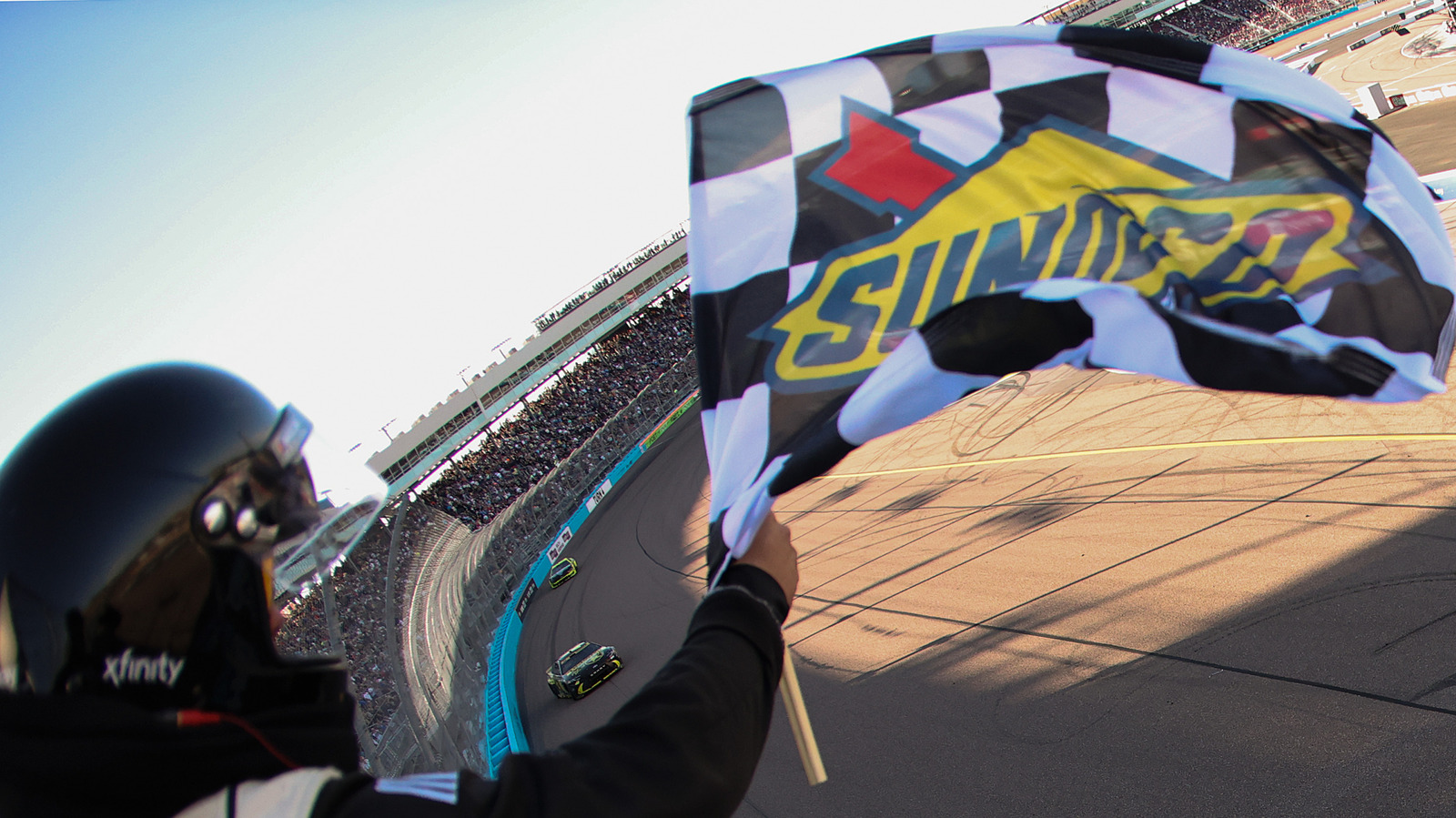


Wave a white flag at a NASCAR driver and he knows he has one lap left to win. Wave the same flag at a Formula One driver and he starts looking for a wounded car crawling around the next corner.
Show it to a MotoGP rider and he heads for pit lane to jump on a second motorcycle.
Same piece of cloth. Three series. Three completely different instructions, delivered at speeds where nobody has time to check a rulebook.
Flags are supposed to be the simplest tool in the safety kit. No signs to read, no hand signals to decode, just a color, a pattern, and a message.
A recent Carscoops breakdown of motorsport signaling shows how far that promise has drifted from series to series.
The basics hold up. Green means go, and both NASCAR and F1 use it to restart a race after an incident, even though F1 starts its races with lights instead.
Red means stop. Checkered means it’s over. Nearly everyone agrees on those.
Yellow is where the agreement starts to fray. In NASCAR, a yellow bunches the field up behind the pace car.
In F1, a single waved yellow means slow down, no overtaking, and be ready to change direction. Two yellows mean slow down hard and be prepared to stop.
F1 also runs “local yellows,” where one section of the circuit is neutralized while everyone else keeps racing.
Then it gets messier. The MotoGP white flag exists because swapping tires on a motorcycle is a slow, awkward job. When rain arrives, it’s quicker to abandon the bike on slicks and climb onto an identical one already wearing wets.
Blue flags carry their own split personality. In F1, blue is an order aimed at the car about to be lapped: move over when it’s safe. According to Carscoops, NASCAR shows a plain blue flag on road courses to warn of trouble ahead, and uses a blue flag with a yellow stripe for the move-over message.
Black is where the stakes climb fastest. A NASCAR driver who sees black alongside his number has to come to pit lane immediately, but it isn’t an automatic disqualification.
Ignore it for five laps and out comes the black flag with two white stripes, meaning the car is no longer being scored. Disqualification usually follows.
In F1, a plain black flag is the disqualification. No grace period. No five laps to think it over.
F1 also flies a black flag with an orange disc, known as the meatball, for a car with a dangerous mechanical problem. A diagonally split black-and-white flag is a sportsmanship warning, a yellow card before the red.
The rare ones are rarer still. A yellow flag with red stripes signals debris in NASCAR, while in F1 and MotoGP it means oil or water on the surface.
MotoGP adds a white flag with red diagonal crosses to warn of rain in one section of track.
NASCAR keeps a red flag with a yellow stripe to close pit entry. Red and black shown together end a practice session. And on occasion, per Carscoops, two checkered flags at once mark the halfway point of a race, not the finish.
Drivers absorb the common flags until they become reflex. That reflex is exactly what gets tested when someone crosses over, and the white flag that once meant a victory lap now means a slow car is waiting just over the crest.


Share this Story