
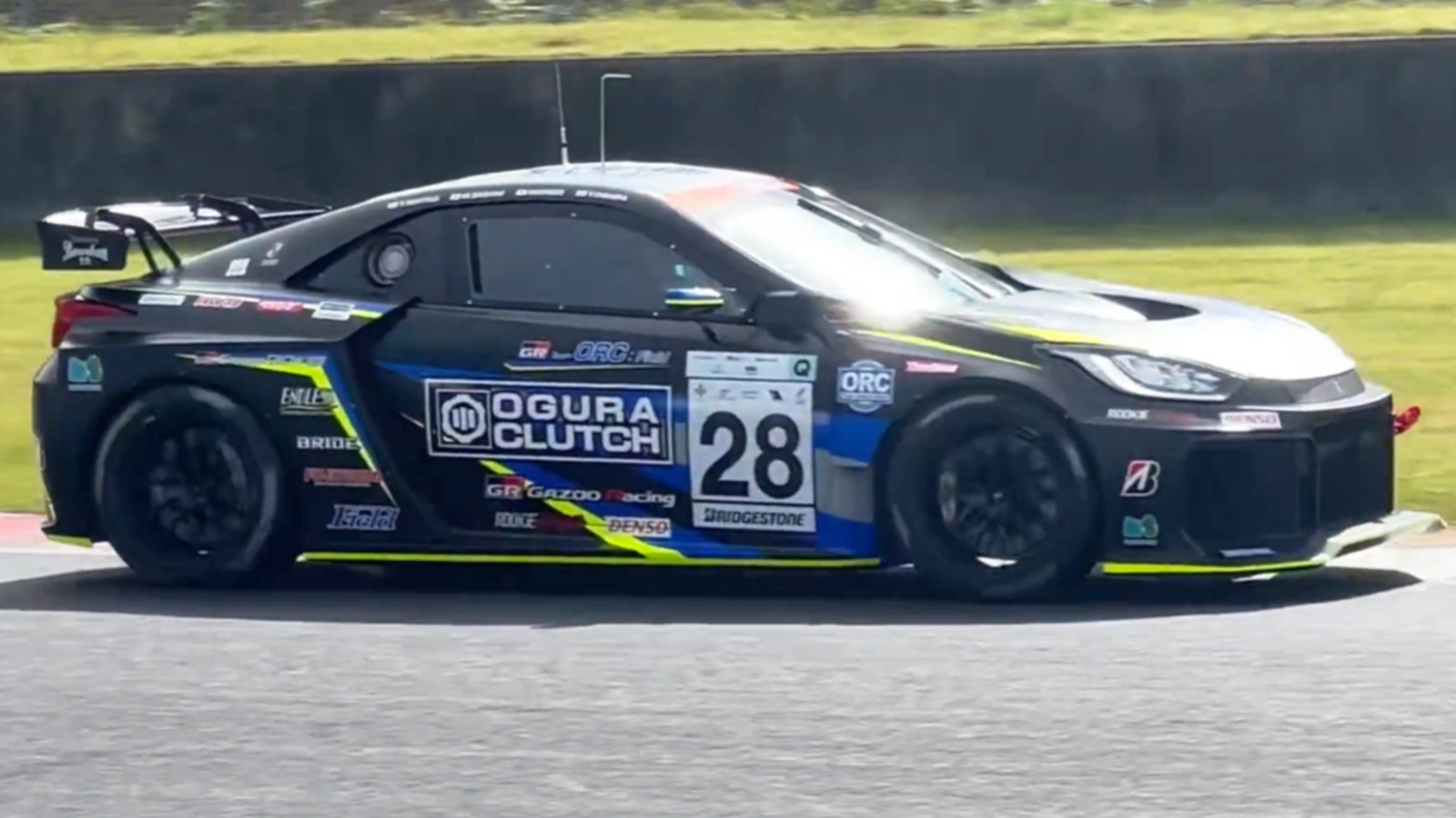


Toyota rolled out yet another mid-engined GR Yaris prototype at a Super Taikyu race in Japan over the weekend, and this one barely resembles a Yaris at all. It looks like a proper mid-engined sports car. The kind Toyota hasn’t built in over two decades.
The company has been testing variations of this concept in Japan’s endurance racing series for more than 18 months. Earlier versions kept the basic GR Yaris silhouette, just with an engine shoved behind the driver and some wider fenders bolted on. This latest car is different.
The proportions have shifted. The roofline drops. The rear haunches flare outward with functional air intakes feeding a centrally mounted powerplant. It closely mirrors a camouflaged prototype spotted by spy photographers earlier this year.
Some GR Yaris DNA remains. The headlights and taillights carry over, and the front end shares a family resemblance. But everything else screams dedicated mid-engine platform.
Under the rear glass sits Toyota’s new turbocharged 2.0-liter inline-four, the engine that will likely define Toyota’s next generation of performance cars. It replaces the beloved but aging 1.6-liter turbo three-cylinder from the current GR Yaris and reportedly surpasses even the outgoing 2.4-liter turbo four in output. Road-going versions are expected to make around 300 horsepower and 295 lb-ft of torque in base form, with hotter variants possibly reaching north of 400 hp and 406 lb-ft.
Those are serious numbers for a car that could weigh well under 3,000 pounds.
Images published by CarWatch in Japan reveal the prototype carries a large radiator and cooling fan up front, where the production Yaris houses its engine. That layout suggests a conventional mid-engine cooling arrangement, with coolant piped from nose to tail. A fixed rear wing and aggressive diffuser round out the aero package.
The production version is expected to pair the 2.0-liter turbo with all-wheel drive and Torsen limited-slip differentials on both axles, borrowing the drivetrain philosophy from the GR Yaris and GR Corolla. Transmission options remain uncertain. Toyota’s current eight-speed automatic is the likely candidate, though a six-speed manual hasn’t been ruled out.
What Toyota won’t confirm is whether the production car will wear the MR2 badge, the Celica name, or something else entirely. The company has teased both revivals at various points, and the ambiguity feels deliberate. A mid-engined, all-wheel-drive layout doesn’t perfectly match either nameplate’s heritage.
The original MR2 was rear-drive. The Celica was front-engined. This car is something new wearing an old silhouette.
That Toyota is developing a dedicated mid-engine sports car at all, in 2026, while most automakers are consolidating around crossovers and battery-electric platforms, says plenty about where Gazoo Racing sits within the company’s hierarchy. This isn’t a concept sketch at a motor show. It’s a car being hammered around racetracks in competition, refining its engine, its cooling, its aero.
The new 2.0-liter turbo four is also expected to migrate into the next GR Yaris and GR Corolla, making this mid-engine project the tip of a broader performance offensive. Toyota is building the engine first and wrapping multiple cars around it.
No timeline has been announced for the production car’s reveal. But each time the prototype appears at a Super Taikyu round, it looks less like a mule and more like a car Toyota intends to sell.

Share this Story