
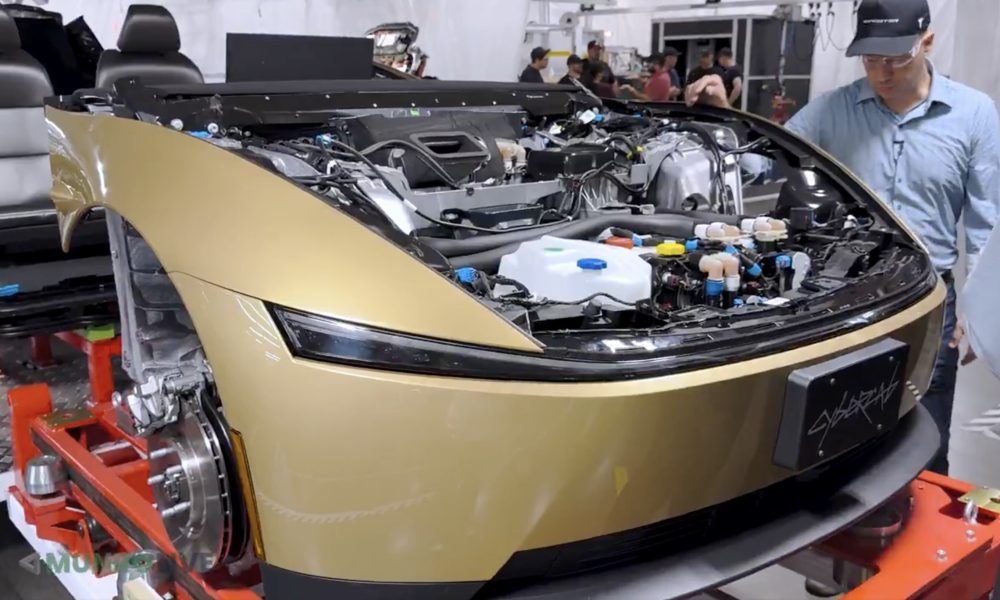


Lars Moravy dropped a line this week that should make every Tesla competitor uncomfortable, and every Tesla investor a little nervous. “We don’t run every day because the line can run so fast. It’s currently outpacing our deployments,” Tesla’s Vice President of Vehicle Engineering told Munro Live during a factory walkthrough.
The Cybercab production line in Texas is building robotaxis faster than Tesla can put them on the road. That is not a manufacturing problem. It is a deployment problem. And it flips the usual EV scaling narrative on its head.
Most automakers struggle to ramp production. Tesla’s struggle is the opposite. The line’s rated capacity exceeds 125,000 units per year, and Moravy says even that number undersells reality.
The final assembly line has just 25 fully automated stations, roughly a fifth to a tenth of what a Model Y requires. The full line runs 78 percent automated, framing hits 100 percent, and floor space per vehicle is cut in half. Tesla’s stated target is one finished Cybercab every 10 seconds.
They deleted the paint shop entirely. Side modules get coated, but exterior panels receive their color inside the molding machine. The battery pack uses 4680 cells in an 88S6P configuration housed in a steel enclosure, a first for the company, with individually potted modules so a single failure doesn’t force a full pack swap.
Wireless battery management boards replace a wiring harness. Tesla’s own battery director graded the pack an A minus, compared with a D for the Model Y structural pack.
That engineering rigor makes sense when the vehicle is designed to survive 500,000 miles of constant commercial use. The 11:1 gear ratio on the drive unit, versus roughly 9:1 on most Teslas, reflects a machine that doesn’t need to do 130 mph. It needs to do 35 mph, all day, every day, without breaking.
But none of that matters if the cars sit idle. Texas records show 463 Cybercabs registered. Tesla had about 50 working the Formula 1 weekend in Austin.
The company says Dallas launches next month, and Moravy mentioned getting Cybercabs to customers by the end of 2026. Every unit produced since the line hit volume in April has gone into Tesla’s own fleet.
The Q3 earnings call last week added context. Tesla reported nearly two million cumulative unsupervised miles for its robotaxi service, with Austin operating hours stretching from 6 a.m. to midnight. FSD attach rates hit 75 percent of new North American deliveries.
Revenue came in at $28 billion, roughly in line with expectations, while free cash flow of $1.53 billion obliterated the negative $4.5 billion consensus.
Still, operating margin sat at 2.6 percent, and automotive gross margin has been sliding. The Cybercab fleet generates no external revenue yet. Every mile driven is a cost center, not a profit line. NHTSA’s open safety review hangs over any expansion beyond Texas.
Tesla built a factory that can outrun its own regulatory and operational reality. The manufacturing achievement is genuine. The unboxed process, the automation rates, the cycle time targets are all real engineering.
But a robotaxi that can’t carry paying passengers is just an expensive test car.
Moravy framed it as a race between production and deployment. Right now, production is winning. That only counts as a victory if deployment catches up before the inventory pile becomes its own kind of problem.
Munro Live asked when it could get a Cybercab to tear down. Tesla’s answer was two words: “Not yet.”
Share this Story