
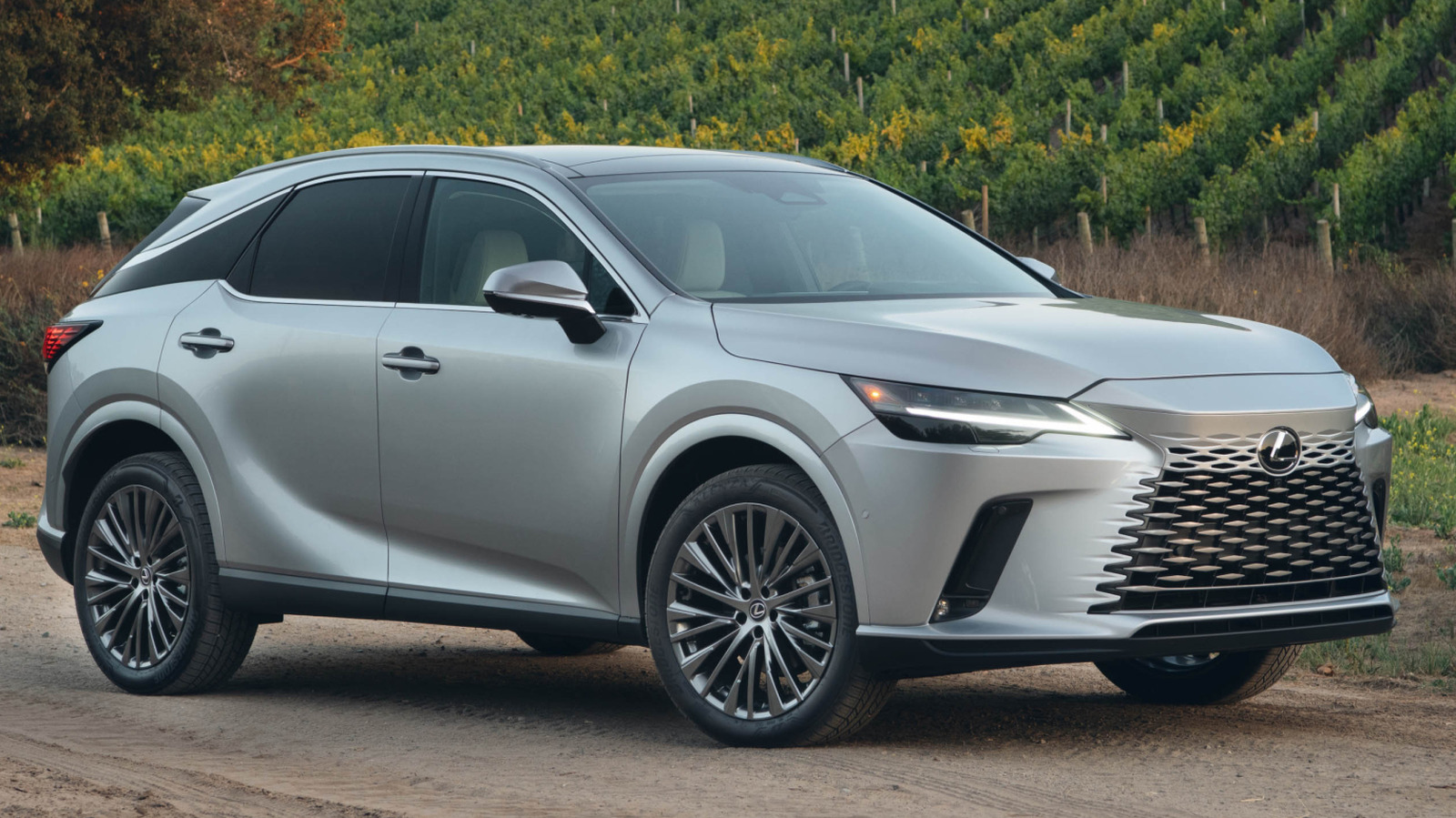


The Lexus RX has been on the road since 1998. Millions have been sold worldwide. And most of the people who own one have no idea what those two letters actually mean.
RX stands for “Radiant Crossover.” Lexus coined the name at the tail end of the 1990s, choosing “radiant” to symbolize a “bright new future” as the millennium approached. The X simply means crossover. Twenty-seven years later, the branding hasn’t budged.
The name is the least of the contradictions baked into the RX’s identity. Those three-digit numbers trailing the letters used to mean something tangible. The original RX 300 had a 3.0-liter V6 under the hood.
Clean, logical, easy to decode. Today’s RX 350 runs a turbocharged 2.5-liter four-cylinder. The RX 500h F Sport Performance, which you might reasonably assume nods to a 5.0-liter V8, actually pairs a turbo 2.4-liter engine with hybrid hardware to produce 366 horsepower.
The numbers have become aspirational fiction, detached from displacement. Lexus isn’t alone in this practice. BMW and Mercedes have been doing it for years, quietly inflating badges while downsizing engines.
But it does make the whole naming exercise feel more like marketing archaeology than engineering transparency.
And the naming convention runs deep across the entire Lexus portfolio. The entry-level LBX is “Lexus Breakthrough Crossover.” The NX means “Nimble Crossover.” The TX is “Touring Crossover.” The GX is “Grand Crossover.”
The flagship LX is “Luxury Crossover.” That’s a lot of crossovers for a brand that also sells body-on-frame trucks capable of serious off-roading. Calling the LX, which shares its platform with the Toyota Land Cruiser, a “crossover” is generous at best.
The sedan side is more straightforward. IS stands for “Intelligent Sport,” ES for “Executive Sedan,” LS for “Luxury Sedan.” The LC is “Luxury Coupe,” the LM is “Luxury Mover,” and the F and F Sport designations reference Fuji Speedway, where Lexus tunes its performance models.
The fully electric RZ translates to “Radiant Zero,” zero emissions being the operative word. It shares the RX’s “Radiant” prefix, linking two very different powertrains under one thematic umbrella.
Meanwhile, spy photographers have caught what appears to be a GR-tuned RX in development. Reports suggest this variant could wear a Morizo RR badge, carry Gazoo Racing’s blessing, and push as much as 600 horsepower from a hybrid system built around a 2.0-liter engine and dual electric motors. A lower, wider stance would complete the transformation from radiant crossover to something with genuine teeth.
If that version shows up with 600 horses from a 2.0-liter base engine, the gap between what the badge says and what the car actually is will stretch further than ever. Lexus chose these names nearly three decades ago to project a polished, forward-looking image. The vehicles have evolved dramatically since then, but the names have stayed frozen in 1998.
A refreshed RX is already confirmed for 2028, the sixth generation of a nameplate that has become Lexus’s global bread and butter. Whether buyers care that they’re driving a “Radiant Crossover” is debatable. Most just know it as the RX, and that recognition alone might be worth more than whatever the letters were supposed to mean in the first place.



Share this Story