
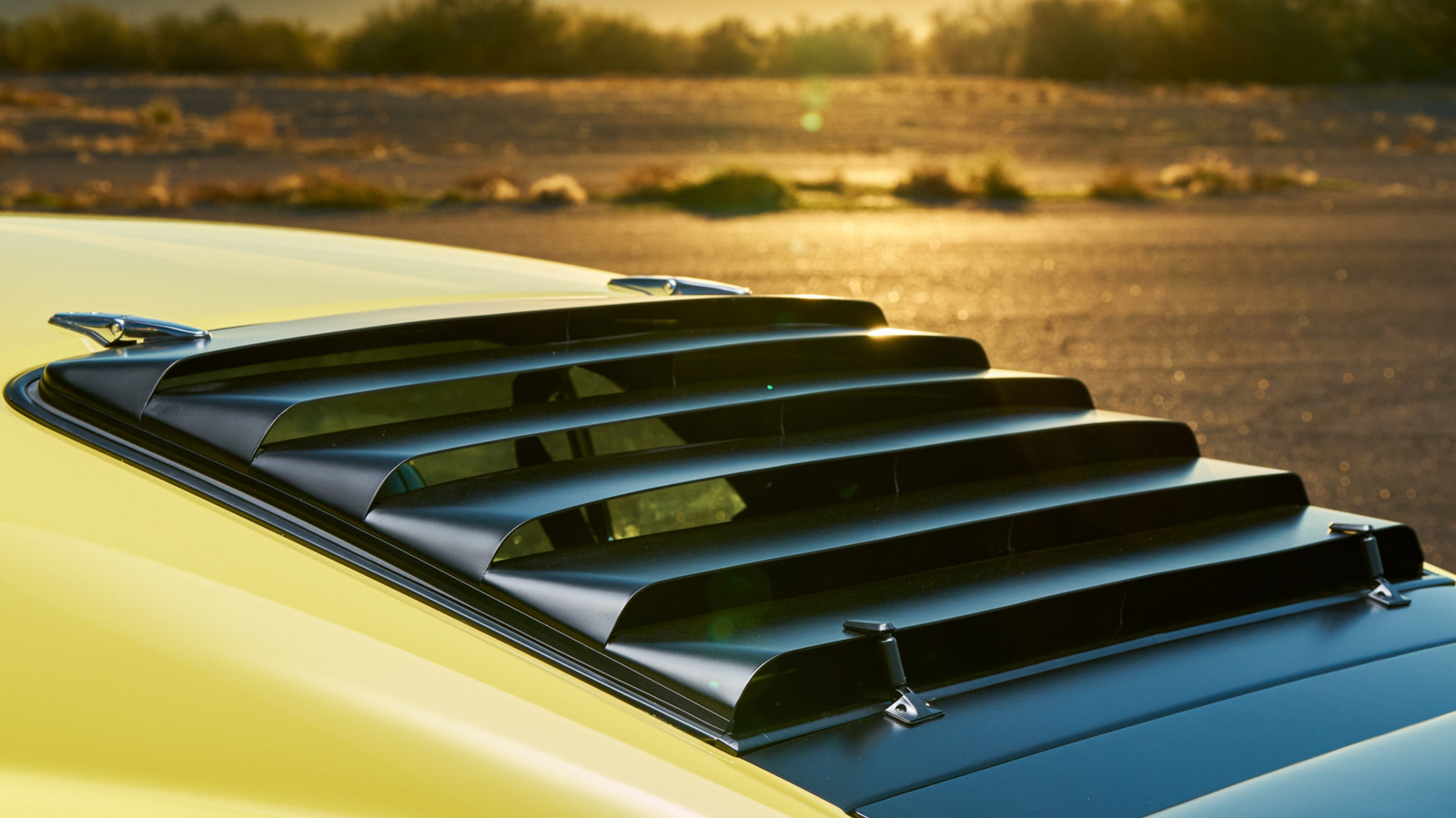


The Lamborghini Miura almost cooked itself. When the mid-engine Italian exotic debuted at the 1966 Geneva Auto Show, a plexiglass window covered its 4.0-liter V12. Lamborghini’s engineers quickly discovered the screen was trapping so much heat it threatened the 350-horsepower engine underneath.
Designer Marcello Gandini swapped the glass for slatted louvers, and a look that would define decades of performance cars was born out of pure thermal necessity.
That origin story tends to get lost in the nostalgia. Most people associate window louvers with American muscle, with Boss 302 Mustangs and second-gen Camaros prowling parking lots at Woodward Avenue. But the slats weren’t decoration first. They solved a problem nobody talks about anymore because air conditioning fixed it.
Fastback muscle cars of the late 1960s had enormous rear windows raked at shallow angles, turning cabins into greenhouses. Air conditioning was an expensive option most buyers skipped. Window tint technology was primitive.
So drivers baked. Louvers acted like venetian blinds for your car, cutting solar heat without killing rearward visibility entirely.
Ford was already experimenting before the Miura arrived. The 1965 Mustang came with fixed metal louvers on its rear quarter windows. By 1969, Ford offered factory “Sports Slats” on Mustangs ordered with the SportRoof fastback body.
A year later, Chrysler answered with louver packages on the Dodge Challenger and Plymouth Barracuda, both using aluminum frames that bolted over the existing glass rather than replacing it.
The aftermarket smelled money. By the mid-1970s, louver kits were available for dozens of models. Japanese coupes became prime candidates.
The Datsun 280Z and Mazda RX-7 wore louvers as comfortably as any Detroit iron, often paired with matching quarter-window slats that gave the cars a bunker-slit aggression. Through the 1980s, louvers remained a staple of the car customization world.
Then they vanished. The 1990s brought widespread window tinting, standard air conditioning, and aerodynamic styling philosophies that treated any add-on panel as drag. Louvers looked like relics from a rougher era, and for about fifteen years, they were.
The comeback has been quiet but steady. Lamborghini still references the Miura’s original solution on its modern Temerario and Revuelto supercars. Chevrolet deploys functional louvers on the C8 Corvette ZR1, a car that generates enough heat from its twin-turbo flat-plane-crank V8 to justify every engineering ancestor’s concern.
The aftermarket has followed suit, selling kits for the Toyota GR86, BMW 4 Series, and just about anything with a fastback profile and an owner who wants that clenched, purposeful look.
What started as an engineering patch on a temperamental Italian exotic became a style statement on American muscle, then a universal aftermarket accessory, then a forgotten trend, and now a factory feature again on some of the most expensive performance cars money can buy. The cycle took sixty years.
Modern cars don’t actually need louvers the way a 1969 Mustang baking in a Texas parking lot did. Climate control is standard. Tinted glass is everywhere.
When Chevy or Lamborghini fits louvers today, the thermal benefit is secondary to the visual signal they send. They say this car takes performance seriously enough to reference the era when keeping cool meant more than adjusting a dial on the dashboard.


Share this Story