
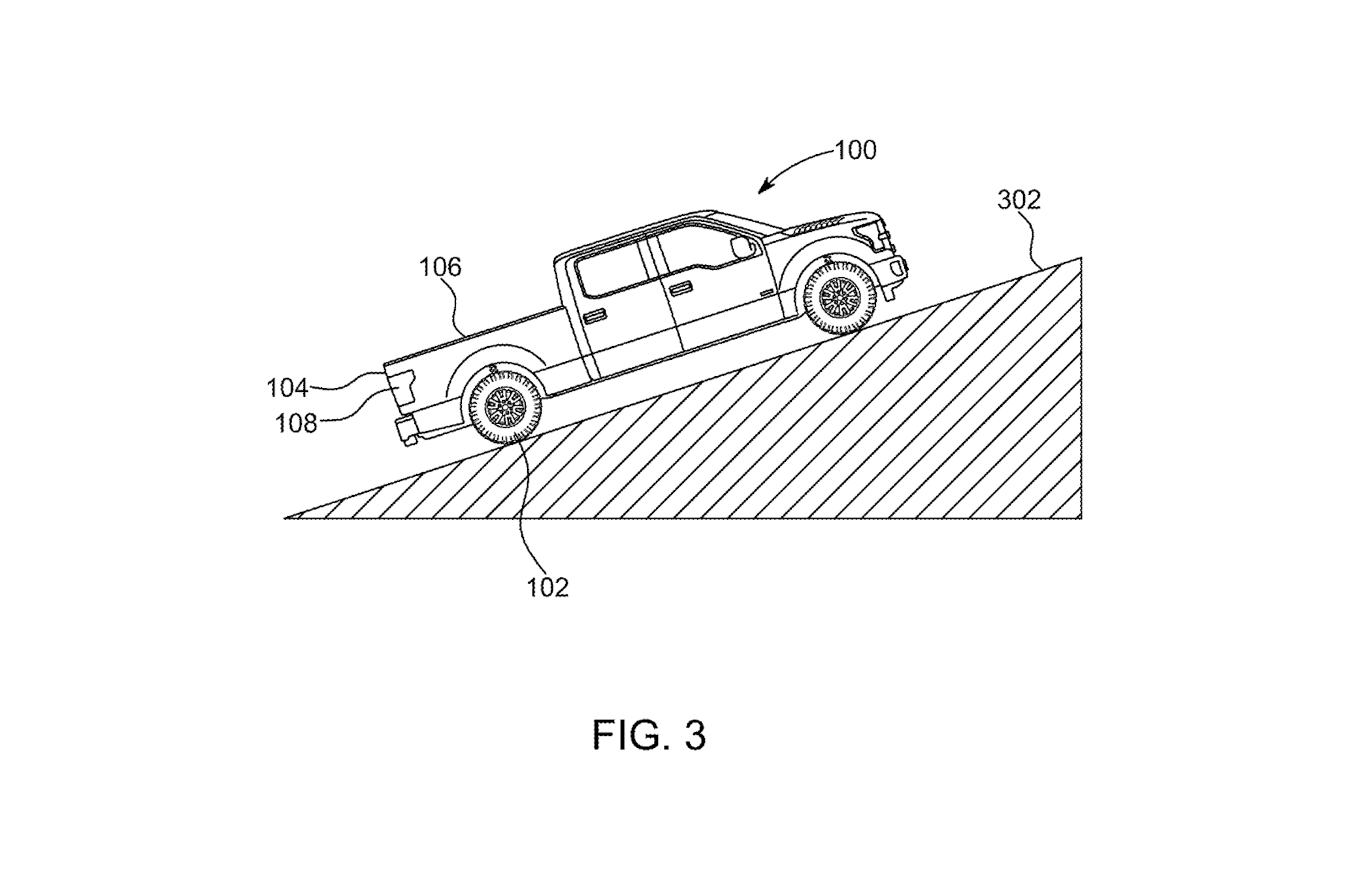


A Ford patent application recently published by the United States Patent and Trademark Office describes a vehicle that could sense suspicious activity and autonomously drive itself to a safer parking spot. Your car, left alone in a lot, would watch its own back.
The system would monitor for threats like a person repeatedly peering into windows or a vehicle circling the lot. If the surrounding environment changed, say a once-crowded parking lot emptied out, the car could decide on its own to relocate. In a simpler version, the vehicle would just suggest a better spot and let the driver handle the actual parking.
But the self-relocation concept is only part of it. Ford’s application spends considerable space on preventing wheel theft, a crime that has plagued owners of newer trucks and SUVs with expensive factory wheels and tires. The patent describes a vehicle parking itself between two immovable objects, like closely spaced walls or other vehicles, to make jack placement impossible. It could also seek out inclines or soft, uneven surfaces where a floor jack would be useless.
Vehicles equipped with air suspension could drop to their lowest ride height after the driver walks away. That would complicate access to the undercarriage, potentially protecting catalytic converters from the sawzall-wielding crews that have turned converter theft into a cottage industry.
Cargo protection gets a mention too. A truck or SUV could back itself against a wall so the tailgate or liftgate physically cannot open. The same principle applies to head- and taillights, which have become theft targets on certain models. Ford envisions letting owners choose priorities before leaving the vehicle: protect the wheels, or protect the cargo area.
The technology required to pull any of this off already exists in pieces. Ford and its competitors have invested billions in autonomous driving systems, and most modern vehicles already carry cameras, radar, and ultrasonic sensors. Connecting that hardware to a self-preservation algorithm is less of a technical leap than a philosophical one. Cars have always been passive objects once parked. Ford is imagining them as active participants in their own security.
Patent applications are cheap speculation, though. Automakers file thousands of them every year, and most never see production. Ford itself has recently patented concepts for a truck you can move by pushing on it and a system that lets parked cars dodge oncoming crashes. Filing a patent costs a few thousand dollars and protects an idea. Building it into a $45,000 truck is a different conversation entirely.
There are obvious questions the patent does not address. Liability sits at the top of the list. If a car autonomously relocates and hits a pedestrian or another vehicle, who pays? Insurance frameworks do not currently account for a parked car that decides to move. Local traffic laws generally do not envision unoccupied vehicles driving themselves across parking lots.
Then there is the practical matter of a driver returning to an empty parking space. Ford would presumably need a robust notification and location-sharing system so owners can find their relocated vehicle. Losing your car in a parking garage is already a common enough frustration without the car actively changing positions.
Still, the underlying problem Ford is trying to solve is real. Wheel theft, catalytic converter theft, and smash-and-grab break-ins cost owners and insurers hundreds of millions annually. The question is whether the solution creates more problems than it prevents. Ford has not commented on any production timeline, and the patent remains just an application.
Share this Story