
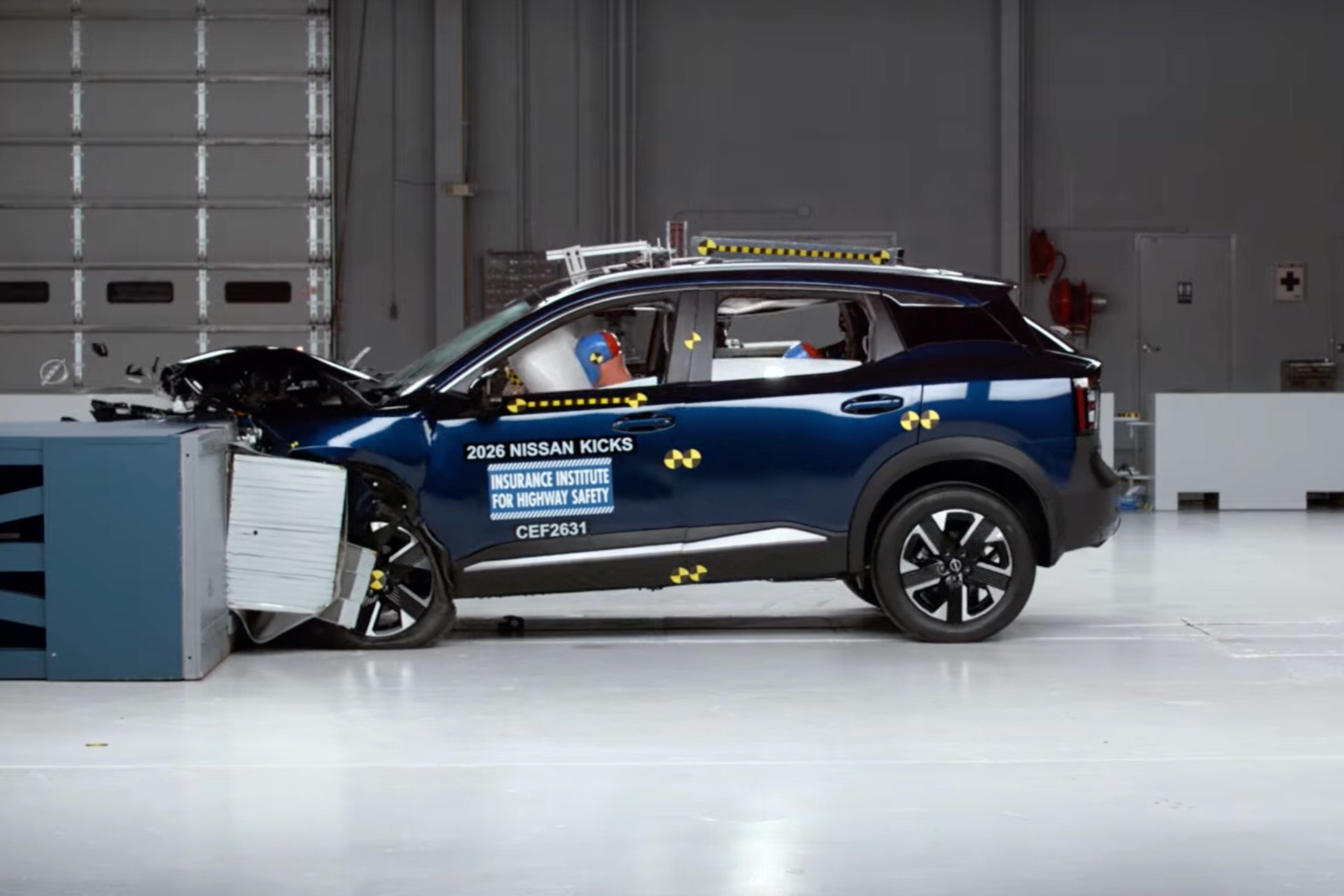


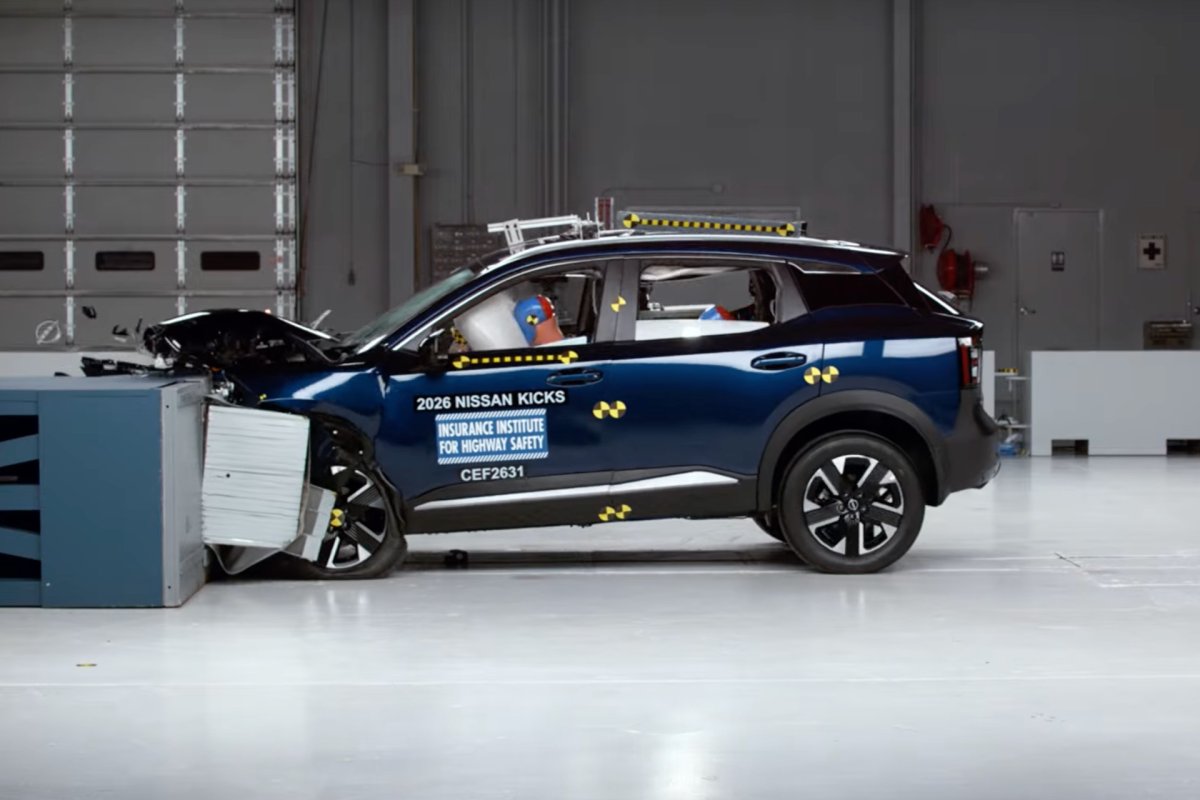
The Insurance Institute for Highway Safety just ran five popular crossovers through its updated moderate overlap front crash test, and four of them came up short. The Nissan Kicks was the sole survivor, earning a 2026 Top Safety Pick award. The Audi Q3, Chevrolet Trailblazer, and Toyota RAV4 in both hybrid and plug-in hybrid form all failed to qualify.
The test itself isn’t new. IIHS updated the parameters of its moderate overlap front crash test back in 2022, adding stricter evaluation of rear-occupant safety. A car hits a barrier at 40 mph with only a portion of the front end making contact. Since the revision, it has chewed through models that pass everything else with ease.
The Kicks is an interesting case. When the current generation debuted for the 2025 model year, it earned the lowest possible “Poor” rating in this same test. Nissan went back to work, modifying the rear seat belts on vehicles built after June 2026. When retested, the Kicks jumped all the way from “Poor” to “Good,” qualifying it for Top Safety Pick status.
The redesigned 2026 Audi Q3, a fresh vehicle from a premium brand, landed a “Poor” rating in the moderate overlap front test. It scored “Good” in every other category. A “Good” in the moderate overlap front test is a prerequisite for any safety award, and the Q3 didn’t come close. That rating also applies to 2027 models.
Toyota’s completely redesigned RAV4, one of the best-selling vehicles in America, stumbled in the same place. The standard hybrid version managed an “Acceptable” score. The plug-in hybrid did worse, earning a “Marginal.” Two different powertrains, two different scores, neither good enough. For a vehicle that sells in the hundreds of thousands every year, that gap between the RAV4’s reputation and its crash performance is worth watching.
The Trailblazer had the roughest outing of the bunch. Beyond its “Poor” rating in the moderate overlap front test, Chevy’s small crossover also drew low marks for headlights and front-crash prevention technology. Multiple failures across multiple categories put the Trailblazer in a different conversation entirely from the others, which at least demonstrated competence everywhere else.
The IIHS operates differently from the federal government’s NHTSA. It answers to insurance companies, not Congress. It can update test protocols without legislative approval, which means automakers face a moving target. That dynamic creates exactly the kind of pressure that pushed Nissan to fix the Kicks in under a year. A “Poor” rating showed up, engineers addressed the rear seat belt system, and the vehicle was retested with dramatically better results.
Audi, Toyota, and Chevrolet now face the same choice. The data is public, and the deficiency is specific. Nissan has already demonstrated that a fix is possible between model years without a full redesign. The question is how long the other three will take to respond, and whether buyers paying attention to these ratings will wait around for them to do it.

Share this Story