
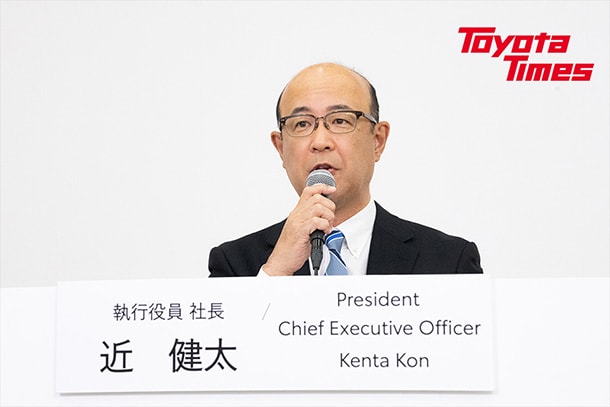


Kenta Kon has been Toyota’s president for barely a month, and he’s already drawing a line between the people who build cars and the people who manage spreadsheets. At his first financial results briefing on May 8, the company’s 13th president delivered a message that read less like a corporate introduction and more like a manifesto for gutting middle management complacency.
“Instead of just ‘managing’ numbers on paper, we actually need to reduce costs at our worksites,” Kon said. The distinction was deliberate. He wants Toyota’s administrative ranks to stop overseeing the front lines from a distance and start getting their hands dirty on them.
Kon took the job in April, succeeding Koji Sato, who shifted to vice chairman. He inherited a company navigating U.S. tariffs, Middle East instability, and an EV transition that has the entire industry spending money it may never recoup. Vice President Yoichi Miyazaki addressed those external headwinds at the same briefing, but Kon chose to talk about something else entirely: people.
His pitch is simple. Toyota’s competitive advantage lives on production lines, not in strategy decks. He cited the Toyota Production System, the kaizen culture, the problem-solving discipline baked into factory work.
“On the front lines, there is no place to hide,” he said. “That’s precisely what gives rise to a strong desire to improve the situation.”
The subtext is unmistakable. Somewhere between Toyota’s rise to the world’s largest automaker and today, layers of management drifted away from the genba—the shop floor, the place where reality lives. Kon wants them back.
He framed the last 17 years under Akio Toyoda and Koji Sato as a period of building Toyota’s foundation as a global, full-lineup manufacturer pursuing multiple powertrain pathways. Carbon neutrality, hydrogen, AI, robotics, Woven City—all still on the table. Kon isn’t canceling bets. He’s saying the company needs more capable people to execute them.
I will increase the number of people who can build ever-better cars,” he said. “I believe that doing so is the engine for Toyota’s sustainable growth and my mission.”
There was a revealing anecdote about braking. Kon said Chairman Toyoda once told him during a driving lesson that brakes exist to help you go fast—without good braking, you can’t step on the accelerator. For Kon, the accelerator means growth investments, and the brake is financial discipline, the thing that lets you keep pushing without spinning out.
He recalled his time as one of Toyoda’s secretaries in 2009, when the global financial crisis threw Toyota into the red. “Being in the red means I can’t let anyone take on new challenges,” Toyoda had told him. Kon watched his boss kill projects and disappoint people.
The lesson stuck: sustainable growth isn’t a slogan. It’s the difference between being able to fund the future and having to amputate it.
That memory now shapes his management philosophy at a moment when the external environment is, by his own admission, “increasingly uncertain.” Rather than retrench, he wants to create room for Toyota’s 5.5 million workers across Japan and its global partners to take risks. “My role is to encourage colleagues to take on challenges without fear of failure,” he said.
It’s a bet that Toyota’s real moat isn’t its battery strategy or its hydrogen dreams. It’s the relentless, unglamorous work of training people who can think critically on a factory floor where the line stops when something breaks and nobody gets to pretend the problem doesn’t exist.
Whether Kon can actually drag Toyota’s administrative class out of its comfort zone is another question. Bureaucracies don’t reform themselves willingly, and Toyota’s is one of the largest on earth. But the new president has named his target clearly. The boardroom isn’t where Toyota wins. The genba is.


Share this Story