
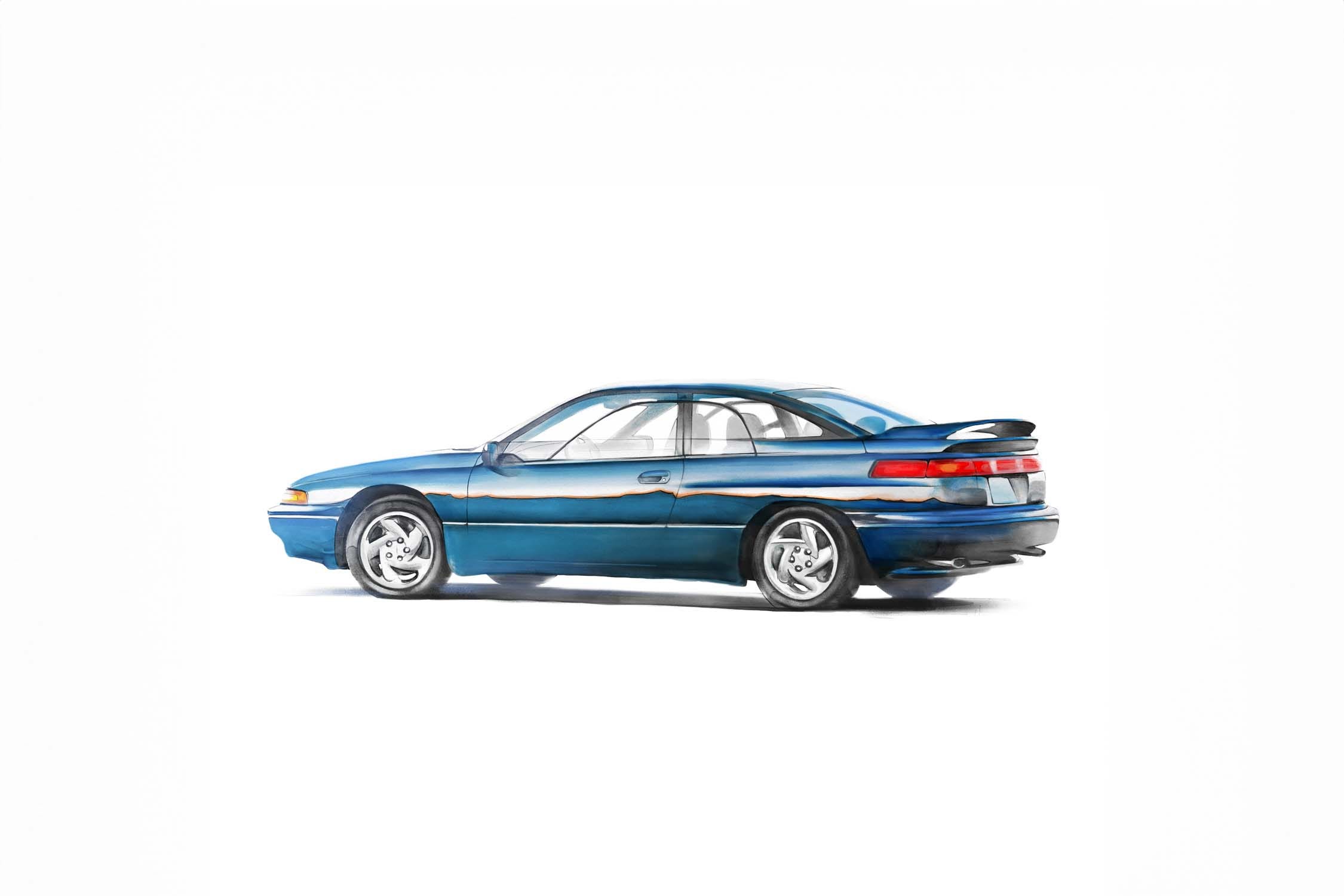


Subaru hoped to sell 10,000 SVXs a year in the United States. It moved 3,667 in 1992 and 3,859 in 1993. The math never got better.
By 1997, the car was dead, a gorgeous anomaly from a company that couldn’t convince American buyers to spend $29,000 on a flat-six grand tourer wearing the same badge as the Justy.
John Phillips, writing in the March/April 2026 issue of Car and Driver, resurrects the 1992–97 SVX in the latest installment of his “Best Odds” series, a column dedicated to cars that were neither the prettiest, quickest, nor most expensive — but were willfully peculiar and intractably idiosyncratic. The SVX qualified on every count.
Styled by Giorgetto Giugiaro’s Italdesign — at considerable expense to a company not exactly swimming in image capital — the SVX carried a design trick that became its calling card and, arguably, its curse. The side doors were too long and shallow to accept the sweeping glass Giugiaro envisioned, so his team inserted a smaller, operable window within a larger, fixed pane. The result was a greenhouse that curved into the roofline, creating what one Car and Driver editor called “a bright and joyful workplace.”
Toll collectors grinned. Everyone else called it the Batmobile.
Under the skin, the SVX ran a 3.3-liter flat-six producing 230 horsepower — the precursor to the last boxer six Subaru would offer until the 2019 Ascent era. At 3,614 pounds, it was no drag strip terror. The sprint to 60 took 7.6 seconds.
But the car’s real talent was swallowing interstate miles at 80 mph with the engine loafing at 2,700 rpm. Phillips once picked one up in New Jersey after lunch and drove it to Ann Arbor without quite meaning to.
The 4EAT automatic transmission used a clutch pack to split torque between the axles, technology that was ahead of its price point. Car and Driver’s long-term test covered 30,000 miles, including a memorable ice-traction exercise where Phillips watched the SVX hurtle backward at 60 mph with the throttle still cracked open. After all of it, the car was rattle-free, “as if built from a submarine’s hull.”
Its ride and handling drew comparisons to the Lexus SC300/400 and Toyota Supra. It made the Dodge Stealth R/T and Mitsubishi 3000GT VR-4 feel childish. Steve Thompson, one of the magazine’s sharpest evaluators, needed only 10 minutes behind the wheel before declaring it a winner.
None of that mattered at the dealership. Subaru in the early 1990s was still the company that sold the XT — a car Giugiaro’s own staff likely mocked over lunch — and the Justy, a vehicle Phillips compares to a Japanese Citroën 2CV. Asking customers to cross-shop a $29,000 Subaru coupe against established luxury and sport brands was a bridge the product could build but the badge could not.
Phillips suspects the SVX was someone’s singular vision inside Subaru, a bucket-list project pushed through by a figure with tenure, talent, and tenacity — a Bob Lutz type who believed a cushy, highway-devouring, deeply weird two-door GT would find its audience. It didn’t, and Subaru retreated to the all-wheel-drive wagons and sedans that would eventually make it a suburban staple.
The SVX now occupies that peculiar space reserved for cars the industry failed to appreciate in real time. Clean examples are scarce. The flat-six is a mechanical jewel. The windows still stop people cold.
Subaru never tried anything like it again. The company learned the lesson the market taught: be practical, be predictable, sell Outbacks by the container ship. The SVX proved Subaru could build a legitimate grand tourer. It also proved that proof, in this business, is never enough.
Share this Story