
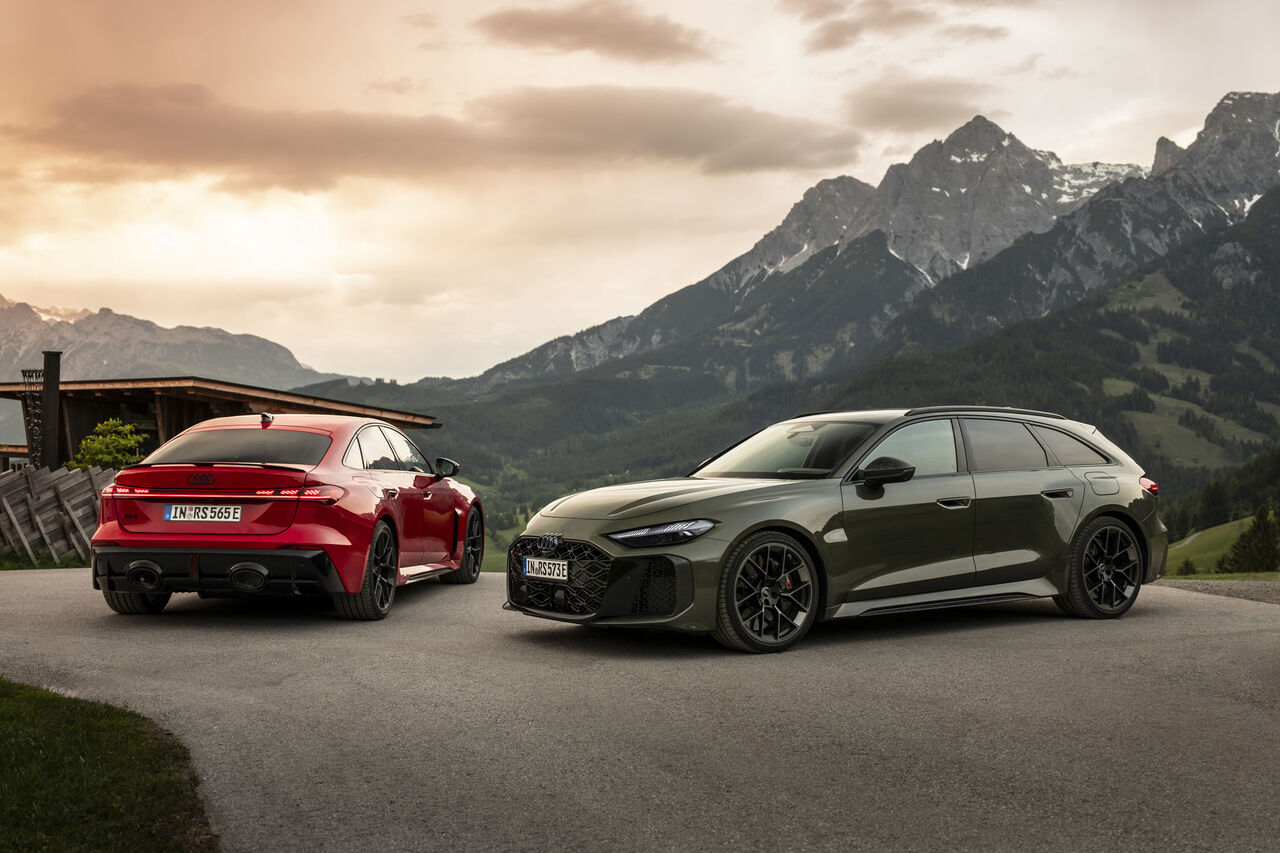


The RS badge just got a power cord. Audi Sport’s new RS 5, now open for European orders and arriving at the end of June, becomes the brand’s first RS model built around a plug-in hybrid powertrain. The twin-turbo V6 remains, but it now shares duties with an electric motor in what Audi calls its “Power PHEV” configuration.
That’s a big shift for a nameplate that has spent two decades defining itself by the snarl of its engines and the grip of its quattro system. The RS 5 has always been the entry point to Audi Sport’s serious hardware. Bolting on a battery and an e-motor changes the character of the car in ways no amount of corporate back-patting about “cross-site collaboration” can obscure.
The numbers tell an interesting story. Weighted combined fuel consumption for the RS 5 Sedan lands between 3.8 and 4.3 liters per 100 km, with CO2 emissions of 86 to 98 g/km. That’s the kind of figure that keeps fleet managers happy and avoids punitive taxes across Europe.
But run that battery dry and the combined consumption balloons to 9.5 to 10.0 liters per 100 km, dropping the car into CO2 class G — the worst possible rating. The Avant wagon is marginally thirstier across the board, as expected.
Audi wrapped the announcement in a story about the engineering partnership between its Neckarsulm development center in Germany and Audi Hungaria’s facility in Győr. Neckarsulm handles powertrain design and validation. Győr picks up continuous engineering and manufacturing after pre-production sign-off.
It’s a well-oiled arrangement that has been running for years across multiple engine programs. “We don’t have to reinvent ourselves every time,” said Sascha Srebacic, head of engine mechanics at Neckarsulm. But the real reinvention here isn’t organizational — it’s philosophical.
The new quattro system features what Audi calls Dynamic Torque Control, using electromechanical torque vectoring to distribute power between the rear wheels. Precise rear-axle torque management can transform the way a car rotates through corners. It suggests Audi Sport is using electrification to chase handling gains, not just regulatory compliance.
Still, there’s a tension baked into this car that no handover workshop between Neckarsulm and Győr can resolve. Plug-in hybrids carry extra weight — batteries, electric motors, power electronics, cooling systems — and extra weight is the enemy of everything a performance car tries to do. Audi hasn’t released curb weight figures yet, and when it does, that number will reveal more about the RS 5’s true character than any fuel consumption statistic.
The timing is notable too. AMG has gone hybrid with its C 63 S E Performance, swapping a V8 for a turbocharged four-cylinder plus electric motor, and the reception has been polarizing. BMW’s M division is threading a similar needle. Every German performance brand is navigating the same regulatory corridor, and each is making different compromises.
Audi’s choice to keep the V6 — rather than downsizing to a four-cylinder — may prove to be the smarter play for RS loyalists who will tolerate electrification but draw the line at cylinder deletion. Srebacic says the car puts a smile on your face. It probably does.
But the RS 5 now has to answer a question its predecessors never faced: Can a performance car carry the weight of two powertrains and still feel like it was built purely for the driver? European customers will start finding out by summer’s end.


Share this Story