
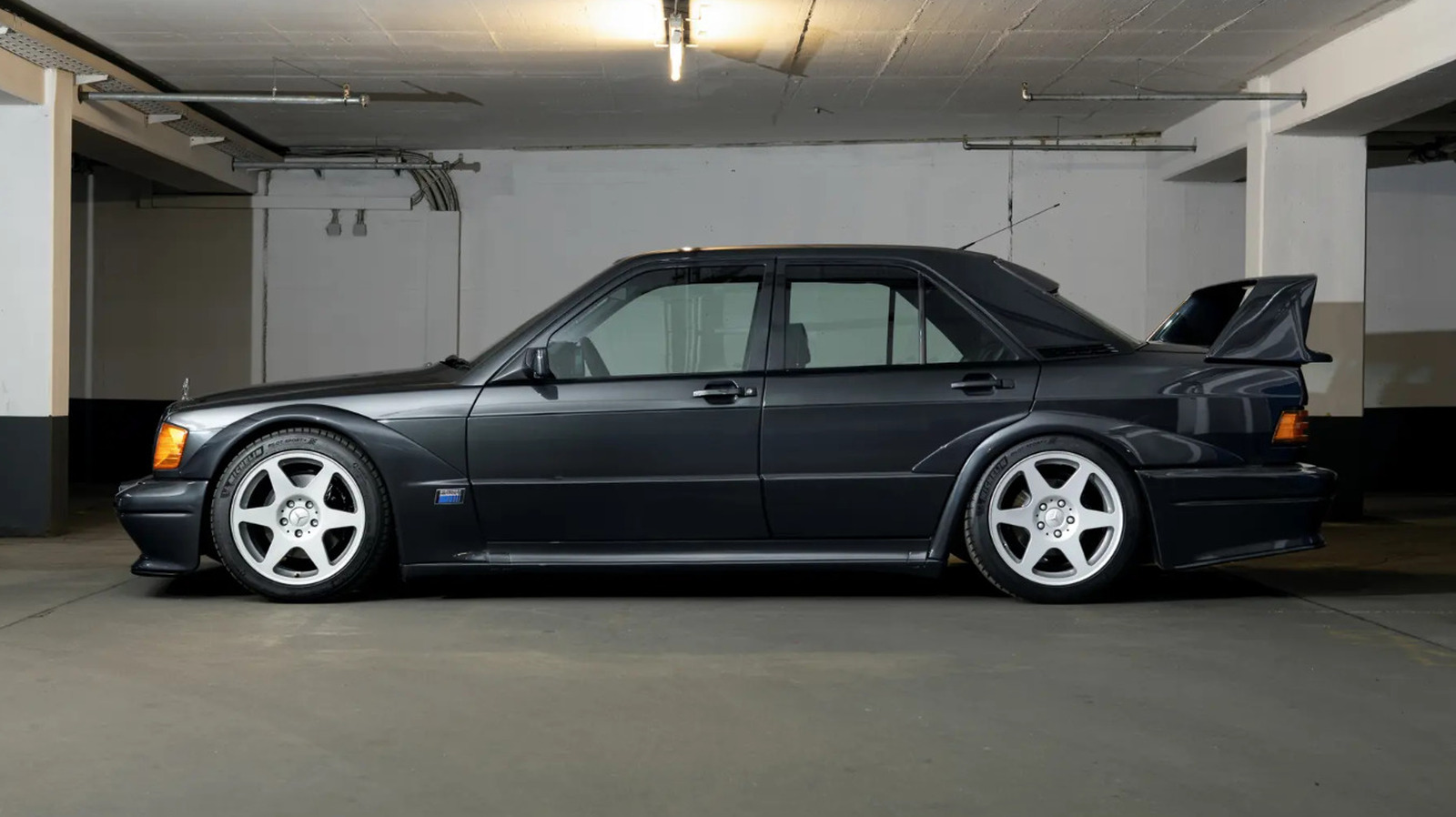


Unit 283 of 502 rolls across the auction block in Monaco on April 25, and it carries a price estimate between $305,000 and $410,000. That buys you a 1990 Mercedes-Benz 190E 2.5-16 Evolution II, a car powered by a Cosworth-developed four-cylinder that screams to 7,600 RPM and makes just 232 horsepower. In 2026, that combination sounds like a contradiction. In 1990, it was the sharpest weapon in touring car racing.
RM Sotheby’s is offering this Blue Black Metallic Evo II at its Monaco sale, and the car tells a story that Mercedes-Benz seems incapable of writing anymore. This was a homologation special, one of exactly 502 road cars built to identical specification so Stuttgart could legally go racing in Deutsche Tourenwagen Meisterschaft. The street car existed to validate the race car, and the race car went on to win the DTM Constructors’ titles in 1991 and 1992.
The engineering is a masterclass in purposeful restraint. Mercedes took its W201 chassis, the compact sedan that was the entry point to the brand, and changed nearly everything. Wider track, stiffer structure, lighter construction, Brembo brakes, wider wheel arches, stickier rubber, a dogleg manual gearbox, and that towering rear wing that looks absurd on a three-box sedan and absolutely perfect on this one.
The engine tells the real story. Mercedes’ M102 four-cylinder started life as a 2.3-liter eight-valve workhorse making 130 horsepower, the kind of engine designed to run forever and inspire nobody. Cosworth developed a lightweight aluminum head with sixteen valves and, for 1990, bored the block out to 2.5 liters with a shorter stroke. The bigger displacement didn’t add peak horsepower on paper, but it reshaped the torque curve, making the car faster where it counted: mid-corner, on exit, lap after lap.
Strip 700 pounds of luxury out of the road car and you had the race machine. The street version kept enough of the track hardware to satisfy the homologation rulebook while remaining a drivable, registered Mercedes-Benz. That balance is exactly what modern manufacturers have abandoned in favor of 700-horsepower sledgehammers that overwhelm with force rather than finesse.
This particular car was delivered new to Switzerland and stayed there for sixteen years, averaging about 3,100 miles annually. Then it essentially stopped moving. In the last twenty years it has covered roughly 1,000 kilometers total, averaging 36 miles per year. A full mechanical and cosmetic restoration beginning in 2021 consumed three years, and the odometer reads 80,598 kilometers.
The estimate seems aggressive until you consider scarcity. Five hundred and two cars, all the same color, all the same spec, built three and a half decades ago. The survivors in restored condition are genuinely rare, and DTM nostalgia has only intensified as the series itself has drifted through multiple identity crises since.
Mercedes today builds hundreds of thousands of crossovers in various shades of silver and gray. The AMG division bolts big turbos onto everything and calls it performance. There is no racing series on earth compelling enough to make Stuttgart produce a street-legal homologation car with a screaming naturally aspirated four-cylinder developed by an outside engineering house. The corporate calculus no longer permits that kind of beautiful insanity.
The Evo II sits at a peculiar intersection: too expensive for most enthusiasts, too raw for most collectors who spend at this level. Whoever wins it in Monaco will own a car that demands to be driven hard, a machine that was literally built to race and only grudgingly made street-legal. At 36 miles a year, it has been treated like sculpture. It deserves better than that.
Share this Story