
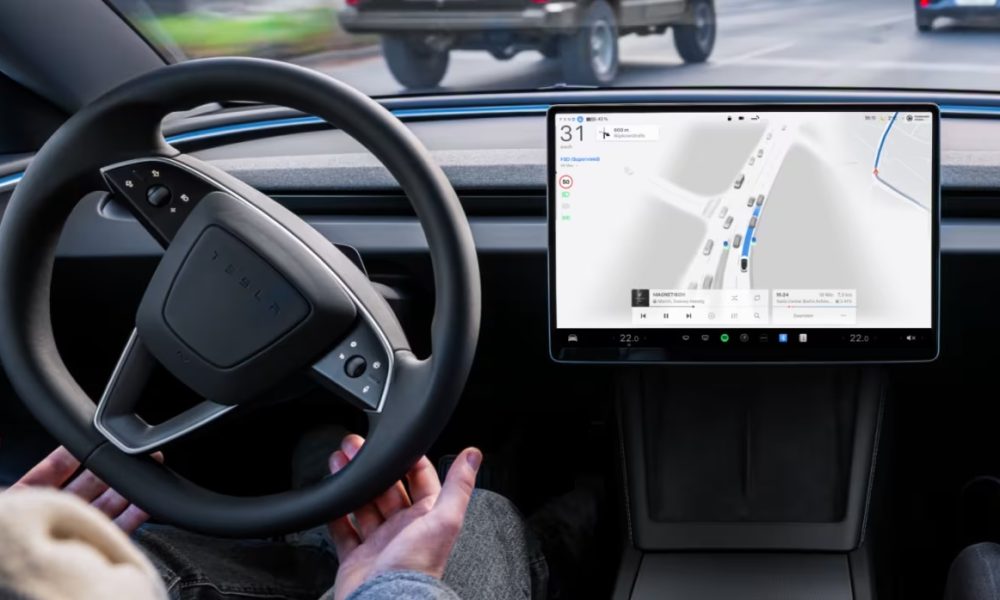


Ashok Elluswamy, Tesla’s AI lead, responded to a near-miss video this week by promising that Full Self-Driving version 15 will deliver “even earlier prediction of hazards, even faster reaction time and overall significantly better safety and collision avoidance.” It was a casual reply on social media. It was also the first public preview of what the company considers its next major architectural leap.
Internally, v15 is described as running a much larger neural network with tighter integration between the prediction and control layers. Some early v15 code is already running in Tesla’s robotaxi operations. A feature called Automatic Collision Evasion has started rolling out to customer cars, letting the driving stack intervene even when a human is behind the wheel in manual mode.
The promise sounds clean. The data behind it is messier.
Tesla’s own North American Vehicle Safety Report shows vehicles with FSD engaged traveling roughly 5.1 million to 5.7 million miles between airbag-deployment crashes. The company compares that to a U.S. average of about 699,000 miles per equivalent event, a ratio it frames as roughly seven times safer.
But that U.S. average mixes crash definitions and driving conditions in ways that inflate the gap. A tighter comparison, one that uses the same Tesla fleet driven manually with active safety features like automatic emergency braking, puts the interval at about 2.1 million miles per major collision. Against that baseline, FSD’s advantage drops to roughly 2.4 to 2.7 times fewer severe crashes. Independent researchers have long argued this is the honest yardstick.
European numbers released this year tell a similar story. Tesla reported FSD as 3.5 times safer than manual driving in the Netherlands and 4.1 times fewer collisions than manually driven Teslas with active safety across more than 100 million kilometers in five approved countries. Better than human, yes. Seven times better? Not by the most rigorous count.
NHTSA’s Standing General Order data adds another wrinkle. Tesla still accounts for the large majority of U.S. Level 2 driver-assist crash reports. The company’s standard defense is fleet size, and it is a fair point, since Tesla logs far more assisted miles than any competitor. But volume alone does not explain away every incident, and it does not silence critics who want third-party validation rather than self-reported telemetry.
What Elluswamy is really selling with v15 is a trajectory. Each major version is supposed to widen the margin between system and unaided human. Tesla’s same-car data does show lower rates of automatic emergency braking interventions and harsh maneuvers when FSD is engaged, suggesting the software drives more smoothly and predictably than most owners do on their own.
The tension is that Tesla keeps asking the public to trust its internal scoreboard while resisting the kind of independent, standardized testing that would settle the argument. Every version ships with better numbers in Tesla’s reports. Every version also ships before regulators have built a framework to verify those numbers against a common benchmark.
One owner’s year-long experience offers a ground-level data point. After logging 13,000 miles on FSD v14 and letting the system handle 75 percent of his driving, he describes reduced anxiety, fewer stressful moments, and a car that made city driving and parking feel routine. Anecdotes are not crash statistics, but they explain why Tesla’s customer base keeps opting in.
v15 will arrive promising a bigger neural network and faster reflexes. Whether it delivers two and a half times safer or seven times safer than a human depends entirely on which human, and which spreadsheet, you choose to believe.
Share this Story