
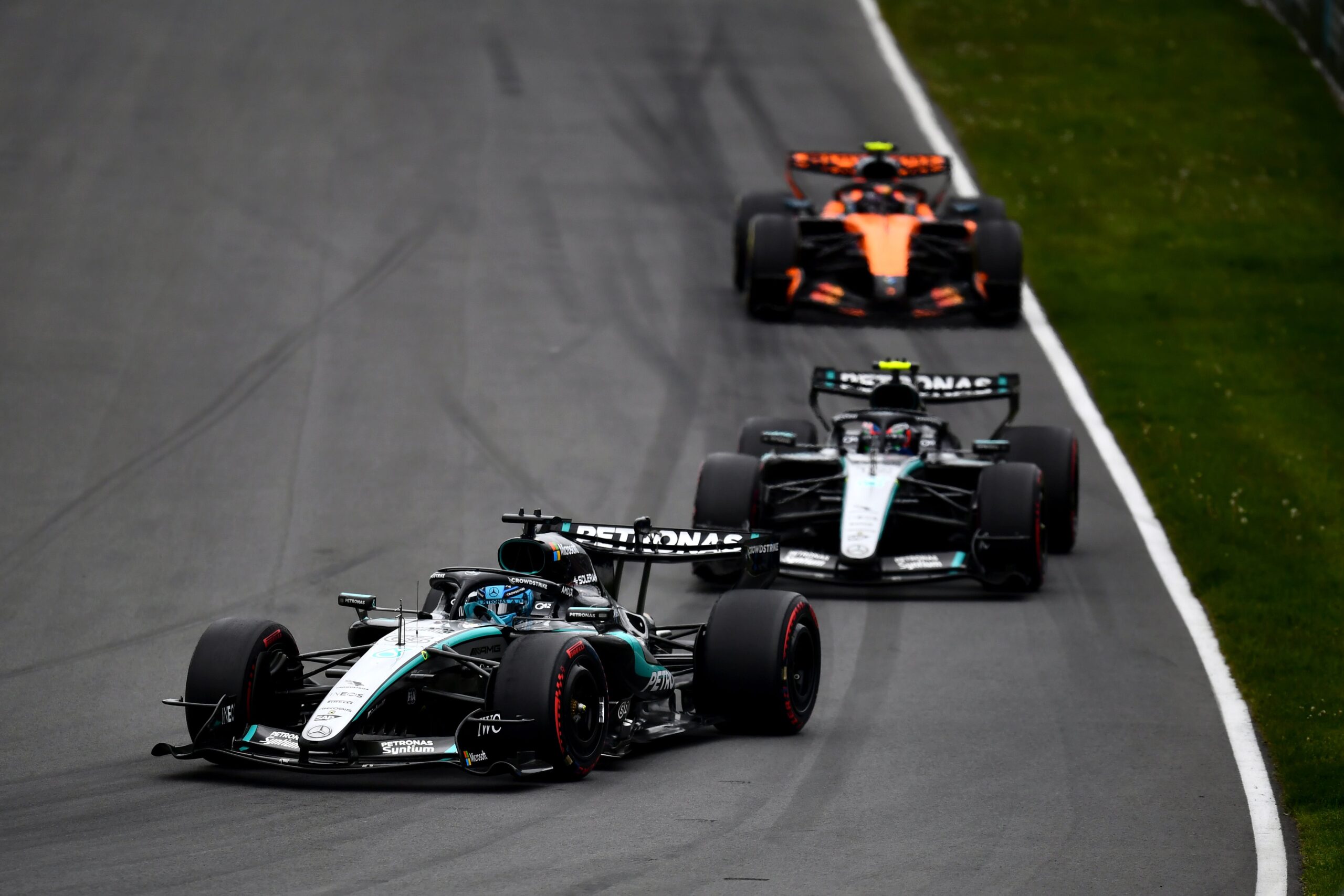


George Russell was leading the Canadian Grand Prix on Sunday when it all went sideways — literally. A trip off track at the hairpin on lap 30 ended with a dead power unit, a thrown headrest, and a £5,000 fine that stings far less than the championship points he left on the table.
The first 30 laps in Montreal belonged entirely to Mercedes. Russell and teammate Kimi Antonelli were in a class of their own, swapping the lead multiple times in the kind of intra-team knife fight that makes team principals age in dog years. The W17 has been the car to beat in 2026, and the two silver arrows were proving it again, pulling away from the field while trading haymakers.
Then Russell went wide defending against Antonelli into the same hairpin that caused friction between the pair during Saturday’s sprint race. The excursion killed his power unit. Race over.
What followed was pure, unfiltered frustration. With the virtual safety car deployed, Russell ripped his head restraint from the cockpit and hurled it onto the track. It was the kind of moment that looks awful on replay and worse in a stewards’ room.
The stewards summoned him after the race. Russell told them he was embarrassed, acknowledged the headrest throw set a poor example, and offered to make a public apology. They handed him a 12-month deferred fine of £5,000 — a slap on the wrist dressed up in official language.
The real punishment is in the standings. Russell came to Montreal trailing Antonelli by 18 points in the World Drivers’ Championship. A win would have cut that to 11. Instead, with Antonelli extending his victory streak to four consecutive Grands Prix, Russell could find himself staring at a 43-point deficit. That’s not a gap — that’s a canyon forming in the first half of the season between teammates driving identical machinery.
Russell wasn’t the only driver to suffer mechanical heartbreak on Sunday. Defending champion Lando Norris retired with a technical failure roughly 10 laps later. McLaren had the chance to bring him in early when problems surfaced, but the team and driver gambled on staying out. The car died in a runoff zone.
Norris walked back to the paddock and found Russell already there, both men victims of the brutal reliability lottery that the new 2026 power unit regulations have introduced. Two of the grid’s most talented drivers, parked before the checkered flag, watching the rest of the field circulate on monitors. That’s the cruel arithmetic of modern Formula 1 — speed means nothing if the machinery underneath you quits.
For Mercedes, the weekend was a study in contradictions. The W17 is clearly the fastest car on the grid. Russell took pole, won the sprint race, and Antonelli won the Grand Prix to make it four straight victories. The team is dominant, but dominance with a fragile power unit is a dangerous thing, and Russell’s fraying patience is starting to show in ways that cost him more than pocket change.
Throwing a headrest onto a live circuit, even under VSC, is reckless. Russell knows it. The stewards know it. The fine is irrelevant. The image of a driver losing composure while his teammate keeps winning is the story Mercedes has to manage now. Antonelli is pulling away, and Russell is pulling parts off his car.


Share this Story