
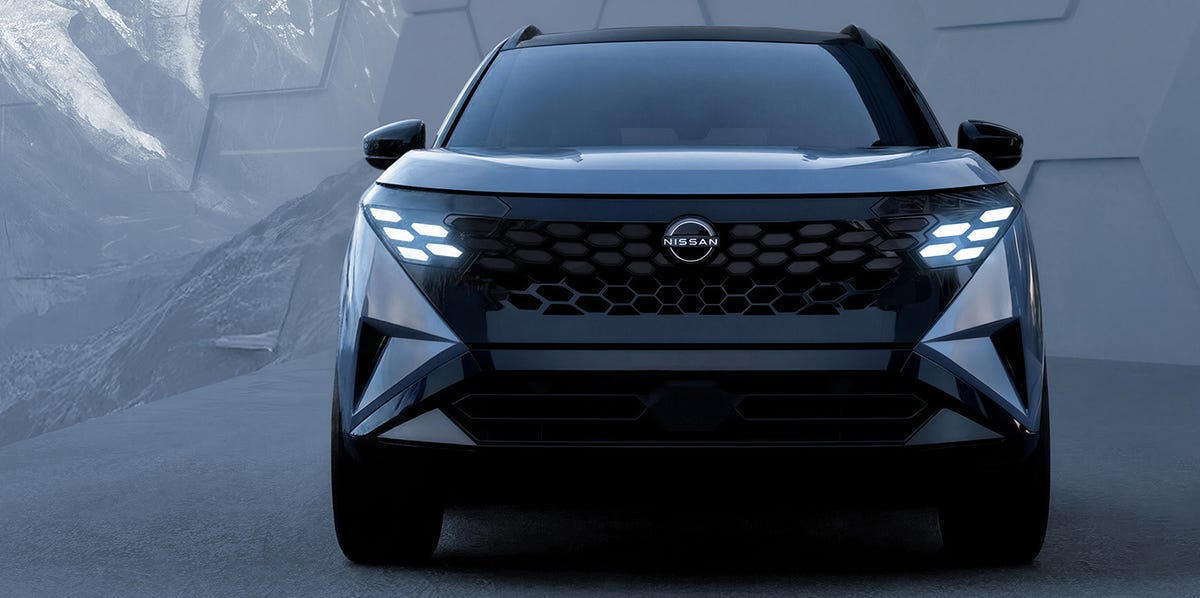


Nearly four million Rogues have been sold in the United States since the nameplate launched in 2000. Now Nissan is tearing up the playbook for its best-seller, launching the fourth-generation 2027 Rogue exclusively as a hybrid when it arrives in showrooms late this year. No gas-only option at the door.
That’s a gutsy move for a company that desperately needs one.
The new Rogue will use Nissan’s e-Power series-hybrid system, a technology the company has sold globally since 2016 in nearly two million vehicles but has never brought to the American market. Unlike conventional hybrids from Toyota and Honda, e-Power uses the gasoline engine purely as a generator. Only the electric motors turn the wheels. Think of it as an EV with its own onboard power station — no plug required, no range anxiety, no transmission.
Dual electric motors provide all-wheel drive, one at each axle. Nissan hasn’t released horsepower or torque figures, and it hasn’t confirmed which gasoline engine handles generator duties. The outgoing gas-only Rogue will remain in production alongside the new model until a non-hybrid version of the fourth generation arrives sometime in 2027.
That staggered rollout tells you everything about Nissan’s confidence level — and its desperation. The compact SUV segment is the single largest in the American market, and the Rogue has been losing ground to the Honda CR-V and Toyota RAV4, both of which have leaned hard into hybridization. Toyota now sells the RAV4 only as a hybrid, and Honda’s CR-V hybrid mix has surged past 50 percent of total sales.
Nissan watched that shift happen from the sidelines, offering a rebadged Mitsubishi Outlander plug-in hybrid as a stopgap under the Rogue name. That was always a Band-Aid, and everyone knew it.
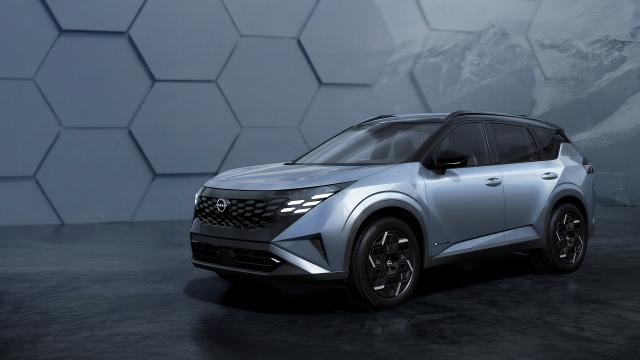
Exterior photos reveal a sharper design with headlights integrated into the grille and grid-pattern taillights flowing into the D-pillar. The overall silhouette doesn’t stray far from the current model, but the details are all new. No interior shots have surfaced yet, though expect larger screens and the same two-row, five-seat layout.
Nissan previewed the Rogue at its “Vision” event in Nashville, a global media gathering built around a new corporate strategy. The underlying message was plain enough: Nissan is restructuring around fewer models and more diverse powertrains. The Rogue sits at the center of that bet.
The company also dropped a second bombshell at the same event: the Xterra is coming back. Targeted for late 2028, the rugged SUV will be built in the United States on a new body-on-frame platform that Nissan says could underpin up to five models, including pickups and multi-row SUVs across both the Nissan and Infiniti brands. V6 and V6 hybrid powertrains are planned.
That’s an ambitious family of trucks from a company currently hemorrhaging market share and slashing costs. The Xterra announcement reads like a statement of intent — or a prayer.
But the Rogue matters more, and it matters now. The question is whether American buyers, conditioned by years of Toyota and Honda hybrid dominance, will trust a series-hybrid architecture they’ve never experienced from a brand that arrived late to the party. Nissan has sold two million e-Power vehicles overseas. Selling the first hundred thousand here will be the real test.
Share this Story