
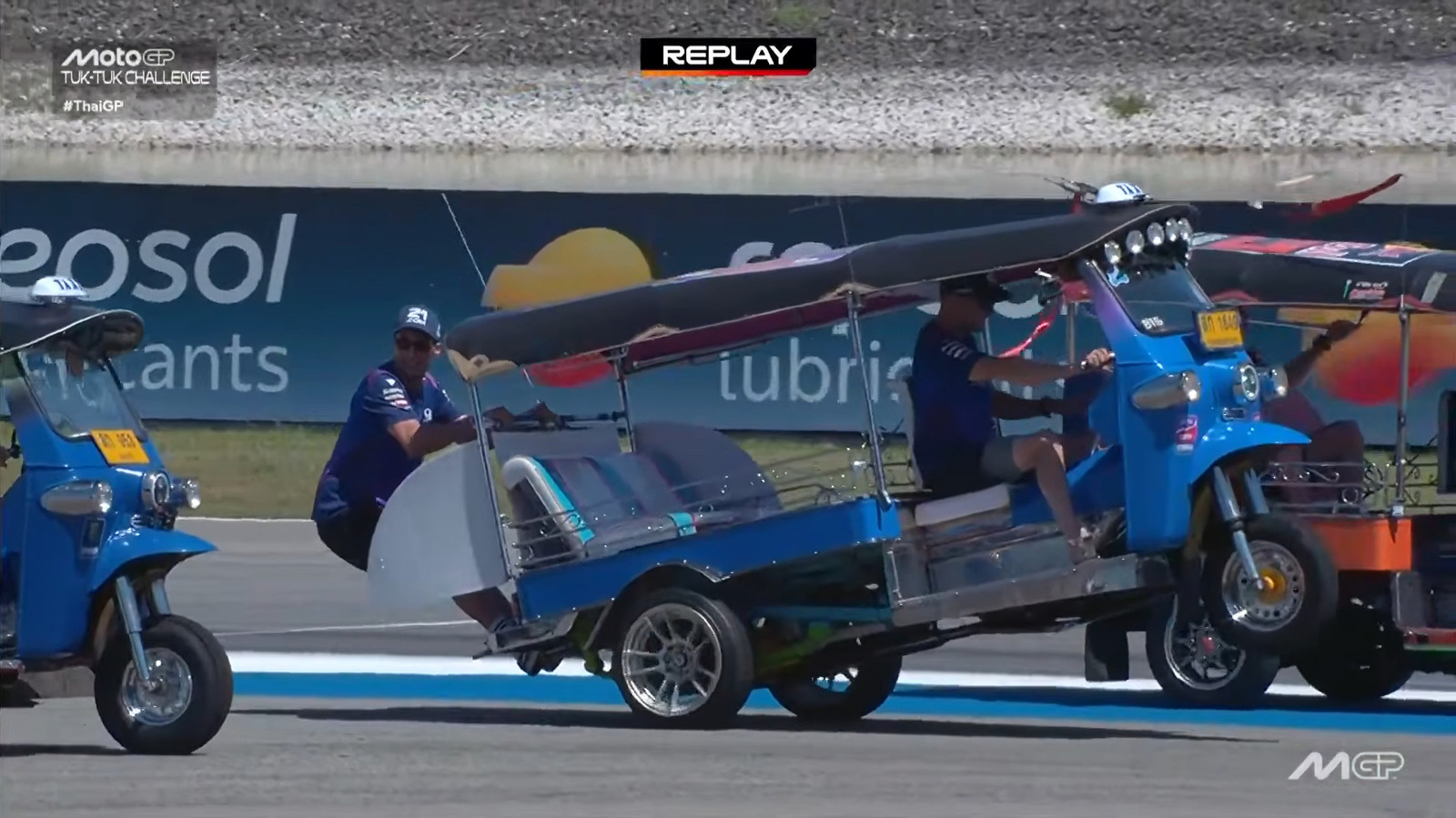


MotoGP’s 2026 season opener at Chang International Circuit in Buriram, Thailand delivered plenty of on-track drama. But the moment everyone kept replaying had nothing to do with prototype motorcycles.
Before the serious racing began, MSEG — the series’ new ownership group, having passed through Dorna and Liberty Media’s hands — organized a one-lap tuk-tuk grand prix for the entire MotoGP grid. Full team pairings. A mandatory driver swap at the halfway point. Official MotoGP timing graphics tracked every second as if these three-wheeled Thai taxi icons were 260-horsepower race bikes.
The result was pure, unfiltered chaos.
Pramac Yamaha’s pairing of Jack Miller and Toprak Razgatlioglu — the Turkish former World Superbike champion making his MotoGP debut — treated the warm-up lap like a stunt reel. They seemed philosophically opposed to keeping all three wheels on the tarmac at the same time. For anyone who has followed Miller’s career-long reputation as paddock class clown and Razgatlioglu’s flamboyant riding style, this was entirely on brand.
The race itself was brief and absurd, a single lap of sideways tuk-tuks piloted by men whose day jobs involve leaning motorcycles over at 60-degree angles at 200 mph. Even here, controversy found a way in — a late-lap one-position penalty echoed the contentious call against Marc Marquez during Saturday’s sprint race. Racing stewards will be racing stewards regardless of the vehicle.
What made the footage genuinely compelling wasn’t the competition. It was the atmosphere. Every onboard camera showed riders with enormous grins plastered across their faces.
These are athletes who spend most of their weekends managing immense physical and psychological pressure at the absolute limit of two-wheeled performance. Watching them dissolve into laughter while wrestling oversteer out of a vehicle designed to haul tourists through Bangkok traffic was a reminder that sport works best when it still looks like fun.
MotoGP has always had something Formula 1 struggles to manufacture: personality. The paddock is smaller, the riders more accessible, and the rivalries tend to carry genuine emotion rather than corporate polish. A stunt like the tuk-tuk race wouldn’t land the same way if it felt forced. It worked because these riders actually seem to like each other, even when they’re banging fairings at 180 mph through Turn 3.
The timing was smart, too. Thailand is tuk-tuk country. Hosting the season opener there and leaning into local culture rather than parachuting in with a generic pre-race show demonstrated a level of awareness that motorsport promoters don’t always exhibit. It costs almost nothing relative to a Grand Prix weekend’s total budget, and it generated the kind of social media traction that no amount of paid promotion can buy.
MSEG is still finding its footing as MotoGP’s latest ownership group in a sport that has changed hands with uncomfortable frequency. But small decisions reveal organizational instincts. Letting the grid blow off steam in the most ridiculous possible vehicle before a pressure-packed season opener suggests someone in the room understands that the product is the people, not just the machines.
Now imagine the entire F1 grid stuffed into tuk-tuks. Max Verstappen white-knuckling a three-wheeler through a chicane. Lewis Hamilton executing a flawless driver swap. Charles Leclerc somehow finding a way to lose the lead on the final corner.
MotoGP just proved the concept. Someone with a checkbook should take the hint.

Share this Story