


Four years in, Gran Turismo 7 is still getting fed. Update 1.68 dropped March 12, adding three cars and four new World Circuit events to a game that launched in March 2022 and, by any normal product lifecycle, should be coasting on fumes. It isn’t.
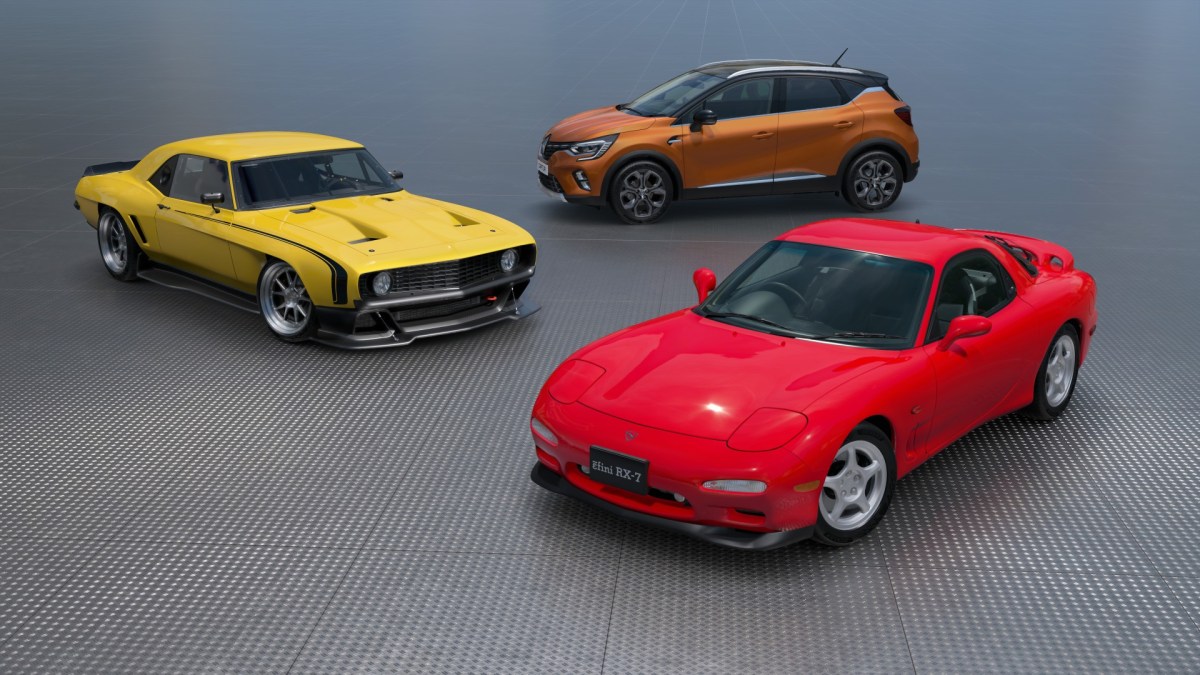
The headliners are a restomodded 1969 Chevrolet Camaro Z28 and a 1991 Mazda ɛ̃fini RX-7 Type R. A Renault Captur crossover also snuck in, because Gran Turismo has always had a soft spot for the mundane. We’ll leave that one on the lot.
The Camaro is the more provocative addition. Polyphony Digital didn’t scan somebody’s SEMA build. They created this one from scratch — a “Race-Mod” that reimagines the original Trans-Am homologation special with carbon-black trim, a wide-mouth front bumper, ducktail spoiler, center-exit exhaust, and a stripped cockpit housing a roll cage, Alcantara buckets, and a sequential shifter.
Under the hood sits a supercharged V8 making 657.8 brake horsepower. It’s a fantasy car with real roots, the kind of thing Polyphony has been leaning into since December’s Power Pack DLC introduced more original creations.
That’s a meaningful shift. Gran Turismo built its reputation on obsessive real-world fidelity, cataloging production cars the way a museum catalogs artifacts. Now the studio is designing its own machines.
Whether that’s creative ambition or content strategy for a game that needs to keep people engaged without a sequel on the horizon, the line between the two has never been thinner.
The RX-7 plays to the opposite instinct — deep-cut authenticity. GT7 already has an FD, the 2002 Spirit R that marked the end of the line. This 1991 Type R is the beginning.
It’s the car as it first appeared under Mazda’s short-lived ɛ̃fini sub-brand, with 252 horsepower from a sequential twin-turbo 13B rotary and a curb weight of just 1,260 kilograms. The ɛ̃fini badge itself lasted only about four years before Mazda killed the retail experiment, which makes this a genuinely obscure variant for all but the most devoted JDM historians.
Polyphony’s car models remain the industry benchmark for digital automotive preservation. Having both the earliest and final iterations of the FD RX-7 in a single game isn’t just completionism — it tells the story of a 25-year rotary chapter that ended because emissions regulations strangled it.
Four new World Circuit events round out the update: a European Sunday Cup at Dragon Trail Gardens Reverse, a Japanese Clubman Cup at Kyoto Driving Park Yamagiwa Reverse, an American Clubman Cup at Road Atlanta, and a World Touring Car race at Circuit Gilles-Villeneuve. Nothing revolutionary, but enough to give the new metal somewhere to stretch.
The elephant in the paddock is what comes next. There’s been no announcement of Gran Turismo 8, and there won’t be until Sony reveals the PlayStation 6. Reports conflict on timing — some say PS6 production has been disrupted by AI’s appetite for memory and storage components, others insist a 2027 launch remains on track.
Either way, Polyphony is in a holding pattern, and GT7 is the vehicle that has to keep flying.
Four years of free updates for a live-service game that doesn’t charge a monthly subscription is either remarkable generosity or a studio with nowhere else to put its energy. Probably both. The January update added three cars and three events, and March brings three cars and four events.
The cadence hasn’t slowed. As long as Polyphony keeps threading the needle between invented restomods and deep-catalog preservation pieces like a first-year ɛ̃fini RX-7, few players will complain. Gran Turismo 7 was supposed to be a bridge — it’s turning into a destination.



Share this Story