
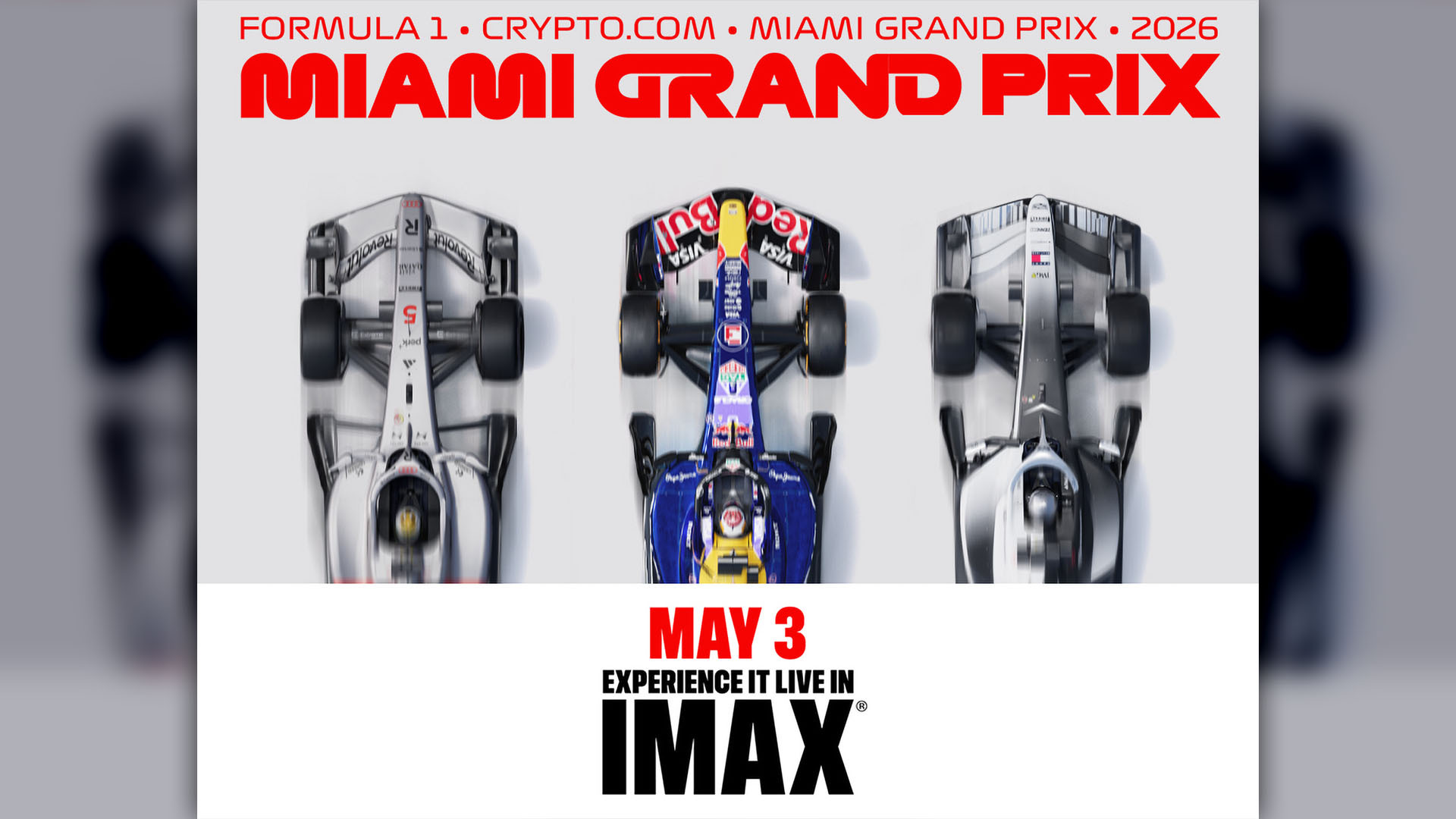


Formula 1 races are coming to IMAX movie theaters across the United States, starting with the Miami Grand Prix on May 3, 2026. Tickets look to run about $30 plus fees, based on early theater listings.
The IMAX screenings are a direct product of Apple TV’s takeover of F1 broadcasting rights, which kicks in for the 2026 season. Apple isn’t just putting races on its streaming platform — it’s pushing the sport into physical venues, trying to convert casual American interest into something closer to a communal event.
Five races made the initial cut: Miami, Monaco, the British Grand Prix, the Italian Grand Prix at Monza, and the United States Grand Prix in Austin. Each screening will run roughly 150 minutes, covering pre-race buildup, the full Grand Prix, and podium celebrations.
The selection tells you exactly where Apple thinks the money is. Three of the five races are legacy European events dripping with prestige. The other two are American rounds, the sport’s fastest-growing market.
No Singapore under the lights. No São Paulo. No Japan. This is a curated list designed to sell tickets in U.S. multiplexes, not satisfy global diehards.
Thirty dollars to watch a car race in a movie theater would have been an absurd proposition five years ago. But F1’s American audience has exploded since Netflix’s “Drive to Survive” series launched in 2019, and Liberty Media has been ruthlessly capitalizing on that momentum ever since. Three U.S. races now sit on the calendar, a Brad Pitt F1 movie backed by Apple hit screens last year, and the sport that once required a specialty cable add-on to watch in America is now mainstream entertainment.
Apple clearly sees the IMAX play as a funnel. Get fans into theaters, build the tribal energy, and push them toward Apple TV subscriptions for the other 19 or so races on the calendar. It’s the same logic behind NFL games at movie theaters — turn passive viewership into an occasion worth paying for.
Whether $30 is the right price point is another question entirely. A month of Apple TV costs about $10. For the price of one IMAX race, you could subscribe for three months and watch every session from your couch.
The value proposition hinges entirely on atmosphere — the massive screen, the surround sound, the crowd reactions. For a sport where on-track action can sometimes flatline for 30 laps at a stretch, that’s a gamble.
The theater experience also comes with limitations no one’s talking about yet. You can’t pause. You can’t rewind. You can’t pull up timing screens or switch camera angles.
The broadcast Apple pipes into those theaters will be a locked, linear feed. For hardcore fans who live on data overlays and team radios, that’s a downgrade from watching at home.
But Apple isn’t targeting those fans with this. It’s targeting the crowd that shows up in McLaren merch they bought at Target, the people who know Lando Norris from TikTok and think DRS is a texting abbreviation. That’s not a knock — it’s the growth demographic, and Apple knows it.
The real test comes after Miami. If IMAX theaters fill up for a race that starts at a reasonable hour on American soil, the concept has legs. If Monaco at 9 a.m. Eastern draws a thin crowd to a dark theater, Apple will know exactly how deep this new fandom runs.


Share this Story