
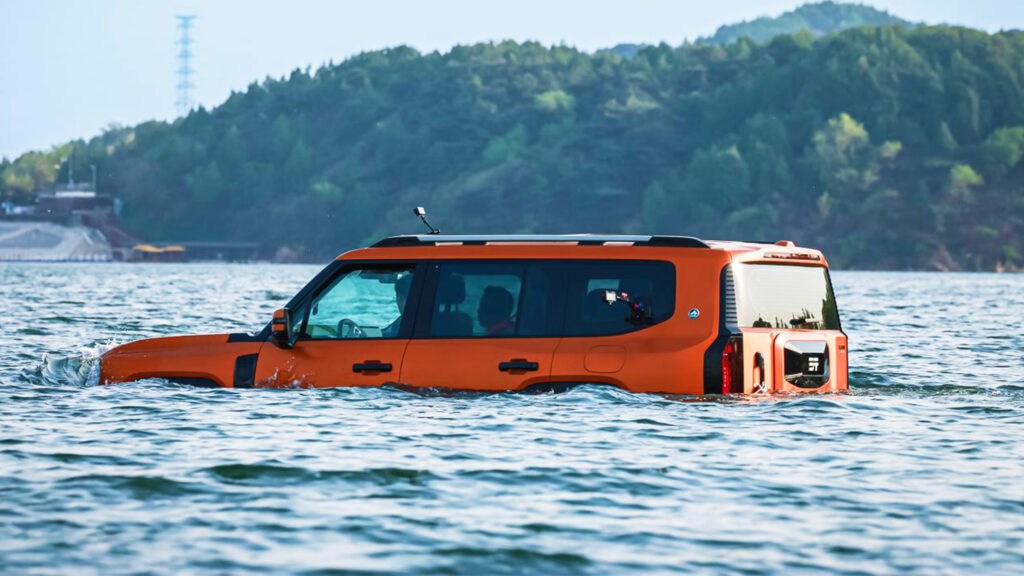


BYD did it first as a party trick. Now Chery’s Jetour sub-brand has one-upped the stunt by driving its G700 SUV across an actual lake, on camera, with the confidence of a brand that knows exactly how viral the clip will go.
The Chinese SUV arms race has officially left dry land.
Jetour’s demonstration showed the G700 cruising across open water, sealed bodywork keeping the cabin dry while torque-vectoring systems provided enough thrust to counter wind and current. It looked like something from a Bond film — if Bond drove a chunky family hauler instead of an Aston Martin.
This isn’t entirely new territory. BYD’s premium Yangwang U8 showed off a brief floating capability roughly two years ago, and that clip racked up millions of views. The difference now is escalation. Jetour didn’t just float in a controlled puddle — it sailed.
The message to domestic and global rivals is unmistakable: if your SUV can’t cross a body of water, you’re already behind the headline cycle.
Let’s be clear about what this is and isn’t. These are carefully staged demonstrations — controlled conditions, calm water, short distances, camera crews standing by. Nobody is fording the Yangtze on a Tuesday commute.
The sealed underbodies and clever drivetrain tricks are real engineering, but they’re deployed here as marketing theater. Brilliant marketing theater.

And that’s the tension worth watching. China’s automakers have figured out something Detroit, Stuttgart, and Tokyo have been slow to grasp: in the age of short-form video, a 90-second clip of an SUV gliding across a lake does more brand-building than a decade of J.D. Power awards. The wow-factor tech war has replaced the horsepower war, and the battlefield is social media, not the Nürburgring.
The underlying technology isn’t trivial. Sealing a monocoque SUV body well enough to achieve positive buoyancy while routing cooling, exhaust, and drivetrain components away from water ingress takes serious engineering discipline. Torque delivery to wheels that are suddenly acting as crude propellers demands software calibration most OEMs have never contemplated.
Whether any of this translates to real-world utility — say, a flash-flood escape or a shallow river crossing in rural markets — remains an open question that neither Jetour nor BYD has answered with data.
What they have answered is the attention question. Every major Western outlet covers these clips. Every enthusiast forum debates them. And every product planner at a legacy automaker has to explain to a boardroom why their $50,000 SUV can’t do what a $35,000 Chinese one apparently can, even if “can” comes with a very long list of caveats.
The broader pattern is familiar to anyone who watched Korean automakers climb from punchline to powerhouse over two decades. First come the stunts. Then come the legitimate quality gains. Then comes market share. Chinese brands are compressing that timeline dramatically, and amphibious SUV demos are just the flashiest symptom.
For now, I’d still keep a tow strap in the boot and a healthy respect for anything deeper than a puddle. Currents don’t care about your sealed door seals, and insurance adjusters tend to take a dim view of voluntary lake crossings. But as a statement of engineering ambition and marketing savvy, Jetour just threw down a gauntlet that floats.
The rest of the industry can either learn to swim or watch from the shore.
Share this Story