
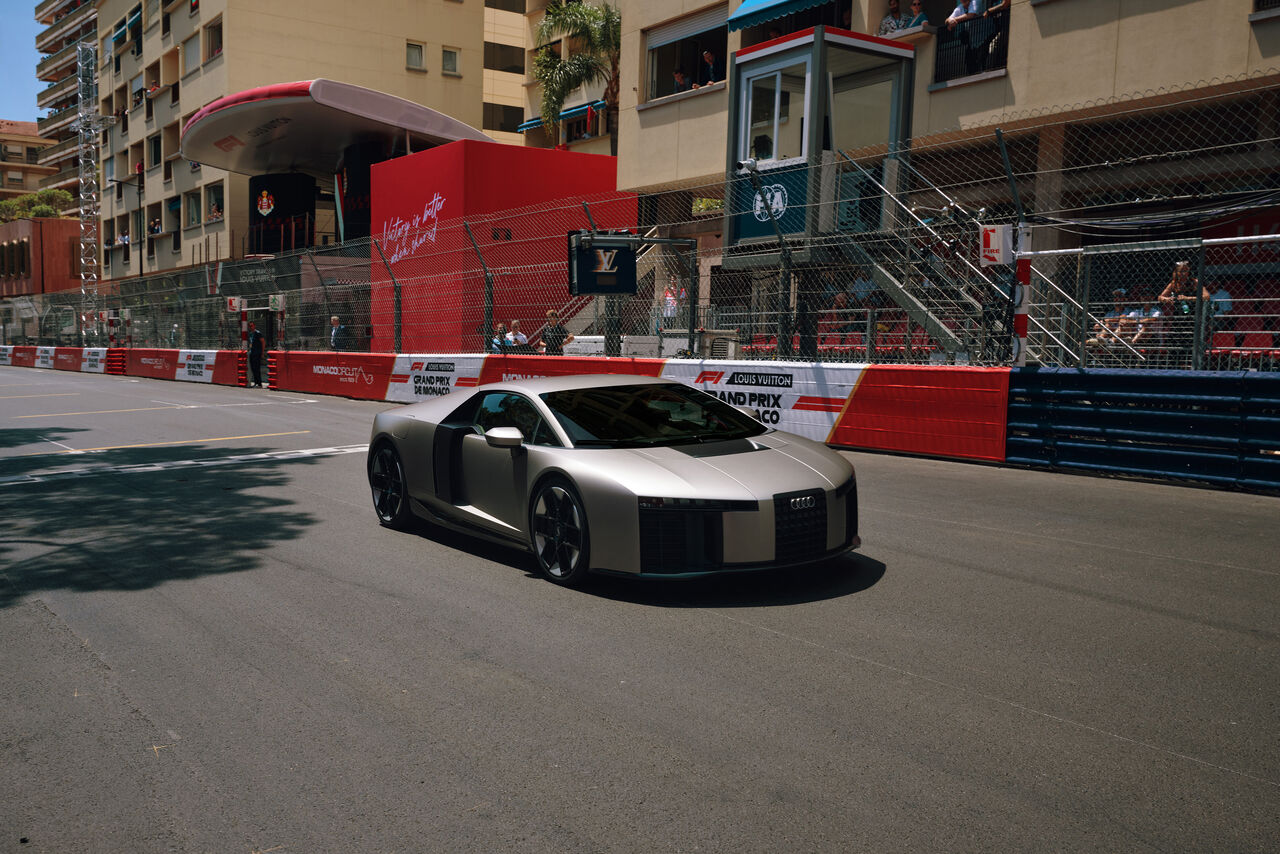


Audi just revealed a near-production prototype of the Nuvolari, a hybrid supercar it claims was developed at a pace the company has never attempted before. Order books open in Europe this fall, with first deliveries slated for the first half of 2027. For a brand that has spent the last several years stumbling through an awkward electric transition, this is a very deliberate statement of intent.
The Nuvolari borrows its name from Tazio Nuvolari, the legendary Italian racing driver who dominated Grand Prix racing in the 1930s, often behind the wheel of an Auto Union — Audi’s predecessor. It’s a name that carries enormous weight, and Ingolstadt is clearly betting it will translate into credibility for a car that blends Formula 1-derived technology with road-going ambition.
At its core sits a high-performance hybrid powertrain. Not a full EV. Audi, the company that went all-in on battery electrics with the e-tron GT, Q6 e-tron, and A6 e-tron, is building its halo car around combustion and electricity working in tandem.
The preliminary fuel consumption figures tell the story: 11.3 liters per 100 km in combined weighted driving, climbing to 14.7 with the battery depleted. CO2 emissions sit at 270 g/km — firmly in the EU’s worst emissions class, G. That’s not a typo.
Audi’s flagship technical showcase, the car meant to redefine “Vorsprung durch Technik,” carries a G rating. In an industry frantically chasing emissions targets, there is something almost defiant about it.
The technology list reads like a motorsport parts catalog. Active aerodynamics, a carbon-fiber exterior built around what Audi calls its Space Frame, and a system branded “quattro predictive ride,” which suggests active suspension that reads the road ahead. Audi says these are F1-inspired innovations brought directly to the street, a claim that carries more substance now that the brand has an actual Formula 1 program through its partnership with Sauber.
Prototypes are already pounding laps at the Nürburgring and Nardò, two proving grounds that leave nowhere to hide for chassis dynamics or high-speed stability. The fact that Audi is publicizing this testing phase, rather than keeping it under wraps, signals confidence — or at least a desire to project it.
The development timeline is remarkably compressed. Audi is emphasizing speed at every turn: faster decisions, shorter development cycles, quicker path to production. For a company embedded within the Volkswagen Group, where bureaucratic inertia has historically smothered urgency, this rhetoric is new.
Whether the execution matches the ambition remains to be seen. No pricing has been announced. No production numbers either.
But the language around “series production” and customer deliveries within a year of the prototype reveal suggests Audi isn’t building a concept-car fantasy. This is meant to be a real product, sold to real buyers, competing in a rarefied space occupied by the Mercedes-AMG One, the Porsche 918 Spyder’s spiritual successors, and whatever Ferrari puts a plug into next.
The deeper tension here is strategic. Audi has spent years telling the world its future is electric. The e-tron lineup was supposed to be the proof.
Yet its most ambitious, most technically advanced new car — the one meant to carry the brand’s engineering identity forward — burns fuel. Lots of it.
The Nuvolari doesn’t contradict Audi’s electric ambitions so much as it reveals their limits. When a company needs a car to thrill, to generate desire, to remind people why four rings once meant something on a starting grid, it still reaches for combustion. The battery helps, but the engine leads.
That says more about where the industry actually stands than any corporate sustainability report ever could.

Share this Story