
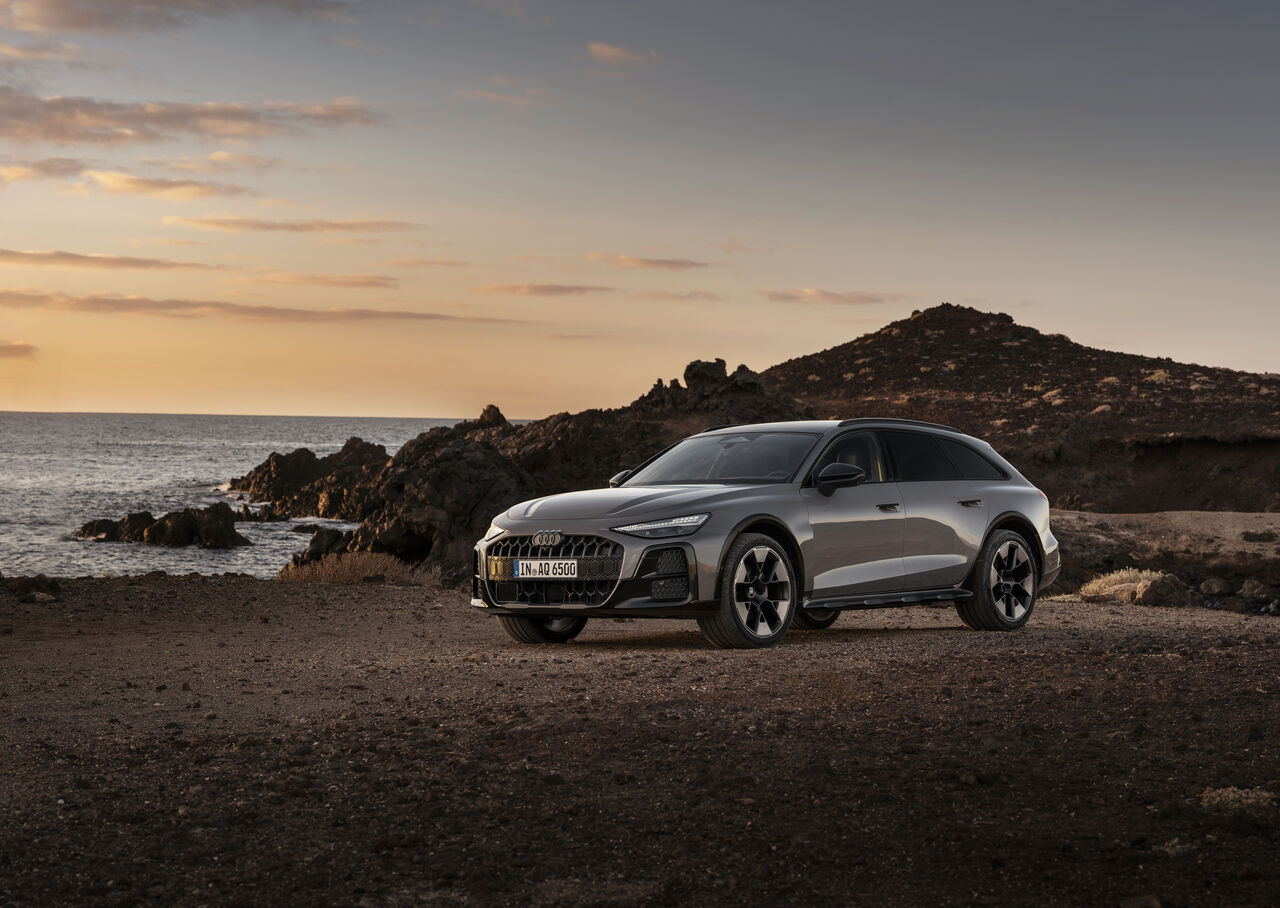


The Audi A6 allroad has been 111 millimeters wider than the standard A6 Avant exactly zero times in its 27-year history. That changes now. The fifth-generation model, unveiled from Ingolstadt with orders opening June 18, 2026, gets the widest body the nameplate has ever worn and, for the first time, a plug-in hybrid powertrain.
Start at 77,250 euros. That buys a car that is 5,016 millimeters long, nearly two meters wide before you count the mirrors, and sits on a track that’s grown 74 millimeters over the Avant at the front axle and 70 at the rear. Standard wheel size is 19 inches, with optional 21s for anyone who thinks subtlety is overrated.
The chassis is where Audi is placing its biggest bet. Adaptive air suspension, developed specifically for this model, is standard and offers 55 millimeters of travel — 25 more than the Avant gets. Ground clearance sits 34 millimeters above the Avant at normal ride height.
Select “offroad+” and the car climbs another 15 millimeters, loosens the traction control, lets the electronic differential lock work harder, and holds gears longer in the dual-clutch transmission. A lift function adds yet another 20 millimeters at speeds under 35 km/h for truly rough stuff.
All-wheel steering is standard on the plug-in hybrid and optional on the diesel. Below 60 km/h, the rear wheels turn up to five degrees opposite the fronts, trimming the turning circle by roughly a meter. Above that speed, they steer up to two degrees in the same direction for high-speed stability.
Progressive steering has been stiffened throughout the entire path from wheel to rack, with increased front camber and rigidly bolted components. Audi wants you to feel the road, not just cruise over it.
Two powertrains are on offer, both electrified, both paired with quattro all-wheel drive. The plug-in hybrid mates a 185 kW two-liter four-cylinder gasoline engine with a 105 kW electric motor for a combined 270 kW and 500 Nm. A 25.9 kWh battery (20.7 kWh net) delivers up to 95 kilometers of electric-only range on the WLTP cycle, and AC charging tops out at 11 kW for a full fill in about two and a half hours.
The alternative is the three-liter V6 TDI producing 220 kW and 580 Nm. Audi layers in its MHEV plus system — belt alternator starter, powertrain generator, and an electric-powered compressor — adding up to 18 kW of supplemental grunt. Combined fuel consumption lands between 5.8 and 6.4 liters per 100 kilometers.
Inside, the cockpit mirrors the broader A6 family: an 11.9-inch virtual cockpit paired with a 14.5-inch central touchscreen, with an optional 10.9-inch passenger display. Digital Matrix LED headlights offer eight customizable daytime running light signatures, and the digital OLED rear lights communicate with following traffic. Contoured seats with ventilation and massage, four-zone climate control, a dimmable panoramic roof, and an allroad-specific display showing pitch, roll, steering angle, ride height, and GPS coordinates round out the cabin.
Adjustable rear seats, roof rails with an optional basket, and an increased trailer load for the V6 TDI over the standard Avant keep the wagon credible as an actual adventure tool rather than just a lifestyle prop.
Audi expects cars at dealerships this fall. The timing is deliberate — slotting the allroad into a market where premium lifted wagons from Volvo, Mercedes, and Porsche are all fighting for the same buyer who wants ground clearance without surrendering to a full SUV.
Five generations in, the allroad formula hasn’t changed: take the wagon, raise it, toughen it, charge a premium. The difference now is everyone else is running the same play. Audi’s response is to go wider, go electric, and dare you not to notice.

Share this Story