
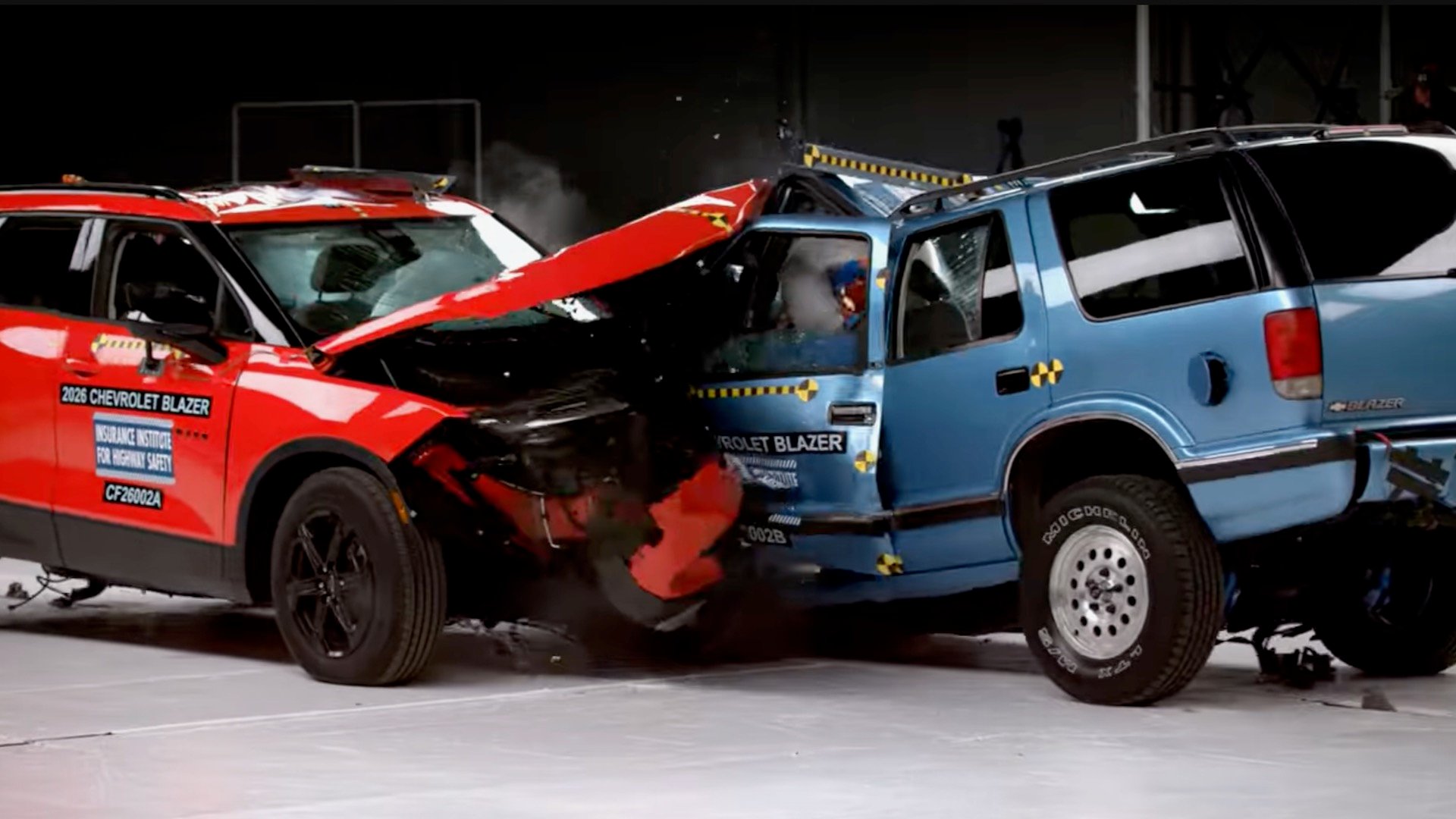


The crash-test dummy’s head ripped clean off. That’s what happened when the Insurance Institute for Highway Safety slammed a 1996 Chevy S-10 Blazer into a 2026 Chevy Blazer in a head-to-head moderate overlap front test. The airbag in the old truck didn’t save the dummy — it hit it square in the chin and snapped the head backward with enough force to detach it entirely.
The driver in the new Blazer would have walked away with bumps and bruises. The driver in the old one would have walked away in a bag.
This is the IIHS’s second generational crash spectacle. In 2009, it famously obliterated a 1959 Bel Air against a 2009 Malibu, demolishing the myth that old steel was somehow safer than modern engineering. That video went viral and still triggers arguments at car shows.
This new test carries a different message: the enemy of safety isn’t just age. It’s complacency.
The 1996 Blazer’s front end folded like tinfoil. The dashboard and steering column were shoved into the dummy’s lap. The cabin, which is supposed to be the last line of defense, simply collapsed.
When new, that truck earned the IIHS’s lowest “Poor” rating in the moderate overlap front test. Nobody fixed it. Nobody had to. There was no competitive pressure to do better because the test barely existed.
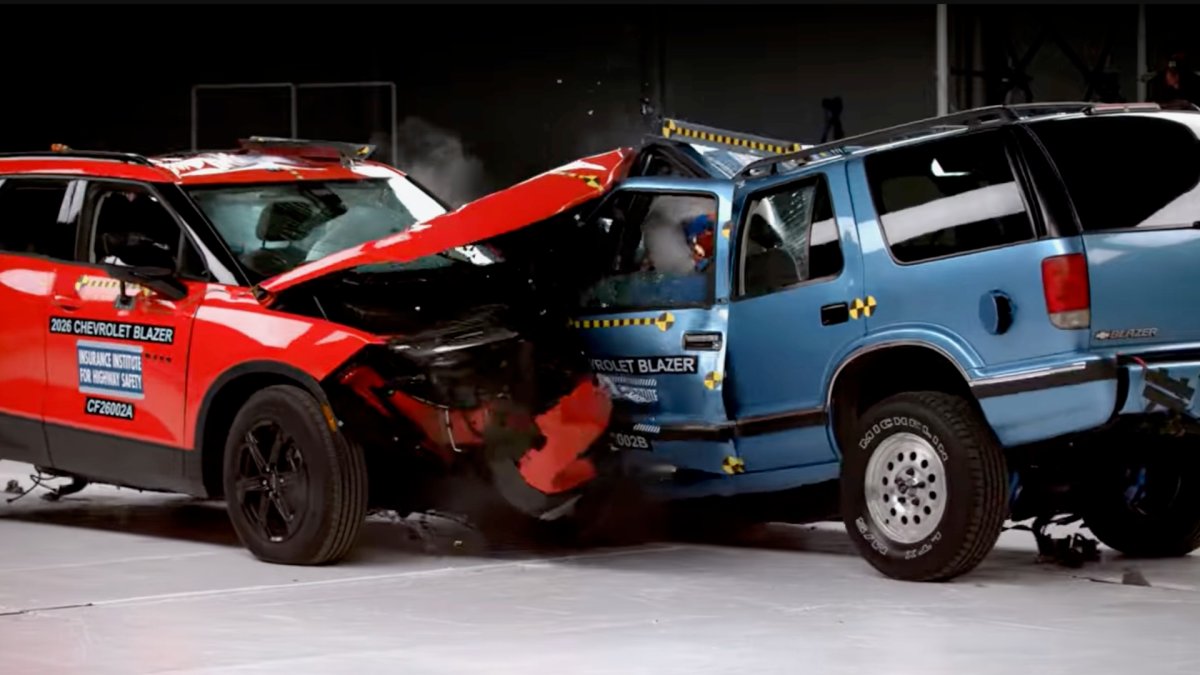
The 2026 Blazer’s front structure absorbed the hit and kept the passenger cell intact, earning a “Good” rating. Crumple zones worked as designed. The airbag deployed where it was supposed to.
Thirty years of iterative engineering got us here, driven largely by the IIHS’s willingness to create tests that expose real-world crash scenarios the federal government ignores.
The IIHS estimates its crash-test program saved 48,352 lives between 1999 and 2024. That figure comes from comparing real-world fatality rates between vehicles rated “Good” and those rated lower. The organization also claims $538 billion in savings, based on Department of Transportation data.
Insurance companies spent roughly $600 million funding the IIHS during that span — a return on investment approaching 900 to 1.
Those numbers land differently when you remember the IIHS isn’t a government agency. It’s a nonprofit funded by the insurance industry, which has a very direct financial interest in people not dying in car crashes. The federal government sets minimum standards. The IIHS sets the bar that actually moves the market.
Automakers chase “Good” ratings and Top Safety Pick awards because consumers see them, dealers advertise them, and poor scores make headlines.
The organization keeps shifting the goalposts on purpose. It has added and dropped tests over the years, introduced headlight evaluations, and started grading automatic emergency braking systems. The 2026 Blazer, for all its “Good” performance here, hasn’t yet faced the updated moderate overlap test introduced in 2022 that also evaluates rear-passenger protection.
Even the winners don’t get to rest.
Now the IIHS is pushing into territory the feds won’t touch: crash-testing larger commercial trucks and implementing updated whiplash evaluations. NHTSA has shown no appetite for putting big rigs through independent crash protocols. The insurance industry, tired of writing checks for catastrophic commercial-vehicle wrecks, apparently has plenty.
A mint-condition 1996 S-10 Blazer got destroyed in this test. That stings a little if you’re sentimental. But sentimentality is exactly what kills people in old vehicles — the belief that heavy steel and a body-on-frame truck will protect you better than a modern crossover with fourteen airbags and a cage engineered by computers that didn’t exist in 1996.
The dummy’s detached head is the rebuttal to every “they don’t build ’em like they used to” argument ever made at a tailgate. They don’t. Thank God.
Share this Story