
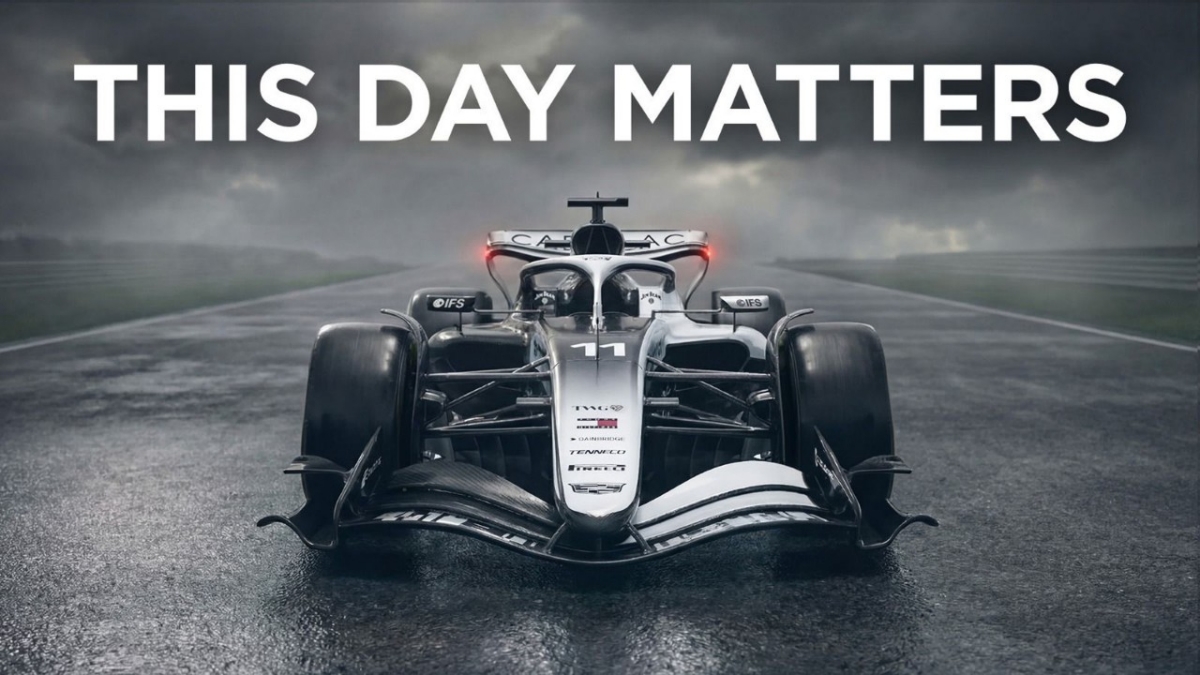


A 3D printer the size of an arcade cabinet, stuffed in the back of a race trailer, saved Formula One’s newest team from missing its own debut.
Cadillac Formula 1 completed its first-ever shakedown at Silverstone, the birthplace of the world championship, in what team principal Graeme Lowdon described as something approaching “a miracle.” The car made it onto the circuit, but barely. Missing parts, foul English weather, and a ticking clock nearly derailed the whole thing before a single lap was turned.
The team, backed by General Motors, has existed in its current form for roughly a year. When its entry was formally approved, the operation began with what Lowdon called an empty room, a screwdriver, and an A4 sheet of paper. That timeline is almost incomprehensible by F1 standards, where established outfits spend hundreds of millions annually just to stay competitive, and new operations historically take years to become remotely functional.
Yet here they are, with a car that runs.
On the day of the shakedown, missing components sent pulses spiking in the garage. The fix came from that trailer-mounted 3D printer, which fabricated replacement parts on site. The freshly printed piece was installed still warm.
“You can never start too early, and you’ll always need more time,” one team member said. A line that reads like a joke but landed as gospel.
Assembly stretched to the edge of the available testing window. The team raced against the clock as much as they’ll race against the field. When the car finally fired up and rolled onto the circuit, the crew erupted — relief more than celebration, by all accounts.
The broader Cadillac effort has been documented through a series called “What Makes Fast,” and this eighth episode captures the texture of a team still finding its feet. Seat fittings happened at the last minute. The transport of the car to Silverstone was described as “surprisingly perilous,” the simple act of rolling into pit lane as “surprisingly nerve-wracking.”
Lowdon has likened the undertaking to the Apollo moon landings, which is either grandiose or apt depending on how you view the sheer volume of engineering, logistics, and human endurance required to build an F1 program from nothing in twelve months. The team has stated its long-term ambition plainly: not just participation, but a championship-winning operation.
That goal lives somewhere far over the horizon. The immediate challenge is Melbourne, where the 2026 season opens on Sunday. Nobody expects Cadillac to threaten for points, let alone podiums.
The grid already features ten teams with decades of institutional knowledge, wind tunnel hours, and supplier relationships that money alone can’t replicate overnight.
But making the grid at all is the story. The last time a genuinely new constructor entered F1 — not a rebrand, not a takeover — the results were dismal. HRT, Caterham, and Manor all entered in 2010 and all eventually folded.
Cadillac has GM’s wallet and an established technical base in England, advantages those earlier entrants lacked. Whether that’s enough to avoid the same graveyard remains an open question. The 3D printer in the trailer tells you where they are right now: resourceful, scrappy, and improvising their way forward one warm part at a time.
The car ran. It came back in one piece. The crew cried. That’s the whole first chapter, and for a team that started with a screwdriver and a blank sheet of paper, it’s enough.

Share this Story