
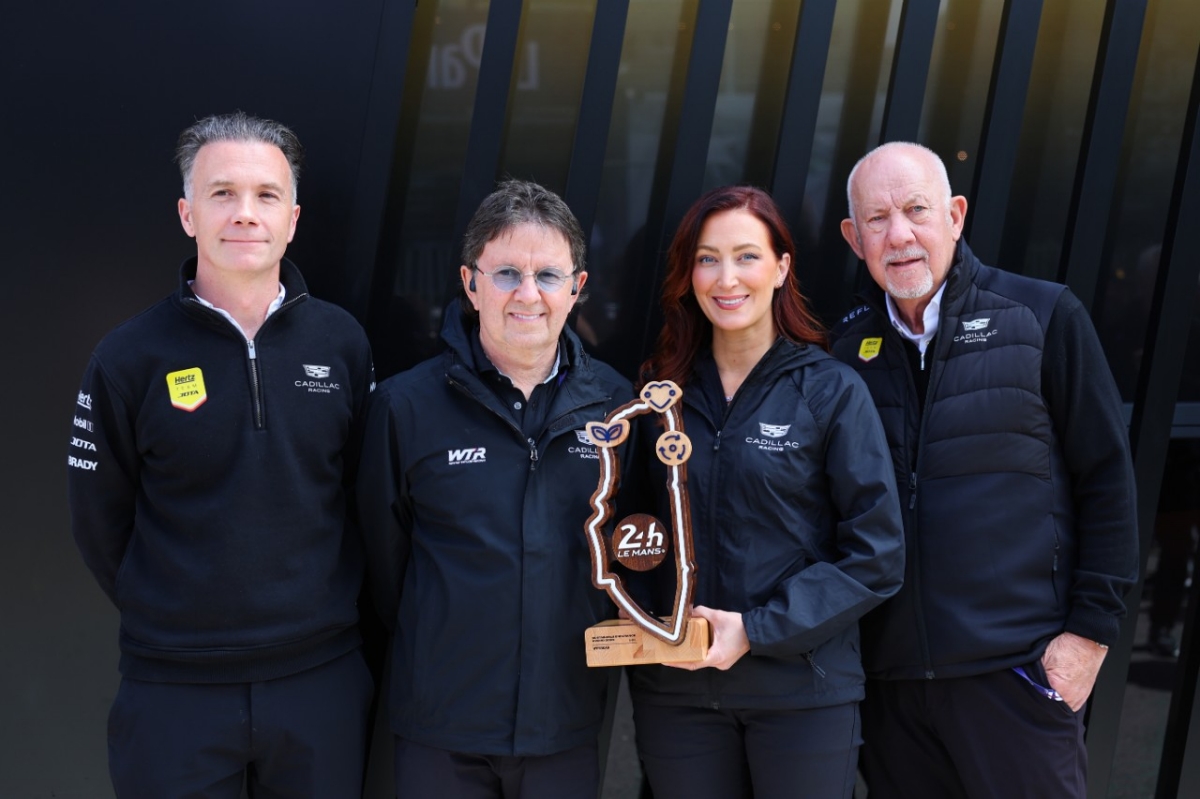


Cadillac Racing took the 2026 DHL Sustainable Endurance Award in the Hypercar category at Le Mans this week — not for anything that happened on track, but for how it got its equipment there.
The jury, assembled by the FIA, ACO, and DHL, singled out Cadillac’s logistics overhaul as the strongest element of its submission. The team increased sea freight for Wayne Taylor Racing equipment from 70 percent in 2025 to 90 percent this year. U.S.-based staff took the train from Paris to Le Mans, JOTA shipped by road from the UK, and wherever possible, gear was stored or sourced locally in Europe.
This is the quiet, unsexy side of endurance racing that rarely gets discussed. Hypercars burn fuel and rubber at astonishing rates for 24 hours, but the carbon math of simply moving a racing operation across an ocean dwarfs what happens between the Mulsanne kinks.
Cadillac’s dossier went deep. The team cut the average carbon impact per meal from 7.13 kg CO2e in 2024 to 6.49 kg CO2e in 2026 — a nine-percent reduction achieved through less beef, more plant-based dishes, local sourcing, and donating surplus food to Les Restos du Cœur. Not the kind of stat that makes highlight reels, but the kind that holds up to scrutiny.
Single-use plastic took a hit, too. Five BWT water stations, 1,000 reusable bottles distributed to fans, and the elimination of disposable plastic from hospitality added up to roughly 4,000 plastic bottles avoided. The team estimated savings of 114.8 kg of plastic and 319.3 kg of CO2.
The hospitality structure itself was reused rather than rebuilt. Energy metering was installed to create a 2026 baseline — an honest admission that you can’t improve what you haven’t measured. LED lighting, efficient appliances, and reduced air conditioning demand rounded out the effort.
Broader initiatives included responsible procurement practices, support for women in motorsport and STEAM education, and a community project with Gaston Bachelard School in Le Mans.
What makes this recognition special is that it celebrates work that happens behind the scenes,” said Keely Bosn, accepting on behalf of the team. “While endurance racing is about performance on track, it’s also about continuous improvement in everything we do.”
The jurors described Cadillac’s submission as one of the most complete and structured they received this year, with concrete actions directly tied to Le Mans operations rather than vague corporate pledges.
That distinction matters in a paddock where sustainability claims can slide easily into greenwashing. Motorsport has always been a spectacular contradiction — engineering at its most refined, fuel consumption at its most conspicuous. Programs like this one don’t resolve that tension, but they show that teams are at least accounting for the full footprint, not just the lap times.
General Motors, Wayne Taylor Racing, and JOTA all contributed to the effort. The award itself carries no prize money and no competitive advantage. It’s a plaque and a press release.
But Cadillac put a number on its meals, weighed its plastic savings, and moved 90 percent of its cargo by water instead of air. In a sport that loves to talk about innovation, those are the kind of receipts that actually count. The 24 Hours of Le Mans starts Saturday. The V-Series.R prototypes will have to earn a different kind of recognition on the Circuit de la Sarthe — but at least the shipping was clean.

Share this Story