
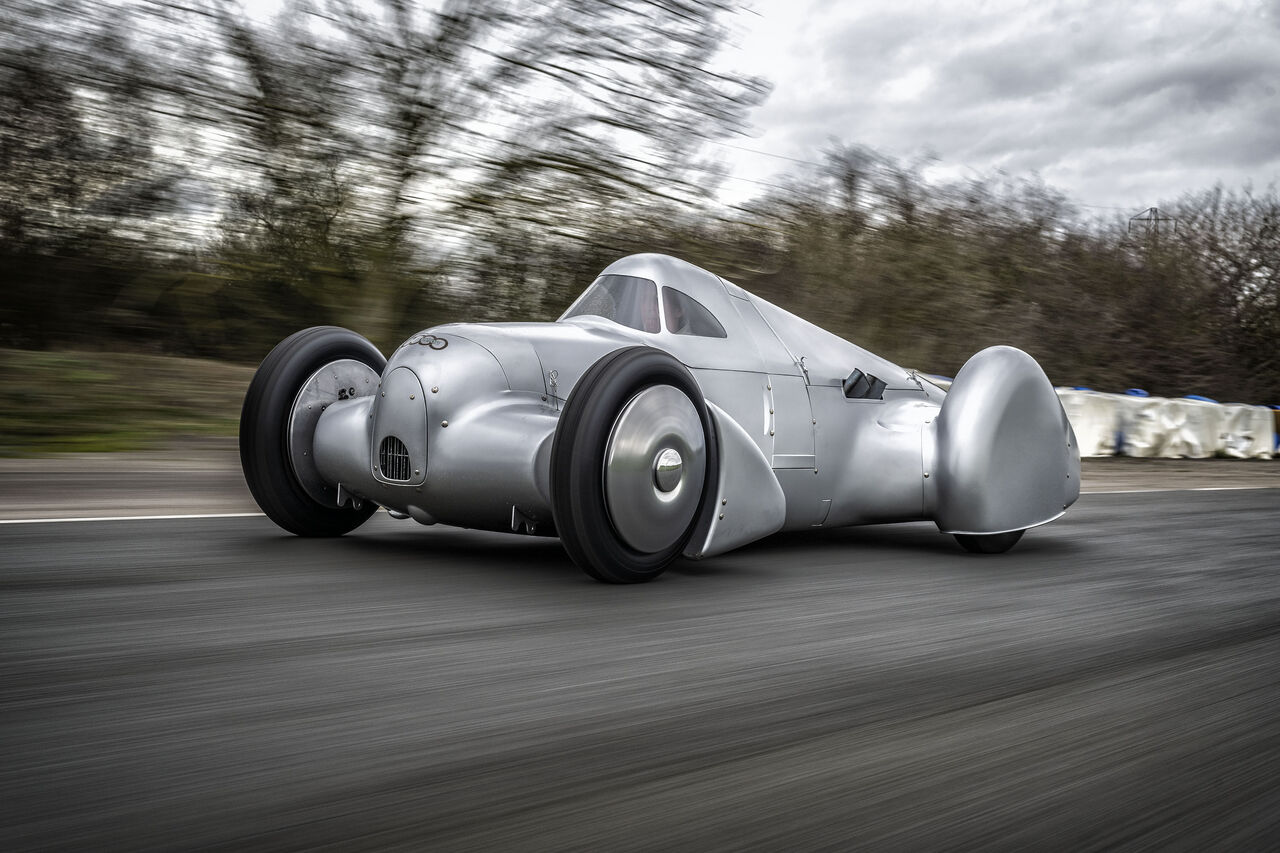


Ninety-one years ago, Hans Stuck pointed a streamlined silver missile down a straight stretch of Italian autostrada near Lucca and hit 326.975 km/h — just over 203 mph. That car, the Auto Union Rennlimousine, then vanished into history. No original survives.
Now Audi has built it again from scratch, and it’s not staying behind glass. The recreation, completed in early 2026 by British specialists Crosthwaite & Gardiner after more than three years of hand-fabrication, was unveiled in Lucca in early May. Its first dynamic appearance is scheduled for the Goodwood Festival of Speed in July.
Audi calls it the Auto Union Lucca, and it slots into the company’s historic Silver Arrow collection — a collection that, until now, contained no Auto Union racing or record cars from the early Grand Prix era. That gap matters more than it might seem. Auto Union’s mid-engine Grand Prix cars from the 1930s were engineering landmarks, yet Mercedes-Benz has long dominated the Silver Arrows narrative.
Audi has been the custodian of the Auto Union legacy since absorbing the brand decades ago, but without hardware to show, the story stayed academic. A running, wind-tunnel-tested recreation changes the equation.
The original record attempt reads like a period adventure film. Auto Union’s racing division in Zwickau finished the car in December 1934 and tested it on Berlin’s Avus circuit. The plan was to beat Rudolf Caracciola’s flying-start mile record of 316.592 km/h, set in a specially prepared Mercedes on a Hungarian highway.
Auto Union shipped its car to Budapest in February 1935, but the weather collapsed. An exhaust pipe burned through during testing. The team packed up and drove south toward Milan, found snow, and kept going until they reached a dead-straight, eight-meter-wide section of autostrada near Lucca.
On the morning of February 15, 1935, with thousands of spectators lining the road and independent chronometrists manning electrically triggered photocells, Stuck averaged 320.267 km/h over the flying-start mile. On one return run, the timing equipment clocked him at 326.975 km/h. The press called it the fastest road racing car in the world.
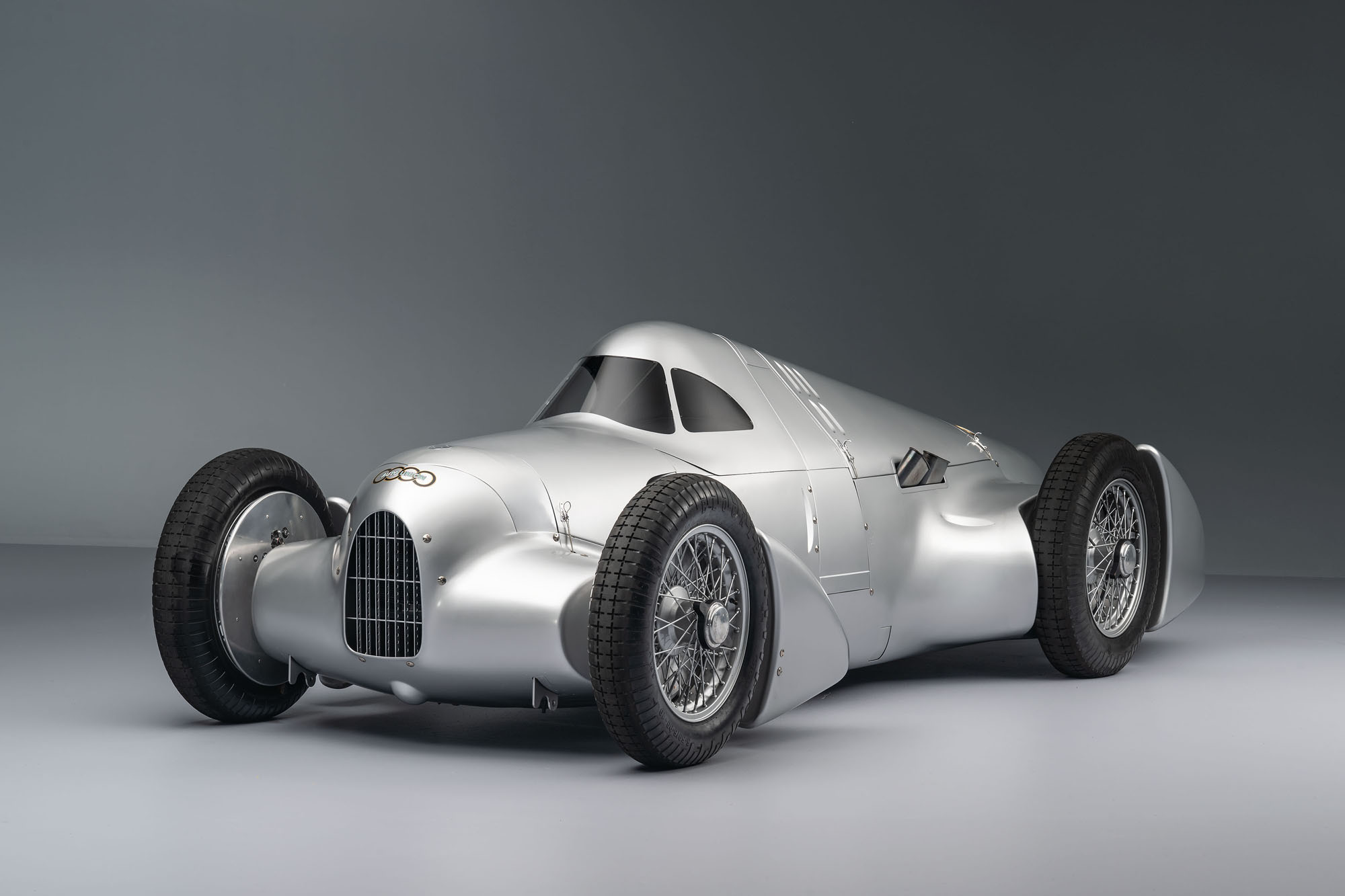
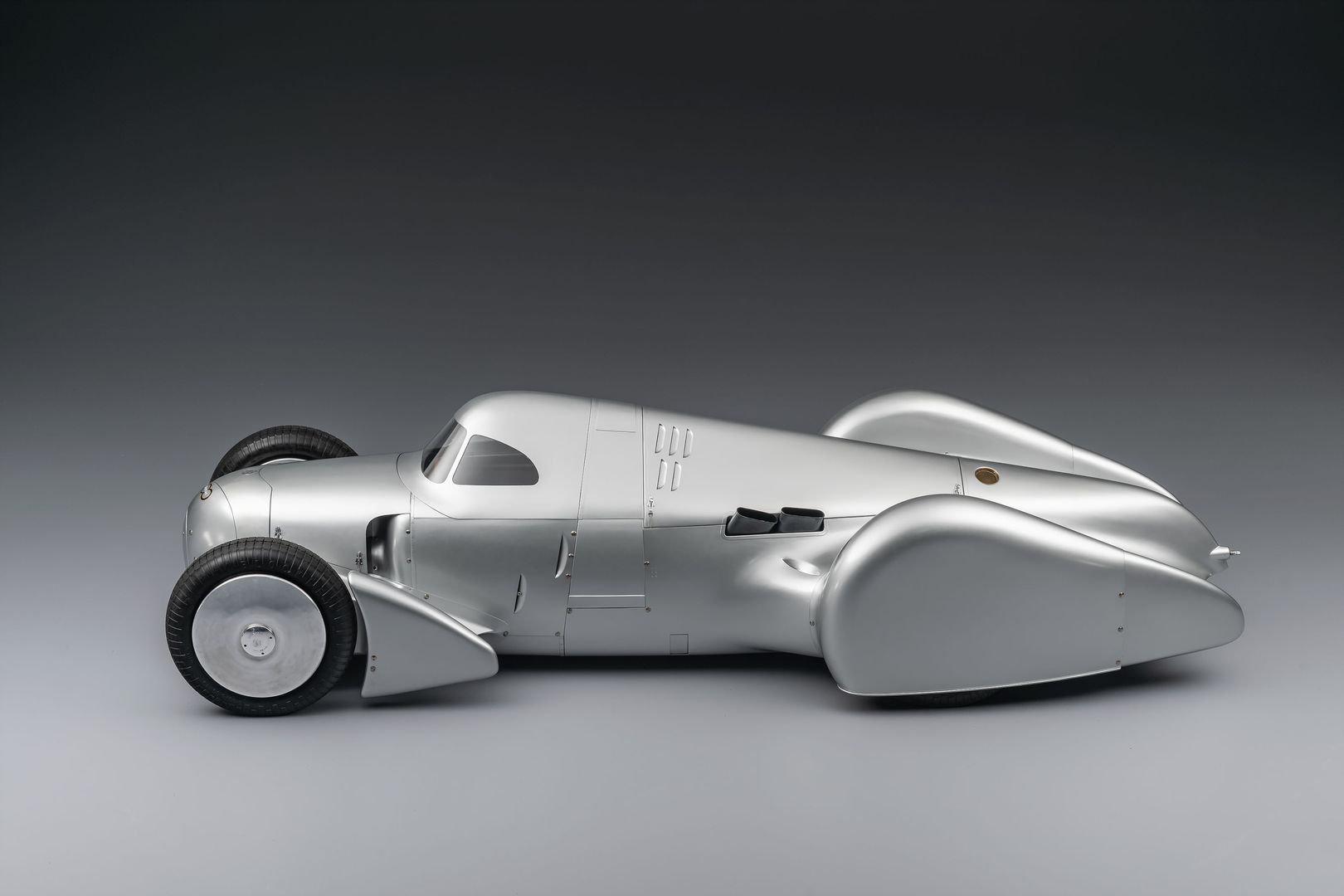
The engineering behind that speed was remarkably forward-thinking. Auto Union’s racing division built a wind tunnel model, tested open and closed cockpit configurations, and incorporated findings from the Berlin-Adlershof Aeronautical Research Institute — a first for European racing car construction, according to contemporary reports. The body was hand-sanded and clear-lacquered, spoked wheels got aerodynamic covers, and the 16-cylinder mid-mounted engine displaced roughly five liters and produced 343 horsepower.
The 2026 recreation takes some liberties, all of them pragmatic. It uses the six-liter 16-cylinder engine from the later Auto Union Type C, which produces 520 horsepower and is visually identical to the original five-liter unit. Ventilation modifications from the car’s later Avus race configuration were incorporated to prevent overheating during demonstration runs.
Audi’s wind tunnel measured a drag coefficient of 0.43 — a number that confirms the original aerodynamic work was genuinely sophisticated for its time. The car weighs 960 kilograms, stretches 4,570 millimeters long, and runs on a fuel blend of methanol, premium unleaded, and toluene. It is a one-off, and Audi has no plans to build another.
Project manager Timo Witt, a former motorsport engineer who has run Audi Tradition’s historic collection since 2015, pointed to the 1935 team’s adaptability as the real achievement. “When the weather takes a turn, the whole team moves on without hesitation,” he said. “Without this high degree of flexibility, the record-breaking drive in Lucca would not have been possible.”
What Audi has done here is fill in a blank that has nagged at its heritage program for years. Mercedes-Benz has spent decades touring its surviving pre-war Silver Arrows. Audi had the history but not the hardware.
Now it has a 520-horsepower, hand-built answer — and Goodwood is three months away.
Share this Story