
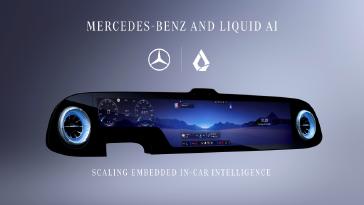


Mercedes-Benz just told the cloud to take a back seat. The German automaker announced a multi-year partnership with Cambridge-based Liquid AI to embed foundation models directly into the vehicle’s onboard hardware. Production deployment in North American models is targeted as early as the second half of 2026.
The deal covers every Mercedes with third- and fourth-generation MBUX infotainment. That’s the E-Class, CLE, C-Class, GLC, the new CLA in both BEV and ICE form, the EQS Sedan, GLE, GLS, S-Class, and even the AMG EA GT 4-door. That’s not a pilot program. That’s a fleet-wide commitment.
Liquid AI is no household name, but the MIT spinoff has built its reputation on small, efficient foundation models designed to run where compute power is limited. Their Liquid Foundation Models process speech recognition, language understanding, and reasoning locally, with no constant data exchange with remote servers required. For a driver barking commands at 75 mph through a dead zone in rural Montana, that distinction matters.
CTO Jörg Burzer framed it as laying groundwork for “the next generation of intuitive and multimodal in-car experiences.” Liquid AI CEO Ramin Hasani went further, calling the software-defined vehicle “one of the most consequential deployments of AI in the physical world.” He insisted his company is building “infrastructure, not just a feature.”
The language around privacy is deliberate and pointed. Mercedes is leaning hard into the words “private,” “sovereign,” and “independent.” Every automaker knows the backlash cycle by now: customers discover their voice data is being shipped to some server farm, outrage follows, lawyers circle.
Running AI on-device sidesteps that vulnerability entirely. The data never leaves the car.
Mercedes isn’t abandoning cloud-based large language models, though. The press materials are careful to position Liquid AI’s embedded intelligence as complementary to existing cloud ecosystems. Think of it as a two-tier system: the lightweight, always-available local brain handles everyday voice commands and vehicle controls, while heavier cloud-based models tackle more complex queries when connectivity allows.
The competitive pressure here is real. Tesla has been running on-device neural networks for years in its driving stack. Chinese automakers are racing to embed sophisticated AI assistants.
BMW and Volkswagen have their own partnerships in the works. Mercedes needed an answer that went beyond strapping ChatGPT to a dashboard. Liquid AI’s low-footprint architecture gave them one that actually fits inside existing vehicle hardware without requiring expensive new chips.
The model-year footnotes buried at the bottom of the announcement reveal the true scope. Fourth-generation MBUX deployment spans model year 2026 and 2027 vehicles across nearly every major nameplate in the Mercedes lineup. That’s the next S-Class, the next GLE and GLS, and the electric CLA that Mercedes is counting on to redefine its entry-luxury strategy.
If Liquid AI’s models work as promised, they’ll touch hundreds of thousands of vehicles within two years.
Both companies say they’ll explore additional areas of product development beyond voice interaction, though neither offered specifics. Reading between the lines, contextual reasoning is the obvious next step. Picture an AI that understands not just what you said but why you said it based on driving conditions, navigation context, and vehicle status.
The real test arrives late this year when the first production vehicles roll out with embedded Liquid models running on MB.OS. Voice assistants in luxury cars have been promising natural conversation for a decade and mostly delivering frustration. Mercedes is betting that moving the intelligence closer to the driver, literally inches away inside the car’s own processors, finally closes that gap.
If it works, every automaker with a cloud-dependent voice assistant will be scrambling to catch up. If it doesn’t, it’s another expensive AI partnership that sounded better in the press release than it performed on the road. Mercedes has put its entire North American MBUX lineup on the line. That’s not a hedge. That’s conviction.

Share this Story