
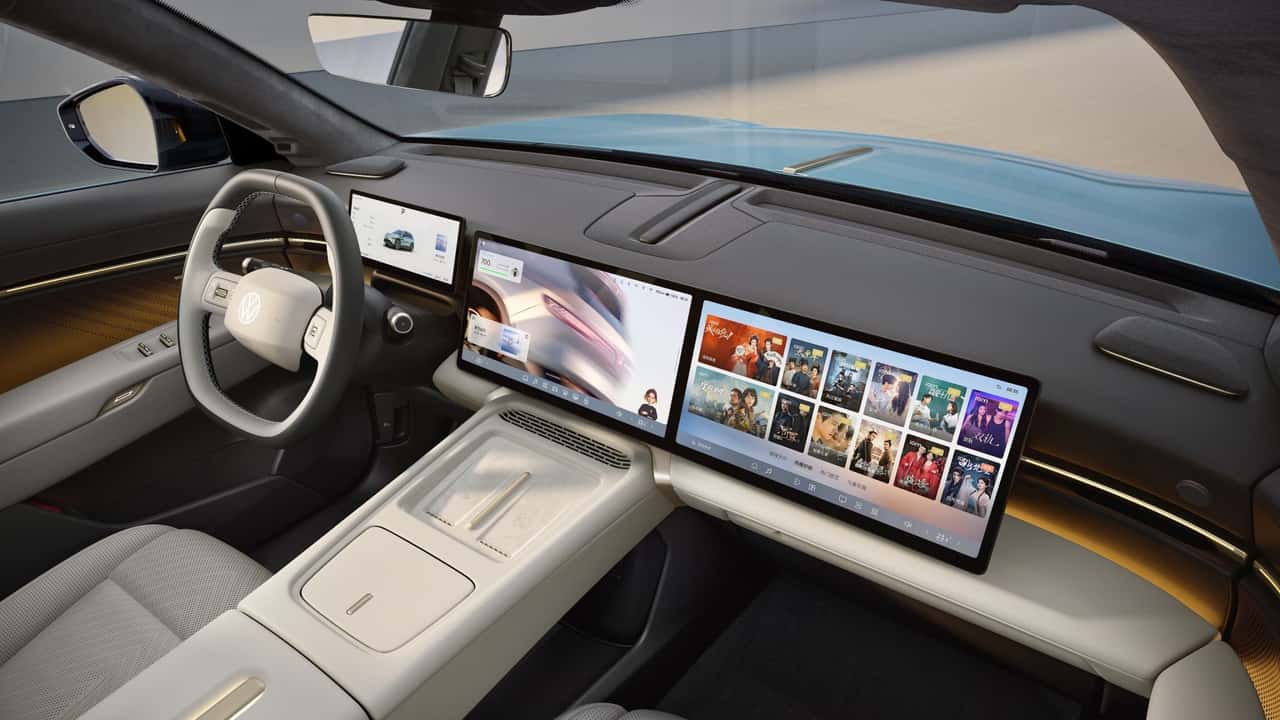


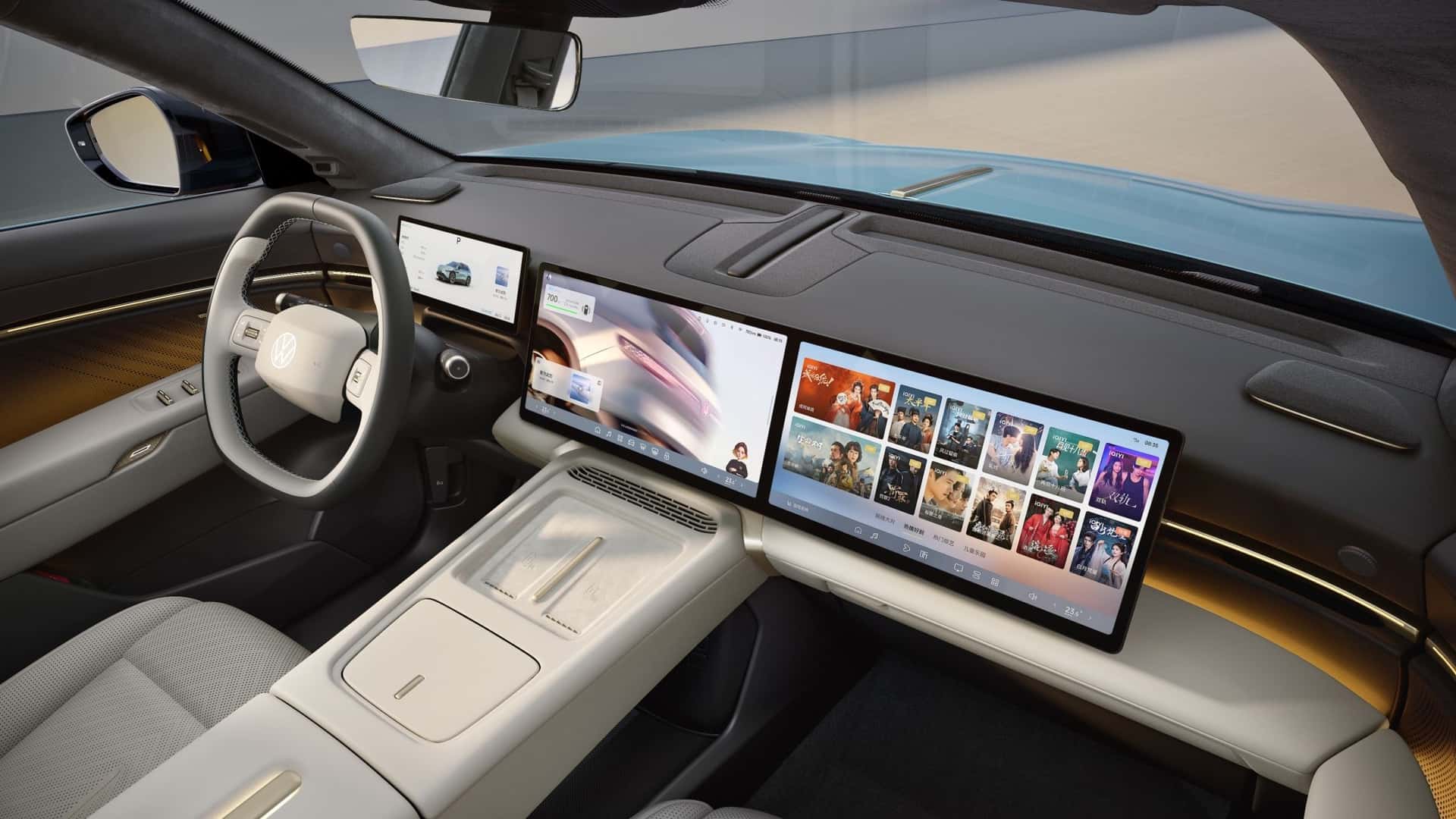
Volkswagen just revealed the interior of the ID. Unyx 08, and if you stripped the badges off, you’d never guess it came from Wolfsburg. Dual 14.96-inch screens dominate the center console. Physical buttons are essentially gone.
A 10.25-inch digital instrument cluster floats from the dashboard like an afterthought. This is what survival looks like when you’re hemorrhaging sales in the world’s largest EV market.
The ID. Unyx 08 is a product of VW’s Anhui joint venture, co-developed with Xpeng — the same Chinese EV maker that’s been eating Volkswagen’s lunch for years. The SUV stretches 196.9 inches long with a 119.2-inch wheelbase and claims up to 454 miles of range on the generous CLTC cycle. Single- and dual-motor configurations will be offered with 82- or 95-kWh battery packs, and sales begin in weeks.
VW itself laid bare the logic last year: European buyers want tactile controls, durability, and driving dynamics. Chinese customers want AI-first connected vehicles with voice control and smart cockpits. So the company built two completely different philosophies under one logo.
The cabin features a dimming panoramic glass roof spanning 18.7 square feet with ten levels of opacity adjustment controlled by voice or touchscreen. Dual wireless charging pads sit atop a lower storage compartment, and a 20-speaker sound system fills the space. Rear passengers get fold-down trays from the front seatbacks, leather seats adjust ten ways electrically, and it reads less like a Volkswagen spec sheet and more like a premium Chinese EV checklist, ticked box by box.
And this isn’t even VW’s only China-specific electric SUV right now. Last week brought the ID. Era 9X, a different model from a different joint venture — SAIC-Volkswagen — complete with a range-extending gas engine. Two separate partnerships, two separate SUVs, two separate strategies, all for one market.
The numbers confirm it. Volkswagen Group’s electric vehicle sales in China cratered 44 percent in 2025. The response? More than 20 EVs and plug-in hybrids planned across VW Group brands this year alone.
For decades, Volkswagen’s China playbook was simple: take global models, stretch the wheelbase for rear-seat legroom, and print money. That formula built an empire. At its peak, VW sold more cars in China than in any other country on Earth.
Those days are gone, buried by BYD, Xpeng, NIO, and a dozen other domestic brands that understood what Chinese buyers wanted before Wolfsburg even started asking the question.
Now VW is outsourcing its product development in China to Chinese companies. The ID. Unyx 08 doesn’t just look different from a global Volkswagen — it was conceived differently, engineered differently, and will be sold differently. Xpeng’s software DNA runs through it.
This is a company that once imposed its identity on every market it entered. Same design language, same engineering ethos, same Volkswagen-ness, from Puebla to Shanghai. That uniformity was the brand’s strength and its calling card.
In China, VW has abandoned that playbook entirely. Whether this represents pragmatic adaptation or an admission that the brand no longer carries sufficient weight in the market that matters most — that’s the question Wolfsburg would rather not answer out loud. The ID. Unyx 08 answers it anyway.
Share this Story