
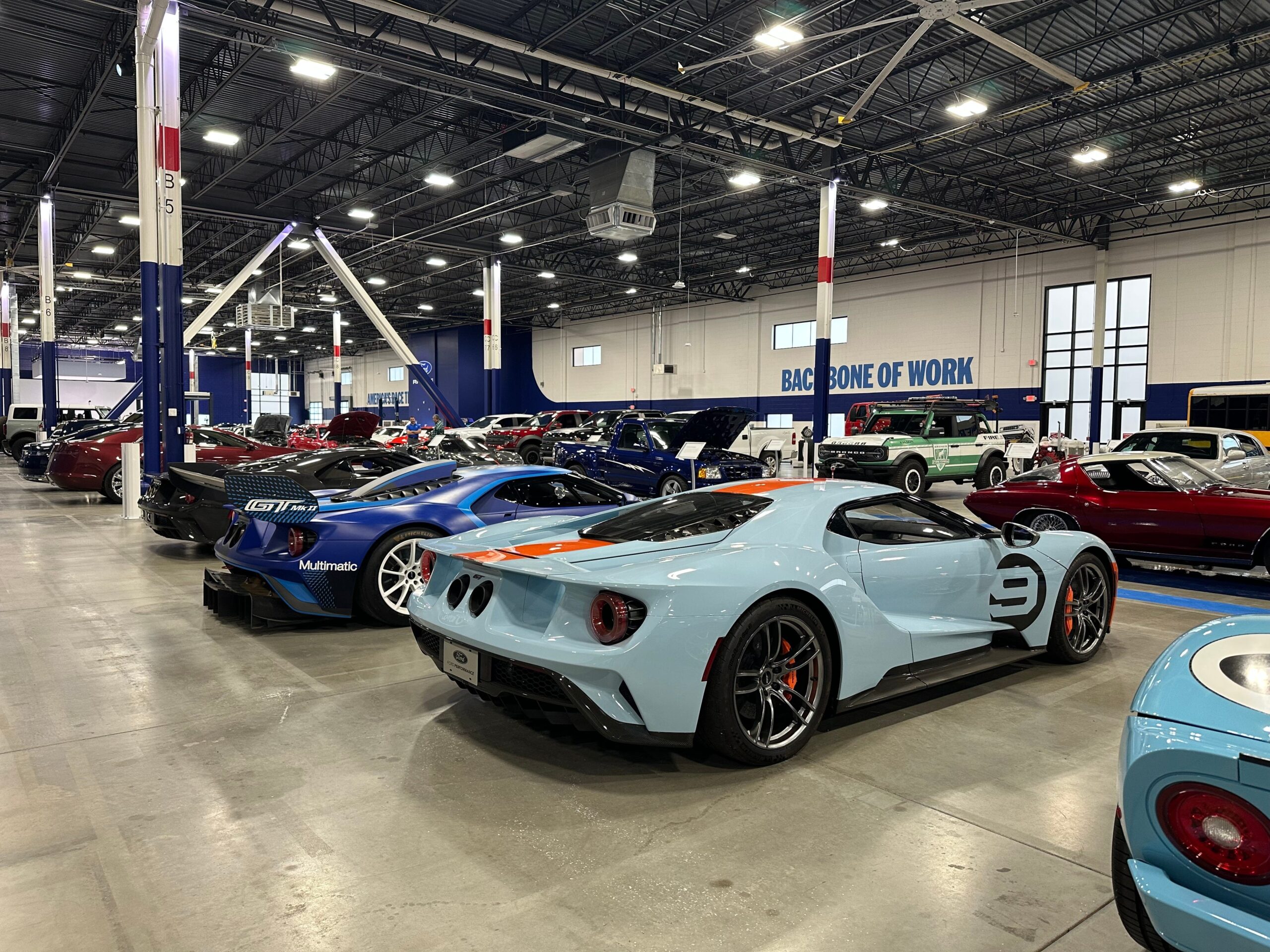


Ford’s history now lives in a former Amazon warehouse in Romulus, Michigan. The building is unmarked, and for now, only Ford employees can walk through the door.
The company calls it the Ford Vault. It holds the Heritage Fleet, a collection Ford only started curating in 2024, more than a century after the first Model T left the factory.
Zoning laws keep the public out. Ford says it is working with Romulus city officials to bring the building up to code for museum use, but it gave no timeline.
The oldest car inside is a 1910 Model T, and it busts a myth. It’s right-hand drive, built for the U.K., and painted green.
Henry Ford’s “any color, so long as it’s black” rule didn’t arrive until 1914. Black paint dried faster, and the assembly line had no patience for anything slower.
That Model T matters to Ford’s current sales pitch. The company has called its upcoming Fathom electric truck a “Model T moment.”
Ford has used that line before. The 2003 Model U concept, now parked in the Vault, was sold as a modern people’s car carrying the Model T’s spirit.
The Model U was a small pickup that turned into an SUV through a retractable rear section. It ran a supercharged 2.3-liter hydrogen-combustion four-cylinder and claimed 45 mpg.
It also had a head-up display, adaptive headlights, and automatic emergency braking. In 2003, those features were rare. The Model U never reached production.
The pattern repeats down the rows. The 2006 Reflex coupe paired a diesel-electric hybrid with lithium-ion batteries, an electric rear axle for all-wheel drive, and a claimed 65 mpg.
It hit 60 mph in a claimed 7.0 seconds. Its floor used rubber from Nike shoes. It stayed a show car.
The 2006 Super Chief concept bet early on the luxury pickup. It had coach doors, American walnut, a glass roof, and a supercharged 6.8-liter V-10 that could burn gasoline, E85, or hydrogen.
Ford eventually sold plenty of expensive trucks. None of them ran on hydrogen.
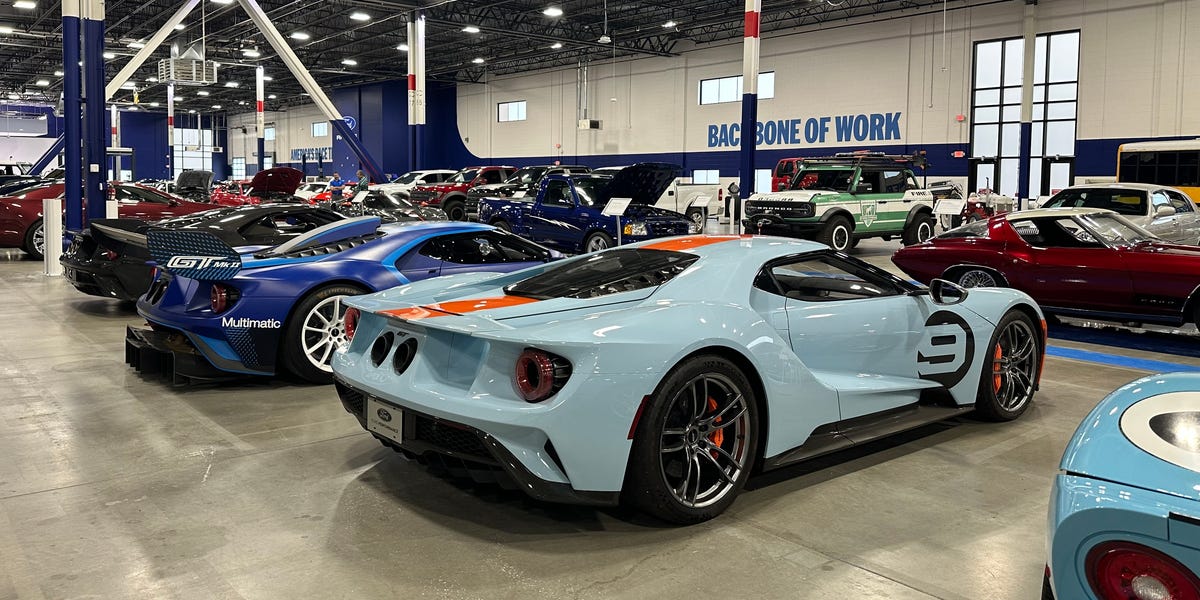
The 1999 Bronco U260 tells a slower story. The Bronco died in 1996, and Moray Callum’s team proposed this Ranger-based revival three years later. It never got past a styling prototype.
Another concept followed at the 2004 Detroit show. Buyers waited until 2021 for a production Bronco.
Lincoln’s 1995 L2K is here too, a two-door roadster on a modified Miata chassis with a 250-hp 3.4-liter V-8. It started life as a Mercury, ran about 100 laps at Saugus Speedway, toured the auto show circuit, and was killed by management.
Reports once said the L2K was scrapped. It wasn’t. Lincoln today sells only SUVs.
Some pieces are pure curiosity. One is a Mustang GT350 that apprentices turned into a ute using a Ranger bed.
There’s also the final first-generation Ka off the European line, with fewer than 10 miles on it. Then there’s the 158-inch SYNus, styled like a bank vault on wheels.
Not everything belongs to Ford. The 1963 Cougar II, a wedge-bodied concept built on a Shelby Cobra, is on loan from the Detroit Historical Society along with the Bordinat Cobra.
Ford says more loaned vehicles could rotate through once the doors open to the public.
The three GT40s that finished 1-2-3 at Le Mans in 1966 visited only briefly. That was the race where Ken Miles, leading late, was told to slow down so the cars could cross together. Bruce McLaren took the win.
Those cars leave within days. The rest stay in Romulus, waiting on the city.

Share this Story