
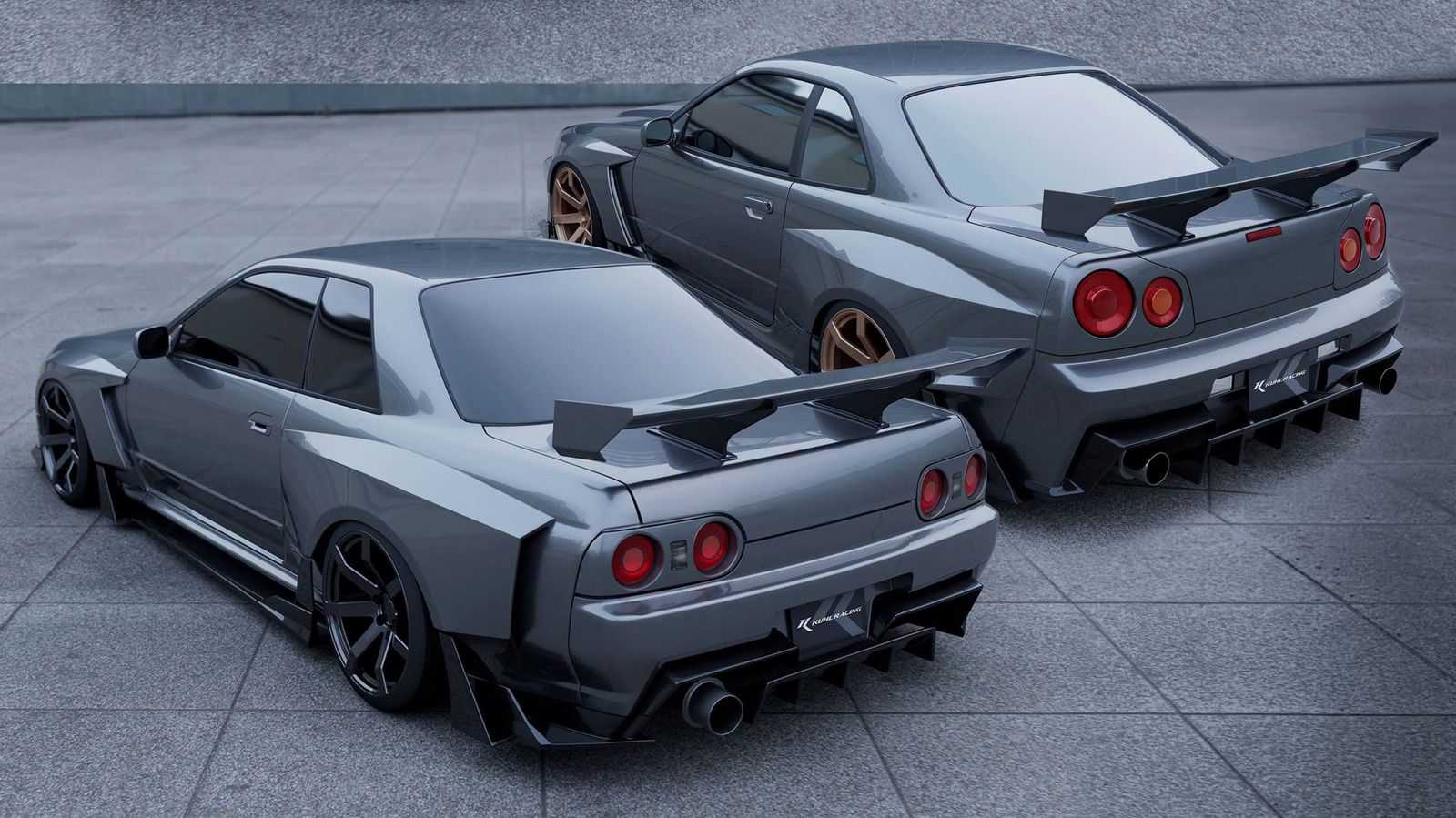


Kuhl Racing has drawn two of the most revered Skylines ever built and bolted boxy, vented fender flares onto both of them. The R32 and R34 GT-R renderings are headed for the 2027 Tokyo Auto Salon as part of the Japanese tuner’s “All Nissan Project.”
So far, they exist only as pictures. Silver pictures, with big wheels and bigger arches.
The R32, the 1989 car that taught a generation what a Japanese supercar could be, gets dark gray seven-spoke alloys and sharper cutouts on its rear fenders. The R34, launched a decade later, rolls on gold wheels of the same design and wears a reworked front bumper with new intakes.
Everything else is shared. Both get sharp splitters, side skirts, finned rear diffusers, and identical rear wings with angular endplates.
The look lands squarely in early-2000s tuning territory. Anyone who burned weekends in Need for Speed: Underground will recognize the vocabulary immediately, from the wide arches to the gold wheels to the slammed stance.
That is the pitch. Nostalgia, rendered.
What Kuhl has not said is anything about what happens under the hood. The renderings show larger tailpipes, lowered suspension, and noticeably wider tracks, but the company has offered nothing on performance.
That silence stands out given what these cars carried from the factory. Both generations ran the RB26, a twin-turbocharged 2.6-liter inline-six officially rated at 276 horsepower under the gentlemen’s agreement among Japanese automakers.
Everybody knew the number was a polite fiction. The RB26 built its reputation on how much more it would take.
The R32 sent power to all four wheels through a five-speed manual, and the R34 got a six-speed. These were engineering cars first, and their bodywork followed function.
Kuhl’s kits flip that order. The arches come first, and the engine story, if there is one, waits.
The tuner has form here. At the 2024 Tokyo Auto Salon it showed an R35 GT-R with a custom widebody, an Elegant Gold finish, and Verz-Krone wheels.
In 2016 it went further, unveiling a gold-engraved GT-R making 820 horsepower. That car later surfaced for sale in Dubai at $550,000.
It had the numbers to match the jewelry. These two, for now, have only the jewelry.
The GT-R projects follow Kuhl’s sporty and off-road packages for the Armada SUV. A full-size American-market SUV and a pair of 1990s homologation heroes now share the same show program, which tells you how wide the net is being cast.
There is no confirmation the kits will be sold, either. Their path to customers may hinge on how the public reacts once physical cars appear in Tokyo.
The color is not settled. The renderings are silver, but the finished prototypes could wear something else.
Kuhl is expected to share development updates as the cars move from screen to shop floor over the coming months. That is when the questions get harder.
Fender flares are easy to draw. Cutting them into the quarter panels of an R32 or R34 is a different conversation, and owners of these cars tend to have it with themselves for a long time.
Tokyo Auto Salon opens in January. Kuhl has until then to decide how much is underneath all that silver.

Share this Story