
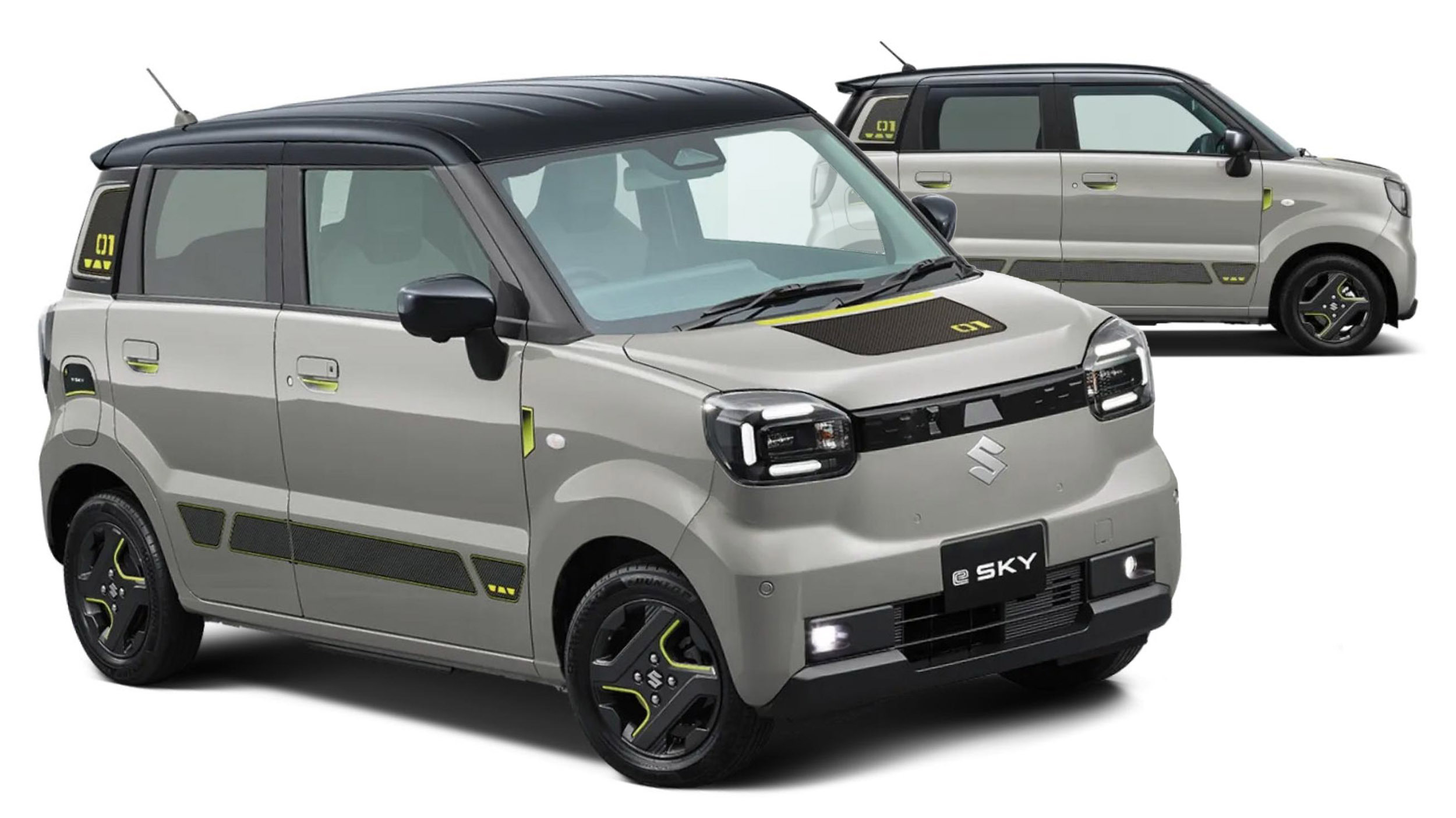


A fully electric five-door hatchback for under ten grand. That’s what Suzuki is now selling in Japan, and it plans to bring the thing to Europe by 2027.
The eSky, Suzuki’s first battery-electric kei car, goes on sale at Japanese dealers November 16 with a pre-subsidy base price of ¥2,120,000, roughly $13,400. Factor in the Japanese government’s ¥568,000 EV subsidy and the entry-level A trim drops to ¥1,552,000. That’s $9,800 for a car with 193 miles of WLTC range.
Those numbers deserve a second look. The eSky squeezes that range from a 26 kWh lithium iron phosphate battery pack, a chemistry favored for its durability and low cost rather than energy density. Getting 310 kilometers out of 26 kilowatt-hours requires a car that barely tips the scales, and Suzuki’s Heartect e platform, purpose-built for lightness, delivers exactly that.
The powertrain centers on Suzuki’s new e-Axle, a compact unit integrating the electric motor, inverter, and reduction gear to drive the front wheels. Peak output sits at 94 hp, but the Japanese-market version will almost certainly be software-limited to 63 hp to meet kei car regulations. DC fast charging tops out at 50 kW.
Inside, it’s a four-seater built around storage cubbies and a dashboard tray, not luxury pretensions. The flagship X trim gets a 10.1-inch infotainment screen. The top-spec model lists at ¥2,790,000, about $17,600 before subsidies.
Suzuki is also pushing a surprisingly detailed accessories catalog. Two styling packages, Mild Sporty and Neo Future, dress up the little hatch with colored decals and LED fog lights for roughly $660 and $730 respectively. There are eight colors of quarter garnish, playful tailgate stickers, and a recyclable polyester floor mat for $180. The message is clear: personalization sells when the base car costs less than a decent used sedan.
The company has set a modest monthly sales target of 1,000 units domestically. That restraint suggests Suzuki is being careful with production ramp-up, or it knows that kei car buyers in Japan still lean heavily toward the tiny gasoline boxes that dominate the segment.
The bigger play is Europe. When the eSky crosses the continent in 2027, it will walk into a knife fight. The Renault Twingo EV is coming. Dacia already sells the Spring. Fiat has the 500e. Volkswagen is working on the ID. Up!.
All of them are chasing the same buyer: someone who wants an affordable, city-friendly electric car without a $35,000 commitment.
Suzuki’s advantage is brutally simple. The eSky was engineered as a kei car first, which means packaging efficiency and cost control are baked into its bones, not bolted on as afterthoughts. Whether European pricing will land anywhere near the subsidized Japanese figure is another question entirely. EU safety and homologation requirements tend to add cost, and there is no pan-European subsidy equivalent to Japan’s program.
Still, if Suzuki can get anywhere close to $15,000 in Europe with nearly 200 miles of range, it will have something most rivals cannot match. The company that built its reputation on the $6,500 Alto is betting that the same formula, small, light, cheap, works with a battery instead of a three-cylinder engine.
Japan gets to test that theory first. Europe is watching.

Share this Story