
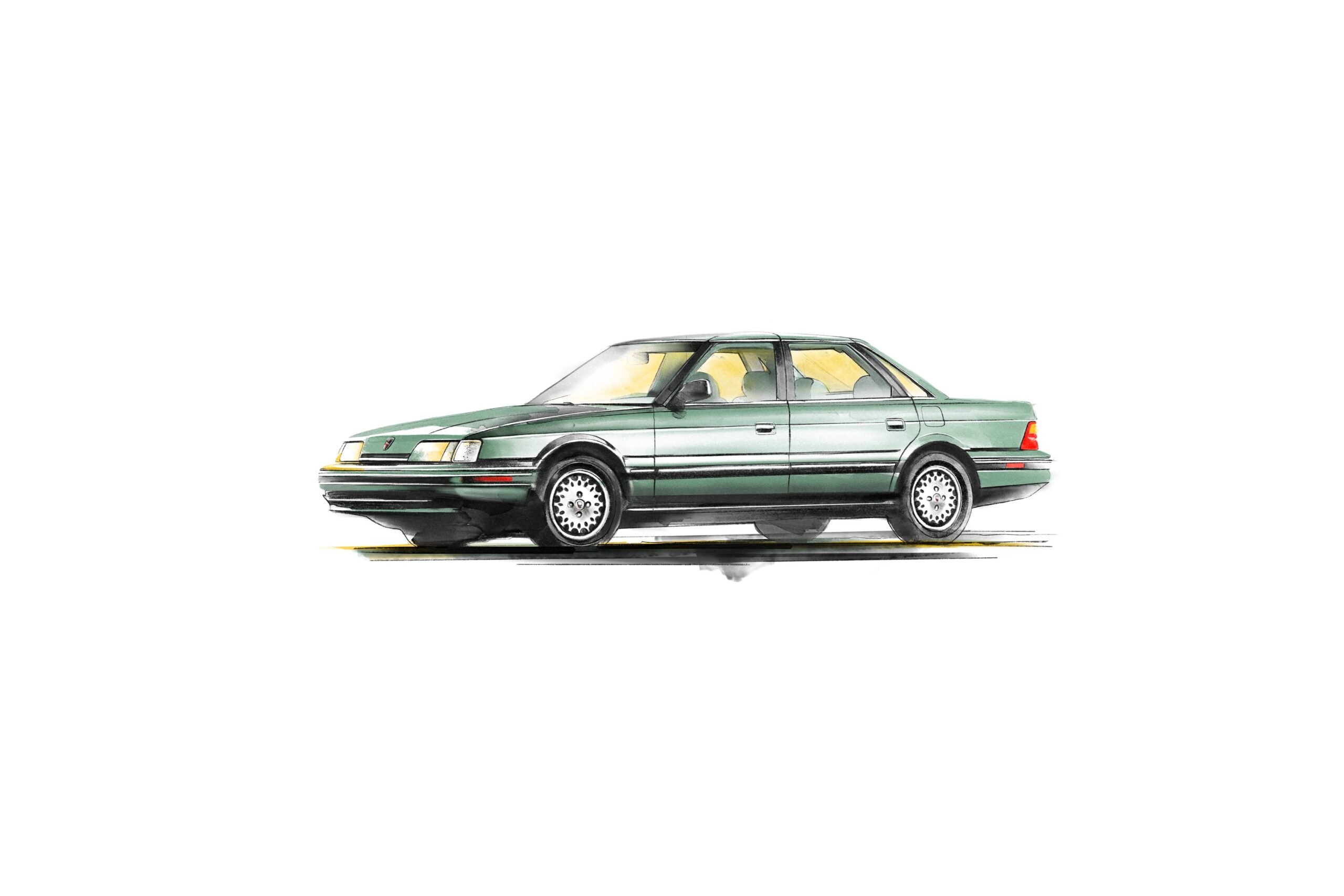


John Phillips bought a Roman candle with an M-80 airburst option when he was 11. It hit a Pontiac Bonneville. Nobody saw it coming. That phrase, “nobody saw it coming,” turns out to be the entire story of the Sterling 825.
In the mid-1980s, Austin Rover Group partnered with Honda and decided to take the first-generation Acura Legend, one of the most reliable sedans of its era, and sell it as a British luxury car called the Sterling. Named after the pound. Dressed in Connolly leather and burl wood. A tablespoon of Earl Grey in the crankcase, as Phillips puts it in the September/October 2026 issue of Car and Driver.
The bones were Japanese. The execution was British. And the gap between those two things would swallow the entire brand in four years.
On paper, the Sterling made sense. Rover stiffened the suspension and gave the interior a proper English club feel. In a 1989 Car and Driver comparison test of mid-$20,000 sedans, the Sterling finished second, behind only the 220-horsepower Ford Taurus SHO. That is not nothing.
Sales in the first year hit 14,171 units. For a brand nobody had heard of, selling a car most people confused with silverware, that number was startling. Momentum existed. Briefly.
Then things started dying. The cigarette lighter went first. Then the power seat adjuster. These were warnings, not problems.
The real problem was the engine shutting down entirely at 2500 rpm, killing the power steering, the gauges, the headlights, all of it, in the middle of high-speed intersections. Phillips reports this happened three times. The hood release was located in the passenger footwell, because apparently someone at Rover thought that was a fine place for it.
The question that haunts this story is almost too painful to ask. How do you take a Honda, a car that would go on to top J.D. Power’s reliability ratings, and turn it into a car that nearly triggered a class action lawsuit? Same platform, same engine, same basic architecture. Rover’s contribution was the wiring, the trim, and apparently a deep institutional talent for making things stop working.
Phillips got summoned to the Miami Grand Prix for what he describes as a “stroppy debriefing” with Sterling brass in a hotel neither party could afford. Later, a lawyer called about the class action and wanted him to testify.
The Acura Legend floated to the top of the quality charts. The Sterling sank toward the bottom. Same car, two completely different reputations. It remains one of the most vivid case studies in how badge engineering can go catastrophically wrong when one partner understands quality control and the other treats it as optional.
Sterling died in 1991. Honda executives reportedly lingered outside their Aoyama Building headquarters in what can only be described as corporate mortification. They had handed Rover a proven product and watched it get dismantled by bad British electronics and questionable ergonomic decisions.
The whole episode lasted four years, 1987 to 1991, about three years longer than it deserved. Phillips, who has been writing about cars since 1974, frames it as comedy. But underneath the jokes about Joseph Lucas and Cadbury-sticky fingers sits a genuine cautionary tale about what happens when you take someone else’s engineering and assume you can improve it with leather and wood.
Rover would stumble through the 1990s and eventually collapse into BMW’s arms, then get sold again, then die for real. The Sterling was just the early symptom. The disease was a company that believed heritage could substitute for competence.
Somewhere, a Honda engineer who worked on the original Legend platform is still shaking his head.

Share this Story