
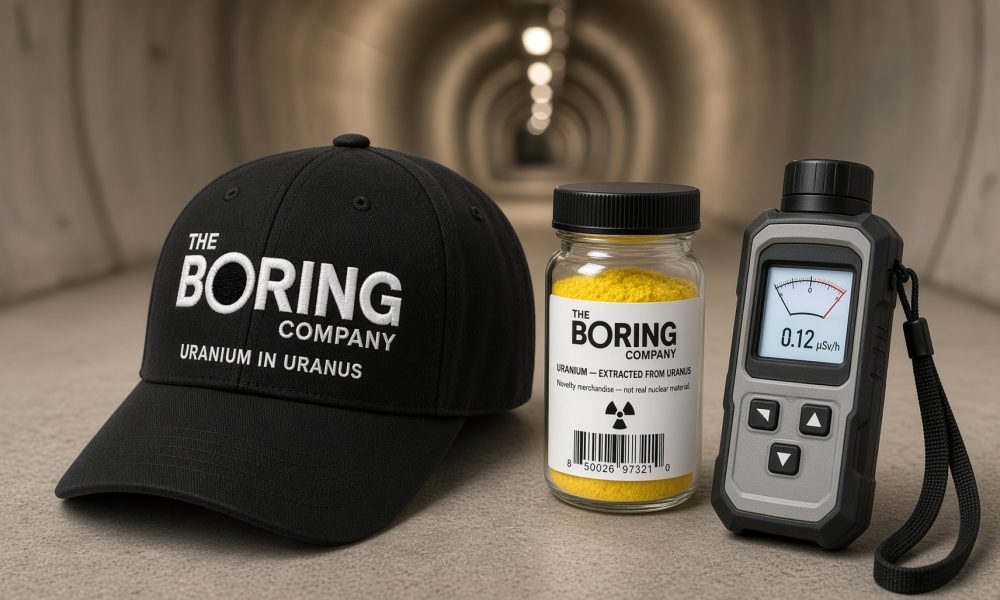


Elon Musk posted on X Saturday morning that the Boring Company’s next piece of merchandise “will put Uranium in Uranus.” He said it would glow in the dark, “because otherwise how could you find it,” and that a Geiger counter would be sold separately as “an optional strap-on.”
No price. No shipping date. No product name. Just a thread that ended with Musk declaring, “It’s not easy coming up with something that is both outrageously unsellable and yet extremely popular.”
He has done this before, and it has worked every time.
The Not-a-Flamethrower moved 20,000 units and pulled in roughly $10 million in 2018. Burnt Hair perfume, listed at about $100 a bottle, sold out fast enough to spawn an eBay scalping market at ten times retail. Boring Bricks, made from actual tunnel spoil, followed the same script of vague tease, long wait, quiet product page, instant sellout.
Each of those items started as a one-liner on social media and took weeks or months to show up, if it showed up at all. The uranium joke sits at step one of that cycle with no indication it will reach step two.
But the joke merchandise has always worked as a kind of cultural camouflage for the Boring Company’s actual operations, which are quietly picking up speed.
Last week, the company announced plans to double the number of operational stations on its Vegas Loop by year’s end. That expansion is tied to a hiring push for drivers and operations managers, the kind of unglamorous staffing announcement that gets buried under headlines about radioactive novelty items.
Prufrock-5, one of the company’s tunnel boring machines, just completed a test tunnel in Bastrop, Texas. It is expected to relaunch on its next assignment in November. The machine represents the Boring Company’s push toward faster, cheaper tunneling at a scale that could make its Las Vegas operation replicable in other cities.
That is the real story. The merch is the sideshow, but it is a sideshow that generates millions in revenue and keeps the Boring Company in the conversation between infrastructure milestones.
Musk’s companies have long used spectacle as a financing and attention tool. Tesla sold branded tequila. SpaceX launched a cherry-red Roadster into solar orbit as a test payload.
The pattern is consistent: do something absurd, let the internet do the marketing, use the noise to keep the brand visible while the engineering teams grind away on the actual product.
The uranium bit follows the same playbook. Past Boring Company merch drops have been preceded by a password-protected page appearing on the company’s website days or weeks before any formal announcement. No such page has surfaced yet.
Whether or not anyone actually ends up buying a glowing Boring Company product shaped like a planet, the company is banking on the joke carrying the same weight it always has. Free publicity, a burst of direct revenue, and cover for the less flashy work of digging holes under the desert.
The Vegas Loop expansion timeline puts real pressure on the company to deliver operational results before 2027. Musk’s posts about uranium, meanwhile, put no pressure on anything. That asymmetry is the entire strategy.

Share this Story